Articles

Violence in Sierra Leone as the government supresses reporting.

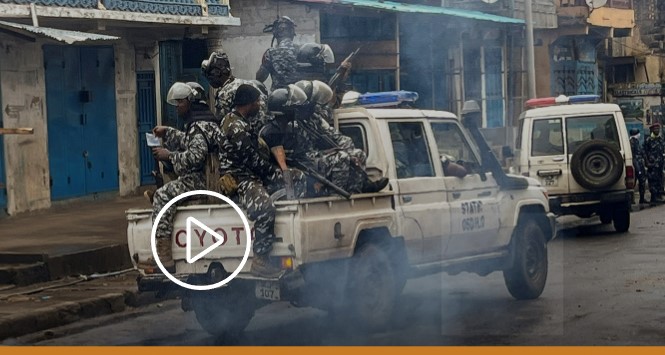
On 10 August 2022, protests broke out in Freetown and other areas of the country amid mounting frustrations over the soaring cost of living. Some demonstrators called for President Bio to resign.  These protests where violently suppressed by security forces with an unknown number of people killed.

According to Amnesty International “we collected testimonies alleging excessive use of force by Sierra Leonean security forces to crack down on protests which turned violent in Freetown, Makeni and Kamakwie in August 2022, in which six police officers and more than 20 protesters and bystanders were killed, including at least two women. Yet, it took more than two months for the State to release the non-police bodies for their burial, Amnesty International said today after having investigated the events”.

Since then repression has continued.  On June 21st 2023 security forces forcibly dispersed a political gathering held by the All People’s Congress (APC) opposition party near the APC headquarters in Freetown. Police have reportedly used live ammunition. Casualty figures remain unclear.

Report via Punk 4 the Homeless:

Terrifying scenes emerging in Sierra Leone the past few days as the country prepares for elections on Saturday 24th June.

People have taken to the streets to protest, violence has broken out between opposing factions, innocent civilians and the police.

Videos are circulating of horrifying scenes and reports are coming out that people have been killed by the police – yet the western media is silent.

Hope Orphanage [which is supported by the Punk 4 the Homeless], has reported that the girls and young women are very scared and trying to keep indoors and as safe as is possible.

Video:

Videos are circulating of security forces again using deadly violence against protestors and innocent bystanders. Information is difficult to get out of the country at the moment and most news services are ignoring what is happening, after all it is more important to focus on millionaires trapped in a death trap of a submersible and the millions spent trying to rescue them. 

Article by Mikey Dredd

Migrant deaths – a deniable genocide

The tragic sinking of a fishing boat packed with over 700 migrants on June 14th off the coast of Greece, inside the boundaries of the European superstate, is an atrocity in capitalism’s war on humanity. The number of lives lost is an estimated 500.

It follows the deaths of around 100 people in Italy in February when another boat from Turkey sank off Cutro – then seen as the worst single migrant disaster. As one excess exceeds the other, countless smaller and often unnoticed examples are a weekly if not daily occurrence.  Including the sending of refugees back out to sea as happened in Greece in May.

The acknowledged Mediterranean death toll alone so far this year is 1,800, already exceeding the annual average over the last decade that has cost more than 26.000 lives – that we know of.

Is this a war?  Yes. The war of profit and greed that is tearing the planet to pieces, destroying its ecosystems through exploitation driven climate change and its social systems through its inevitable infliction of poverty, hunger and war.

According to the United Nations, the numbers of displaced from climate change and war is approaching the hundreds of millions. (UNHCR calculates 2,000,000 dead and 21,000,000 displaced annually through climate change; 110,000,000 through conflict (not counting the dead).

 Madagascar is becoming a desert, island peoples are submerging, Pakistan briefly became a lake.  40,000 have just lost their homes to floods in Haiti as the earth’s lungs gasp in the Amazon.  

The stolen treasure violently accrued over the last 300 years in the heartlands of capitalism’s hyper-wealth is tilting the globe, and the hungry dispossessed are sliding to where the grass still grows. 

Refugees and migrants are increasingly numerous and desperate across most of the world.  Climate change and exploitation accelerate as the ‘developed’ states pull up the drawbridge and carry on vilifying and blaming the victims. 

How is this not genocide?  Because the weasel words of international lawyers are designed to keep guilty hands clean.

The ICC (International Criminal Court) defines as genocide as:       “…characterised by the specific intent to destroy in whole or in part a national, ethnic, racial or religious group by killing its members or by other means: causing serious bodily or mental harm to members of the group; deliberately inflicting on the group conditions of life calculated to bring about its physical destruction in whole or in part; imposing measures intended to prevent births within the group; or forcibly transferring children of the group to another group.”

Capitalism’s ruthless plunder and destruction is not considered ‘deliberate’ enough to qualify as ‘intent’ despite every other characteristic being there.

There is a deliberate refusal of responsibility and the intent neither to redress nor repair but to carry on regardless.  Despite the huge diversity of needs and contexts amongst migrating communities, they certainly have very specific characteristics.  Most centre around them being from the global colonial looted world of 300 years of capitalist imperial expansion.

There is no solution that doesn’t involve the abolition of imperial legacy and capitalist global domination.  Capitalism not just won’t solve it, it’s simply can’t. It’s not profitable. And in its attempt to preserve itself, it is the driver of this genocide by stealth.

Article by Dreyfus

Ukraine’s Two Floods

As the brutal horror of capitalism’s war in Ukraine again floods our screens. The destruction of the Kakhovka dam sees the waters of the Dnipro reservoir pour south while thousands of Ukrainian deserters flow east.

The desperate struggle to survive this catastrophe and ecocide is obscured from being seen as the inevitable consequence of the crime of capitalist war, behind the hypocritical mutual allegations of war crimes by the respective warring states, echoed internationally in the heartlands of rival imperialist blocs

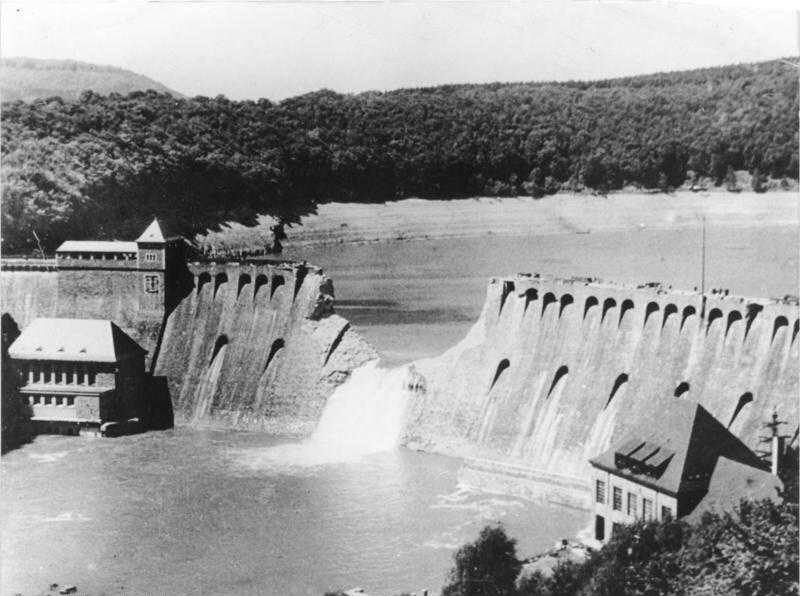
It has happened literally weeks after the British state commemorated the 80th anniversary of the Dam-busters Raid which destroyed the Eder and Möhne dams flooding the Ruhr valley, drowning 1,600 people (most of them POW’s and slave labourers), not as a great allied war crime but as a heroic victory!

Despite the near certainty that this atrocity was the work of Putin’s forces, this may have been more dictated by circumstance and timing rather than the competing moral positions of either side.  Dams are targets and the ensuing deluge, weapons of war – either side would have done if it suited their aims.  It was even mooted at the beginning of the war as a way of stopping the Russian advance on Kherson.

While millions continue to be affected by catastrophic flooding due to climate change, out of sight, out of mind, in Pakistan and Haiti, the manufactured Dnipro disaster is as much a part of war as genocide and concentration camps.

The Belgians did it to stop the Germans in WW1, the Dutch in WW2.  The Chinese nationalists drowned 1 million of their own people to slow down the Japanese.  Even Ukraine, when it was part of the Soviet Union, suffered the same event initiated by their own side.

But this is not Ukraine’s only flood.  War weariness and compulsory militarisation backed by lengthy prison sentences are leading to a second outpouring of refugees. 

It has been well reported that up to 1,000,000 Russians have crossed their borders to avoid the war since the invasion. Much less focus is given to what’s happening for those Ukrainians who don’t want to heed national patriotism or fight.

The BBC reports that Ukrainian military service has been hard to enforce due to reluctance and corruption. Many are paying a monthly sum to avoid being called up.  Ukrainian frontline commanders are reportedly complaining that the increasing number of conscripts too scared or unwilling to fight is proving a burden on the battlefield.

Many are risking their lives to cross the Tisa river in the west to seek refuge from combat in Romania.  According to the Romanian government, at least 20,000 military aged men eligible for military service have entered the country since the beginning of the war, ostensibly to visit and then simply not return to the Ukraine.

Another 7,000 deserters have crossed the Tisa river despite armed patrols and road blocks, as the only way to save their lives.  Ukraine’s police force claim they are detaining at least 20 men a day on the international border – each facing up to 10 years in prison in ‘free’ Ukraine.

Numbers appear to be growing despite the cost of ‘people smugglers’ and the dangers of the journey itself.  Ukrainian sources say that at least 90 people have died from exposure, frostbite and drowning.  One deserting combat veteran describes how even after reaching the Romanian side of the river, he was spotted by a Ukrainian patrol on the other bank: “I heard shots first, then a string of insults”. 

Capitalism’s lust for profit and its consequential wars with rivals, targets our class.  They shoot us, starve us, drown us and displace us.  Ukraine’s two floods, the Dnipro south and the dissident’s west are mirrored on the Russian side of the front-lines.  It is not about freedom or justice, it is about slaughter and greed. These are not war crimes, this is the crime of war.

Desertion is only one form of resistance. Perhaps at the height of the battle, it is the easiest one to take.  However, to end the war, this war and the next, all of capitalism’s wars, resistance has to be globalised and militant.

The working class is in the firing line for capitalist greed whatever side of the frontier we are on. That is why we say that the fight to end it begins at home.

Uncompromisingly pursuing our class agenda here against their social peace to undermine their war, there.  No war but the class war means exactly that.

Article by Dreyfus

Militancy and Escalation Needed – Not Compromise

The current situation with the strikes is not good enough at all, not going far enough and sadly it appears to be a lost cause – but they do highlight the fact that it’s us versus them. And striking workers themselves are rightly dissatisfied with how things are at the moment –  we need autonomous collective action, revolt from below, militant grass roots sabotage and subversion, workplace occupations, popular assemblies and worker’s councils, or coordinating committees, workers’ resistance groups and things like that. Not unions – not reformist ones anyway.

And really, trying to make workers content with capitalism by trying to get them better pay and conditions is not truly sufficient or effective. We need proper resistance to worsening capitalist barbarism and real, militant revolutionary upheaval from below. And the current strikes very much seem to be going nowhere and stand to put people off of unions and strikes altogether. The TUC unions are also centralised, bourgeois organisations, and cannot be relied on. The independent unions do good work, but are also basically reformist in practice and therefore limited – though they are much smaller than the reformist unions.

The strike wave should really have been a starting point, but this doesn’t seem to have happened, at least not yet, and it seems very unlikely that this will change. Mick Lynch has been great at showing up pundits and commentators on telly for being the idiots and stooges of the establishment they are, but it was people such as him who called off the rail strikes when the queen died. The reformists and union bureaucrats have deliberately failed to make the most of the strikes, which does the ruling class a huge favour. People like Lynch are too close to the Labour Party and are getting behind Starmer for the next general election. They are also, in their own way, part of the establishment – union leaders whose job is to divert and pacify discontent and negotiate social peace with the bosses. It’s up to workers what they do, but if the reformist unions are not doing what is necessary, lacking militancy and escalation, then we advocate the idea that workers can always organise and fight outside of such organisations.

As things are, we have the unions and they are clearly bourgeois and frankly useless.  The strikes are going nowhere and look completely hopeless. We’ve even got Unite helping the smooth operation of an atomic weapons manufacturer (AWE/NG Bailey) by representing the electricians in such an industry and winning them a pay deal. We desperately need some real militant, autonomous, grass roots collective direct action and people need to completely reject this system and genuinely resist it.

Article By Tom Hughes

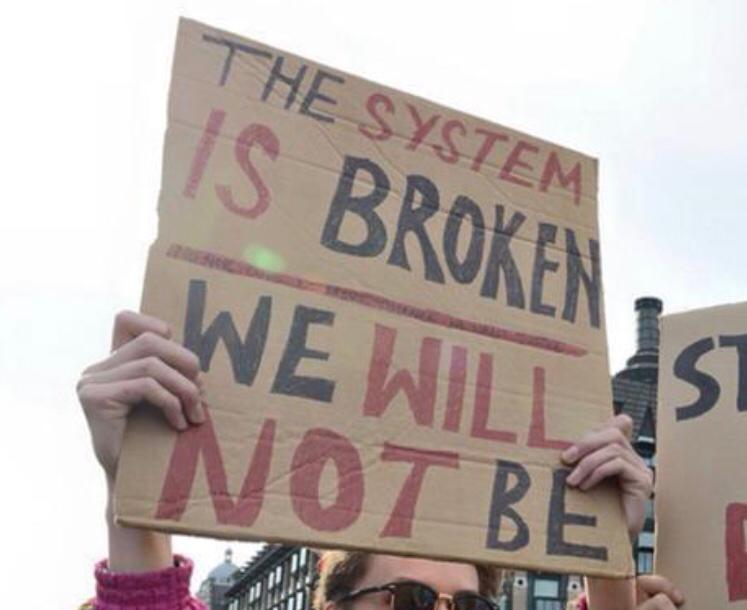
If you vote, you’ve no right to complain…

Look at the person you are thinking of voting for, what makes them not look, sound or feel like any politician you’ve ever seen strutting and lying on your TV screens? 

What makes them so excel in virtues you don’t have that you should hand your power and autonomy over to them? 

Would you hand the contents of your home so easily over to a burglar, or your family without a murmur to a kidnapper?  Of course not! That would be ridiculous, yet it’s the same principle they don’t want us to see in the carnival of election time.

The idea that we willingly handover all agency over our neighbourhoods, our welfare and our futures to professionals who excel in some of the worst human arts of manipulation, deceit, lies and corruption is the stuff of nightmares and dark graphic novels. That they want to have power in the first place should be clue enough. 

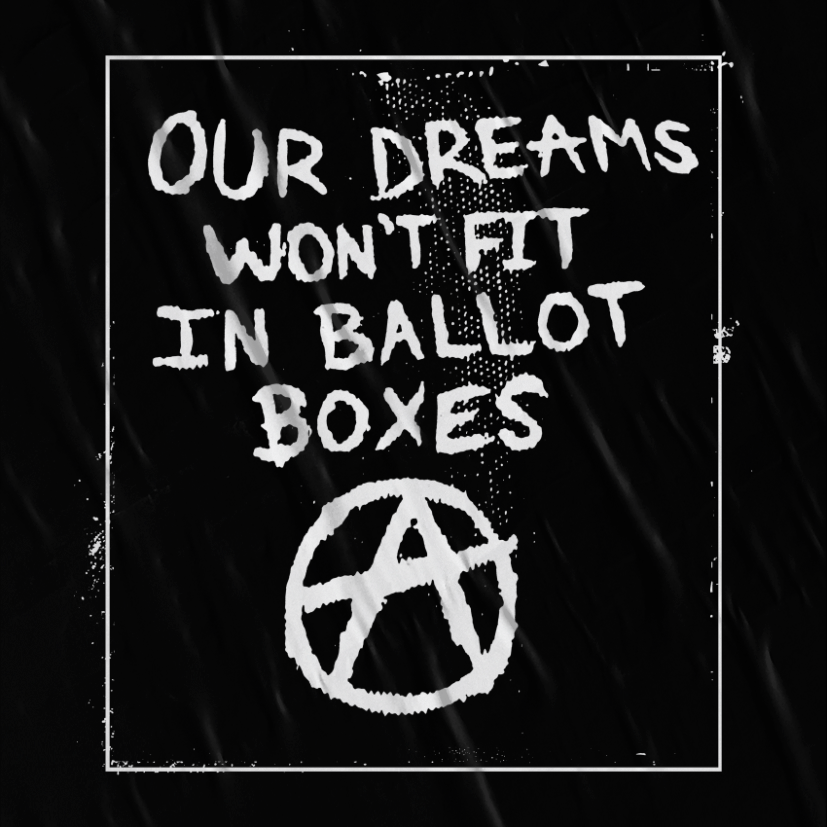
For all the lies that pervade election times, perhaps the biggest is that the ballot box makes us equal, that Rishi with his million-pound swimming pool and the shop worker with a paddling pool have the same rights and responsibilities as each other.   Except that what we give Rishi is his for the duration, while we wait for our right to place an X in five years-time on another piece of paper.   And how precious that X is made to feel given that you probably only have 10 of them to use in your lifetime. 10 moments of feeling equal is your lifetime ration of influence or participation. 

In the process, its dull familiarity creates the attitude in most of us summed up as “I don’t believe in politics” or “what has politics got to do with me?”  And that is exactly what they want us to feel.   Distanced and docile. 

However, always pushing back against this is our innate humanity and our struggle for a dignified existence.

Our own lives are social, economic and emotional all of which combine to make our existence deeply political.  We care massively, about our friends, our loved ones, our neighbourhoods and environment, our welfare and our futures.  On a day-to-day level we demonstrate this actively with our colleagues, communities and the kinds of social family we consciously choose to construct.  We come together all the time in free, and yes, political association, To combat litter, to look after our vulnerable neighbours, to volunteer, to assist and to commune with others like us in football teams choirs, for feeding people, hospital transports or knitting circles.  And to strike against them!

It’s often said that local elections affect us directly and are somehow different to the Parliamentary ones.  Nice try, but even the most dedicated voter can recognise the army of ‘mini me’s’ starting to climb the greasy pole. 

Political parties, election campaigns whether national or local are not the community in action! They are the definition of our blindsided manipulation and exclusion from anything meaningful that looks like change. 

They want our participation in this staged event – it looks good for them.  It encourages them and allows them to claim their greed is in our name.  Look at the last time you used your X, what did it change?  We feel sure if they thought it could really change anything they would make it illegal. 

Wouldn’t it be great if these elections receive the contempt they deserve.  Voting leaves them feeling empowered and subjects us to passivity at best, state sanctioned brutality at worst.  Refusing to vote in favour of the community mobilisation is not apathy, on the contrary, if you vote you may feel you’ve no right to complain.

Article by Dreyfus

May Day Greetings on International Workers Day 2023

The AnarCom Network wishes all our comrades across the world a Happy and Revolutionary International Workers Day.

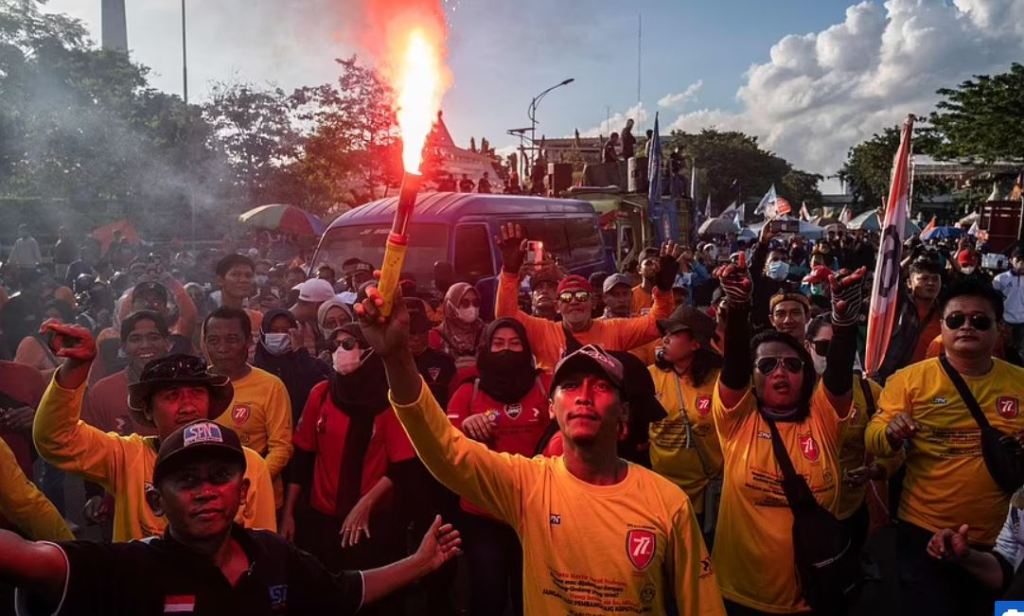
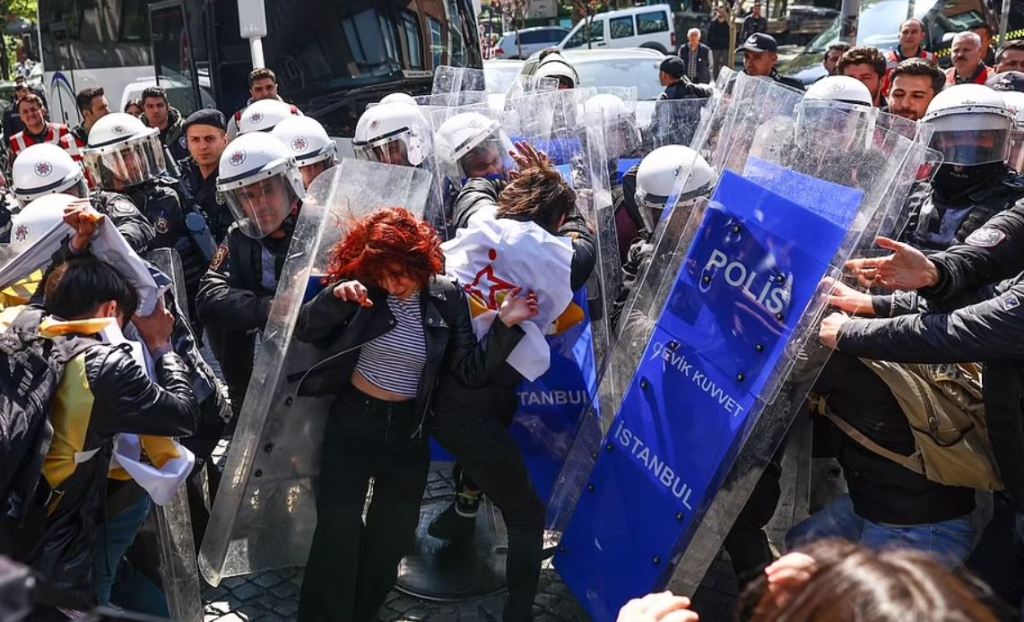
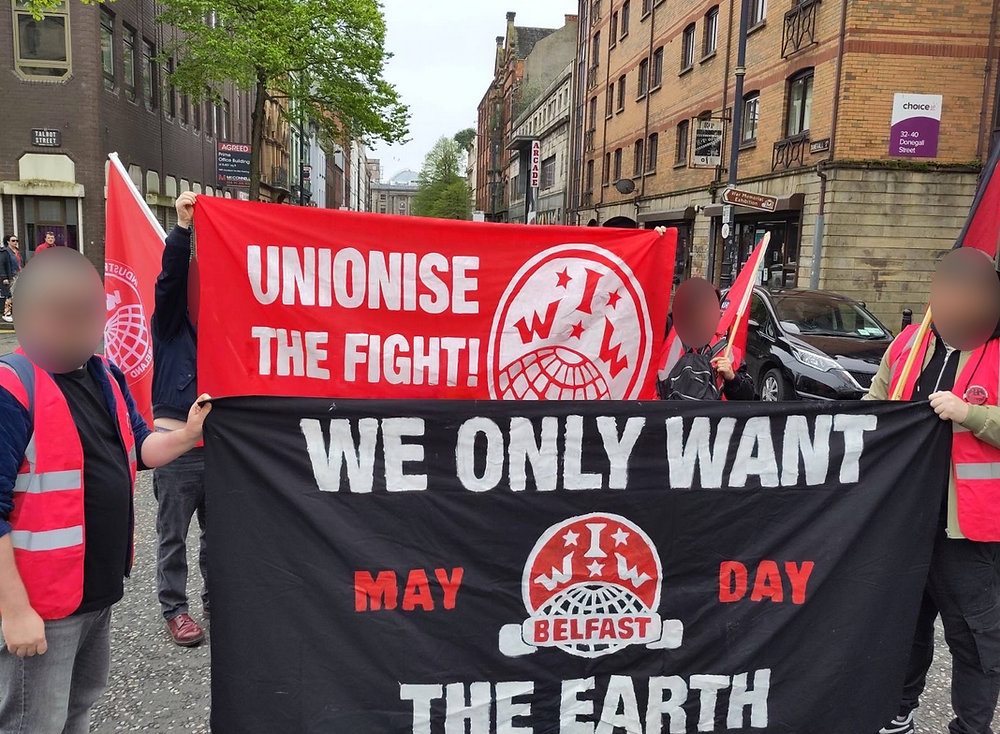
Below are some pictures from protests that have taken place around the world followed by our article on the origins of the modern May Day.

France

Stuttgart Germany

Kosovo

Indonesia

Istanbul Turkey

Belfast Ireland

The origins of May Day

A three-year depression; a banking collapse; falling production; a crisis of living standards and working conditions that lead to continent wide mass strikes and demonstrations. 

Capitalism’s response: the demonisation of migrants, foreign workers and strikers as militant anarchists.  Police violence and state repression.  This familiar story whilst sounding like today, is the birth of May Day as International Workers Day nearly 150 years ago.

The events that led to it were part of a rolling campaign by workers for the eight-hour day.   It began when the American Federation of Labour adopted an historic resolution which asserted that “eight hours shall constitute a legal day’s labour from and after May 1st, 1886”.

In the months prior to this date workers in their thousands were drawn into the struggle for the shorter day. Skilled and unskilled, black and white, men and women, native and immigrant were all becoming involved. This movement was particularly strong in the large industrial cities and on May 1st 1886, 400,000 rallied in Chicago

The beginning of May as a day for the celebration of the fruits of labour go back millennia as a pre-Christian pagan festival.  According to the anarchist historian David Graeber:  

“May day came to be chosen as the date for the international workers holiday largely because so many British peasant revolts had historically begun on that riotous festival.” (Graeber & Wengrow ‘A New History of Humanity’)

A Chicago newspaper of the time reported that that day: “no smoke curled up from the tall chimneys of the factories and mills, and things had assumed a Sabbath-like appearance”.

This was the main centre of the agitation, and here the anarchists were in the forefront of the labour movement. It was to no small extent due to their activities that Chicago became an outstanding centre organised labour and made the biggest contribution to the eight-hour movement.

2 years earlier they had produced the world’s first Anarchist daily newspaper, the Chicagoer Arbeiter-Zeitung, plus a weekly, Fackel, and a Sunday edition, Vorbote.  They were among the many labour militants from migrant backgrounds active across the city in many languages.

When on May 1st 1886, the eight-hour strikes convulsed that city, one half of the workforce at the McCormick Harvester Co. came out. Two days later a mass meeting was held by 6,000 members of the ‘lumber shovers’ union who had also come out. The meeting was held only a block from the McCormick plant and was joined by some 500 of the strikers from there.

The workers listened to a speech by the anarchist August Spies, who has been asked to address the meeting by the Central Labour Union. While Spies was speaking, urging the workers to stand together and not give in to the bosses, the strikebreakers were beginning to leave the nearby McCormick plant.

The strikers, aided by the ‘lumber shovers’ marched down the street and forced the scabs back into the factory. Suddenly a force of 200 police arrived and, without any warning, attacked the crowd with clubs and revolvers. They killed at least one striker, seriously wounded five or six others and injured an indeterminate number.

Outraged by the brutal assaults he had witnessed, Spies went to the office of the Arbeiter-Zeitung and composed a circular calling on the workers of Chicago to attend a protest meeting the following night.

The protest meeting took place in the Haymarket Square and was addressed by Spies and two other anarchists active in the trade union movement, Albert Parsons and Samuel Fielden. Throughout the speeches the crowd was orderly. Mayor Carter Harrison, who was present from the beginning of the meeting, concluded that “nothing looked likely to happen to require police interference”. He advised police captain John Bonfield of this and suggested that the large force of police reservists waiting at the station house be sent home.

It was close to ten in the evening when Fielden was closing the meeting. It was raining heavily and only about 200 people remained in the square. Suddenly a police column of 180 men, headed by Bonfield, moved in and ordered the people to disperse immediately. Fielden protested “we are peaceable”.  At this moment a bomb was thrown into the ranks of the police. It killed one, fatally wounded six more and injured about seventy others. The police opened fire on the spectators. How many were wounded or killed by the police bullets was never exactly ascertained.

A reign of terror swept over Chicago. The press and the pulpit called for revenge, insisting the bomb was the work of socialists and anarchists. Meeting halls, union offices, printing works and private homes were raided.

All known socialists and anarchists were rounded up. Even many individuals ignorant of the meaning of socialism and anarchism were arrested and tortured. “Make the raids first and look up the law afterwards” was the public statement of Julius Grinnell, the state’s attorney.

What followed was a famously sham trial that the Governor later, declaring the anarchists, innocent of the charges. described as based on: “hysteria, packed juries and a biased judge”.  Of the eight anarchist workers tried, 4 were judicially murdered while a 5th took his own life.   When Spies himself addressed the court after he had been sentenced to die, he was confident that this conspiracy would not succeed:

“If you think that by hanging us you can stamp out the labour movement… the movement from which the downtrodden millions, the millions who toil in misery and want, expect salvation – if this is your opinion, then hang us! Here you will tread on a spark, but there and there, behind you – and in front of you, and everywhere, flames blaze up. It is a subterranean fire. You cannot put it out”.

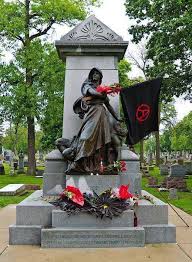
From then on May Day demonstrations spread worldwide to commemorate the “Chicago Martyrs”, until the international labour organisations adopted it across the globe in 1889.

It has internationally become a day when workers express their solidarity and the power on the street. Governments have always feared it and many have tried to cancel or change it – American capitalism introduced Labour Day in October to replace it, Thatcher in the UK abolished it in the early 80s replacing it with the May bank holiday.  It continues to mobilise across the world.

There is no new lesson to learn from this today.  The lesson remains the same. Capitalism and its relentless assault on workers continue to this day as it did then, with austerity, violence and war.  The villainous class remains in power, our struggle against it, to overthrow it, towards emancipation, continues.

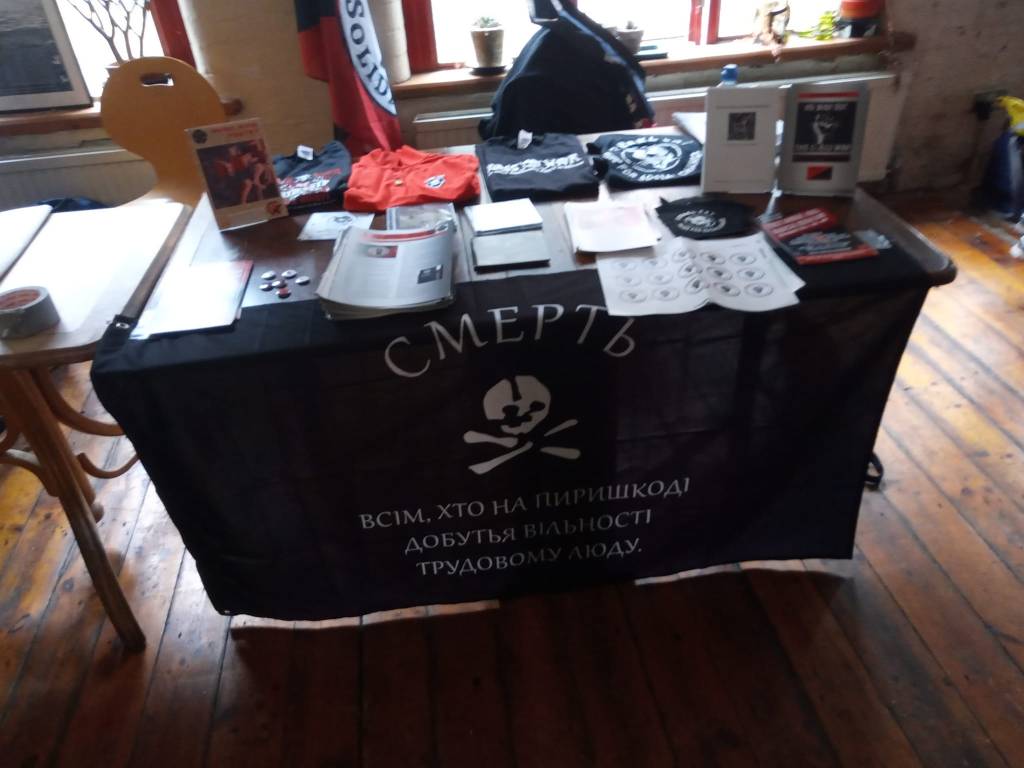
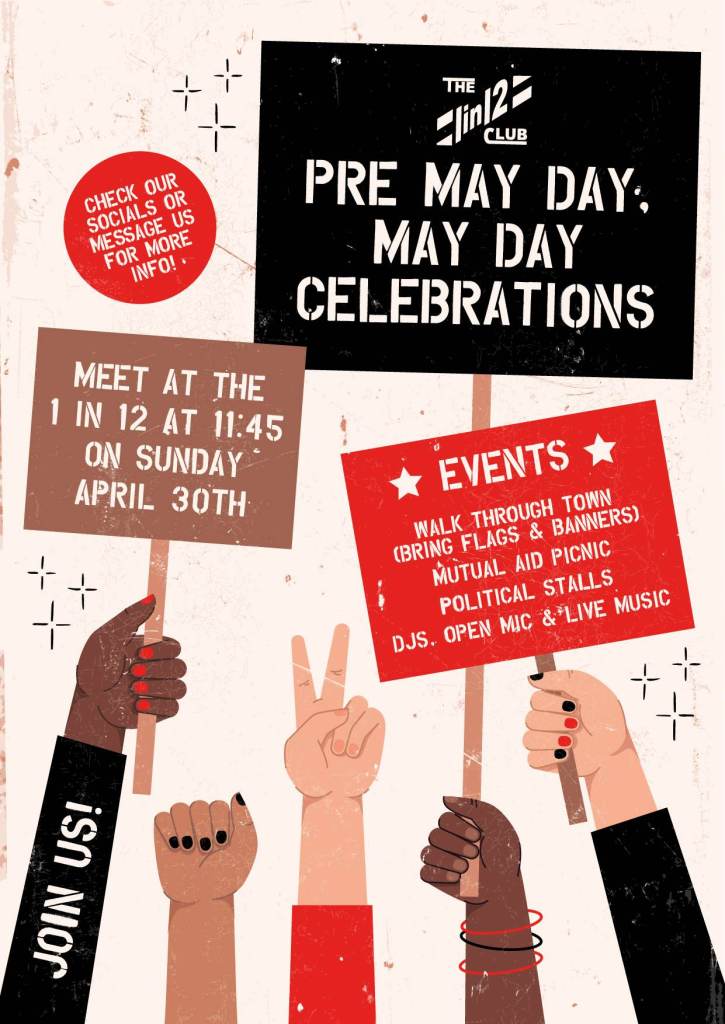
AnarCom Network Upcoming Stalls for 2023

30th April – pre May Day event, Bradford @ 1 in 12 Club

13th May – Banners Held High, Wakefield @ City Centre

27th May – Red and Black Clydesdale, Glasgow

12th August – Hull Radical Bookfair, Hull @ Danish Church

2nd September – Bradford Anarchist Bookfair, Bradford @ 1 in 12 Club

4th November – Manchester & Salford Bookfair, Manchester @ People’s History Museum

Pathologising Resistance

Not just as an anarchist, but as a gay man and psychotherapist, I’ve spent most of my life either not fitting in, or working with people who feel for some reason that they don’t.

My work initially was with sexuality, identity and gender dysphoria, focusing over the last 20 years on complex trauma and more recently, neuro-diversity and ‘spectrum disorders’. 

If there is one overwhelming insight I’ve gained it is the state’s obsession with pathologising difference, generally described as dysfunction or disorder.  Differently functional is seen as ‘abnormal’, sick or deviant.  Whatever the politico-medicalised framing of well-being intervention: medication; supervision; care in the community; case management etc, the end product for the individual is generally repression.

Government itself doesn’t walk round slapping people and nor do the bosses.  At work this is left to HR algorithmic management methods, on the street it’s left to the police and mental health services, economically, the slap is disenfranchisement and poverty, and in childhood, to schooling and discipline.  At home, the nuclear family struggles from the start by its own experience of this machine, neither educated nor supported in how to respond. 

But how did these conditions – unreferenced until the industrial era, suddenly appear? And what is this supposed ‘normal’ neurotypicality that these deviations are supposed to threaten? 

It’s no accident that we don’t have any attempt to define psychological disorder until the advent of industrial revolution. The industrial revolution made being human more complex than it had ever been.  Until the 18th century there had been no shared concept of universal time, time could vary from village to village and county to county. Science didn’t just create the technology of accuracy but did it to meet the need for the new class of exploiters to utilise it.  

Many misinterpret dating inconvenient change to the industrial revolution as imagining a fantasy longing for primitive times past.  That fundamentally misses the point. Nobody craves a return to painful dentistry and toilets that don’t flush!  But the experience of being human fundamentally changed with the clock, the factory, wage labour and profit. 

Henry Stanley Miller’s study of pre-Industrial peasant working conditions (‘Life on the English Manor’ 1987), concludes that a day’s work was considered to be the period from morning to lunch. This averaged about 6.5 hours of work during the peak of summer.  Even for the self-employed proto-capitalist artisan class, rarely exceeded 8 hours.  Life may be hard for sure, but took place in the context of settled communities where each was known and mutually essential to survival. 

There was no such thing as an aspergic midwife; a dyslexic baker; an ADHD blacksmith or an autistic ploughman.  Instead differences were the character components of a community, some the wise, some the truth speakers, some the visionaries   some the listeners and so on. 

Then, the advent of capital, the creation of credit, investment, land clearances and mass impoverishment feeding the factories in which waged labour replaced craft and occupation. 

It also brought the discipline of the factory clock and its overseers. 

Functionality became redefined for financial necessity and social control: clock on time; permitted breaks only; stay to the end of the working day defined neither by self nor season.  Demand nothing, eat sleep repeat until squeezed dry. 

In addition to the generational trauma caused and the need for standardisation in labour practice (or at least behaviour and expectation), difference became subversive and characters to be judged dysfunctional.  The refuseniks, habitual malcontents, fantasists and dreamers.  Ultimately the outcasts, anti-socials and unemployables. 

In preindustrial society communities were historically rural and geographically stable.  In industrial society, the experience of community at least reproduced itself in the form of industry and (re)location. 

Post-industrial society however has presided over its virtual abolition where almost all collective concepts of community, whether it be clan, extended family, geography, trade or work have ceased to exist.

Thatcherism made material the experience that there is “no such thing as society.” This has further atomised the human experience to a point where many feel excluded or at the edge of exclusion. 

Struggle for belonging and community has more and more expressed itself in individual terms, in identity often in isolation.  In some ways our natural human instincts to make communities where we can, have left us transient with a lack of permanence with those we feel have shared interests.  While understandable, it is desperate and economically without power.  It makes us more easily dividable and targetable setting one to go against the other. 

The democratic construct necessities the acceptance of this ‘individuality’ whilst pointing the finger at those who refuse to accept.  The angry black man; the hysterical woman; the troublesome Unionist; the selfish gay; the ‘safe-space’ threatening trans, the crazy anarchist. 

The reality is that diognoses often serve to blame the individual for psychological dysfunction.  That dysfunction being essentially distress.  This is the new norm – deep unhappiness and the necessary cognitive dissonance of telling ourselves a story about our lives to make our experience sound acceptable despite what we actually feel.  This incongruence, the suppression of our emotional life, is the universal price we pay to stomach our imposed existence in capitalist society.

Professionally I’m unsure if I’ve genuinely encountered normal or authentic ‘neurotypicality’.  Instead I see people forced to change shape to conform, those who struggle less consequently defining functional, and those for whom changing shape can be unmanageable and traumatic defining the dissident.  The temperamentally unsuited to capitalism at an advanced stage of social decomposition! 

Increasingly I am seeing people diagnosed with PDA (Pathological Demand Avoidance) or ODD (Oppositional Defiant Disorder).  The latter, mostly diagnosed in childhood are defined as uncooperative, defiant, and hostile toward the demands of peers, parents, teachers, and other authority figures.  The former describes those whose main characteristic is to avoid everyday demands and expectations to an extreme extent.  Refuseniks of externally applied order. 

None of this is to underplay the reality that some people are significantly vulnerable and debilitated by some aspects of neurological divergence from birth, but most falling into the diagnostics are simply different.

For liberalism it is expedient to demonstrate acceptance, though generally in the form of toleration, itself an insidious form of oppression.  This acceptance doesn’t sit easy with them – witness to somersaults over conversion therapy, faith endorsement of same sex relationship or the furore over gender recognition.   Where diagnoses occur, consequences follow. 

Neuro divergent activists point to the ‘Triad of 70’:  People living with these diagnoses are 70% more likely to attempt suicide; 70% more likely to be unemployed and 70% more likely to die before the average age of mortality.  Difference is manipulated to lead to exclusion and creates vulnerability and a sense of powerlessness.  An experience shared across marginalised or minority communities, it is the lived experience of racism, sexuality, gender and identity, and class. 

This experience breeds rebellion and is consequently described as such and pathologised (Emotionally Unstable Personality Disorder currently popular).  Despite that over time the target groups and diagnostics may change with changing context and political need, the establishment concepts of normality, mental health, work and functionality remain the platform from which dissidence and resistance is diagnosed and the rebellious dealt with. 

Article by Dreyfus