Articles

May Day, as always, Our Day!

As opposed to the electoral bourgeois farce on 7th May, the 1st of May and any ensuing weekend has for nearly a century and a half been a time for working class celebration.  This encompassing organising, actions, catch ups with friends and comrades, community events and remembering the past with a determined optimistic look to the future.  This is particularly the case for us as anarchists.

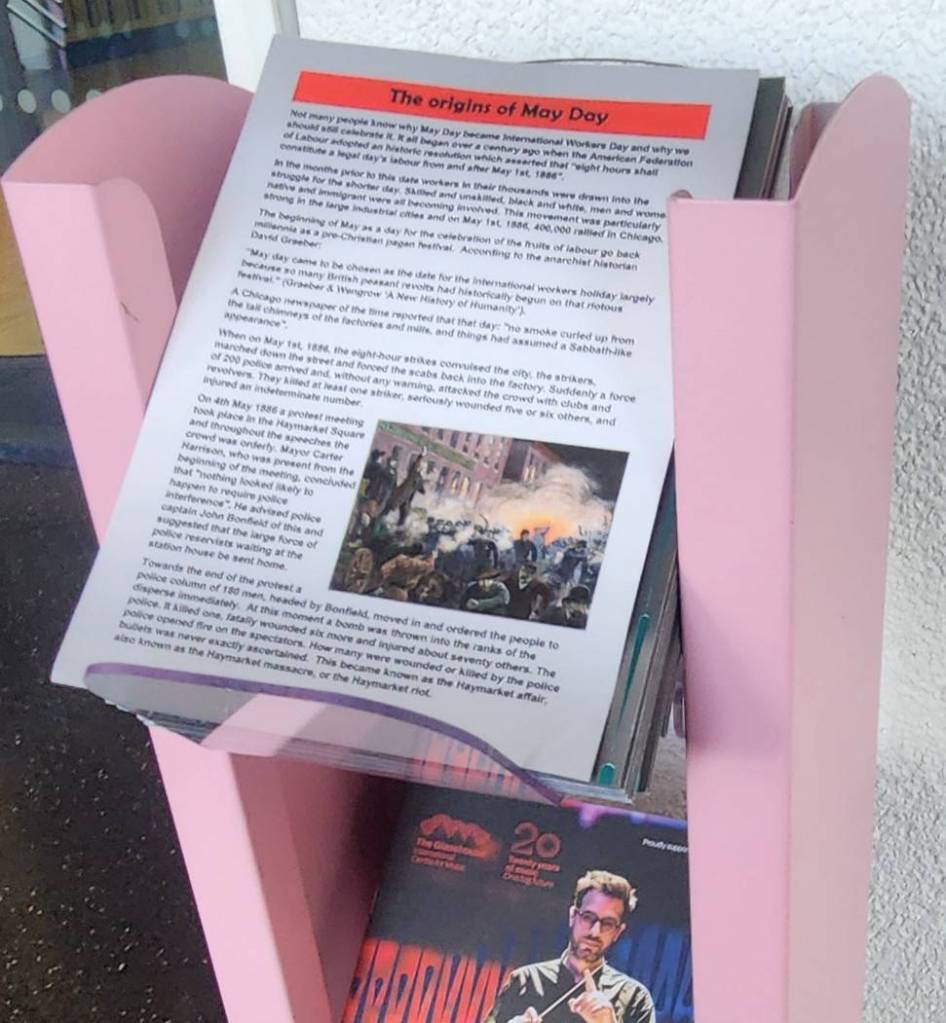
For those who don’t know, the modern incarnation of May Day began as a day of remembrance in the 1880s.  This is the case from the start for fallen anarchist comrades and then over the years, more generally, for workers facing the wrath of the capitalist system.  

For in 1887, in reaction to an explosion at an event in Chicago’s Haymarket Square the year before, attended by an enormous number of (40,000) striking workers during an increasingly mass bitter struggle for an eight-hour day, the state used the event as the pretext to sentence comrades of ours to death in cold blood.  This was despite no evidence whatsoever having proven a link to the bomb’s manufacture or consequent explosion.  The consequent killings which shook the world, took 5 of our comrades’ lives, including 4 who had the death penalty enacted upon them and 1 who committed suicide before they could be hanged.  3 more were convicted before being later pardoned.  The funeral procession of the slain was followed by thousands upon thousands of workers.  They became known as the “Haymarket Martyrs”.

“There will come a time when our silence will be more powerful than the voices you strangle today.” (August Spies – often cited as his final and bravely defiant words on the scaffold.)

There have been attempts by some political party and trade union officials in the West to muddy the reasons for celebrating May Day as International Workers’ Day.  There have been entire May Day cancellations by governments, including in Spain (particularly Barcelona) in 1937 in order to crush anarchist inspired workers resisting an onslaught upon them in street battles.  There have been hideous parades of military might in state capitalist Soviet Eastern Europe on May Day until the 1990s, which continue on to this day in Stalinist states. 

In the face of all this, we continue to remember the real origins of this day and look to a time of serious potential challenges to and then emancipation from state and capital.  This, a time of resistance and joy.  A time when we can really begin to live in harmony with the planet and the incredible other species that inhabit it.  A time to end conflicts over resources.  A time for internationalism and real solidarity.  A time to gain control over our own lives.  A time when this system can finally be flushed down the toilet.  A time for history to finally begin.

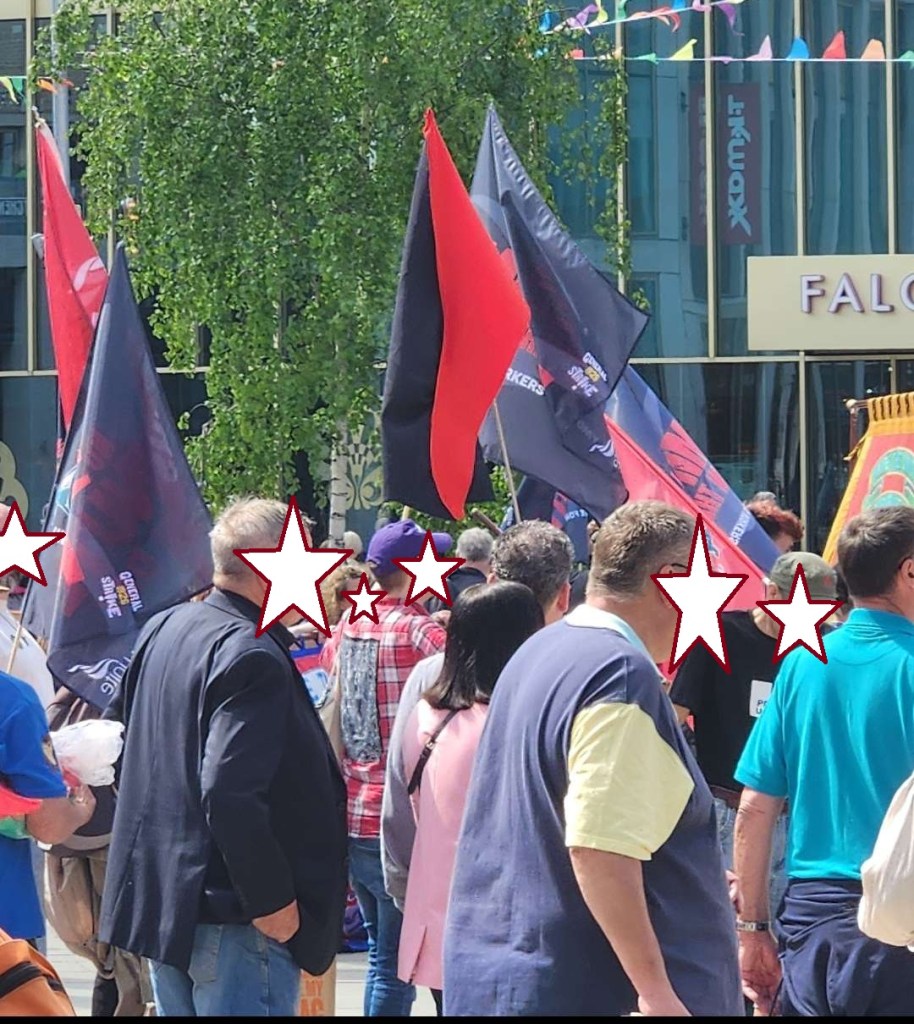
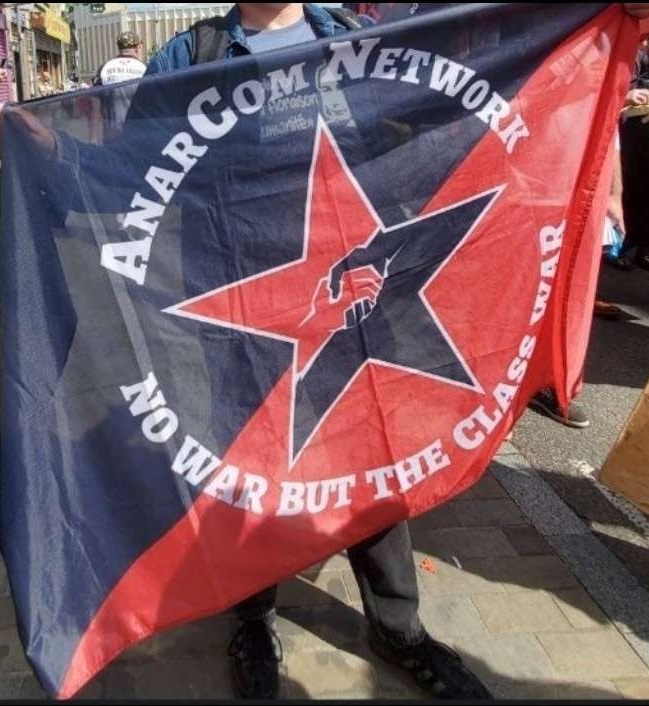
Class struggle anarchists have often taken to the streets and attended events on this important day and weekend for us over the years – at both official labour movement events, where we have ducked and dived the dull stultified atmosphere and ludicrous Mao and Stalin banners, to bring our revolutionary message of emancipation for all.  And at unofficial events, where we have danced, celebrated, shared literature, marched and directly challenged those who defend the current, yet in reality, obsolete system of capital and state.

This year as a group, though small in number, following a stall at the Hull Radical Bookfair on 25th April, we will be at events in South Yorkshire (Barnsley, 2nd May) and the Northeast (Gateshead, 4th May) as well as Manchester and Salford.  We may yet be at further events too over the May Day weekend?!  We will be chatting, celebrating and trying to learn lessons from the past, whilst talking to others about our potential futures.

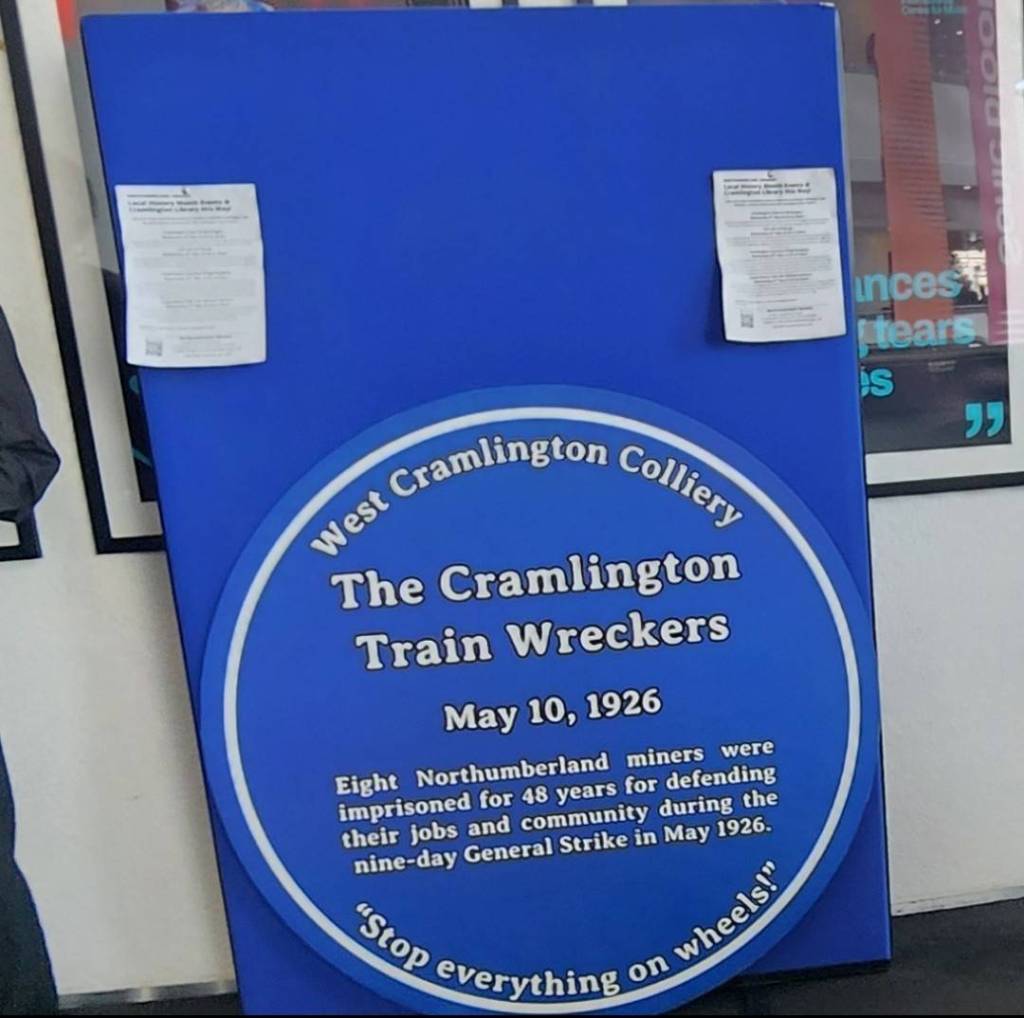
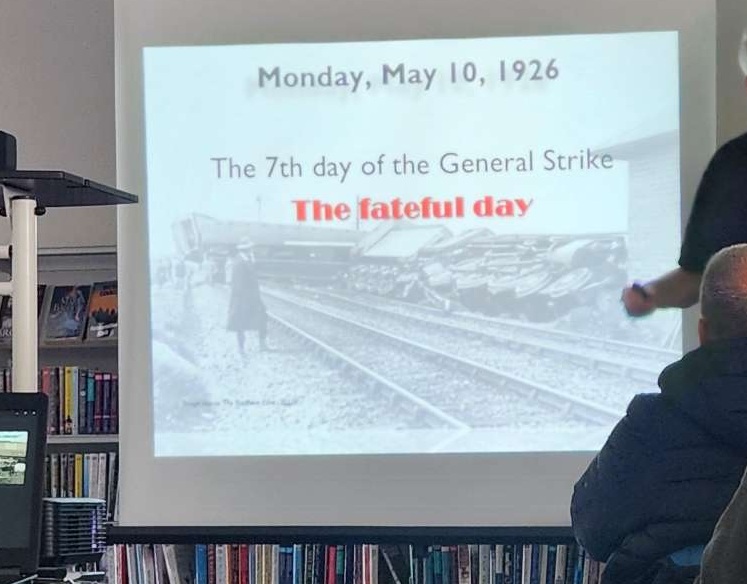
It is the centenary of the General Strike of 1926 in the UK.  Many leftists will be showing degrees of simplistic nostalgia over this.  For us, whilst noting some impressive local examples of determined working class unity and direct action at that time; we will point out that this event revealed the hopeless nature of official, capital friendly, trade union perspectives and of those claiming to represent us (the Labour Party and so-called Communist Party at that time but not restricted to them).  For in reality, any early enthusiasm or claims of workers potentially having any real power through this event quickly abated as its limited nature became apparent and as it failed to shake the base of the society and profit system in each we live.  We need to be honest about this but not despondent.

For our class can still challenge and potentially overcome the present system.  Be it through, for example, autonomous networked direct action, strike and community committees, popular assemblies and workers’ councils, or / and novel new bodies that display a development of genuine revolutionary content.

Emancipation and liberation are not guaranteed or in any way inevitable.  There is also much despondency currently, many recent defeats, a horrendous international conflict situation and a quietism too often displayed by our class in the social war.  However, despite all this, with the mass of resources available to humankind now and for us to thrive (moreover, as well as survive?), they need now be closer than ever.

As such, we wish to convey with hope and a determination based upon real potentials, revolutionary May Day greetings to all friends, comrades and workers throughout the world.

“I am an anarchist: I have no apology to make to a single man, woman or child, because I am an anarchist, because anarchism carries the very germ of liberty in its womb” (Lucy Parsons, anarchist organiser – on both anarchism and on our fallen comrades, murdered in 1887 by the state).

“Does this rising generation know that those who inaugurated the eight-hour day were put to death at the command of capital?”

Stuff the Ballots or Tell Them to Sod Off and Begin to Organise with a World to Win?!

7th May is the latest D-Day, or so we are told.  For then there is another large scale round of that popularity racket, known as election time.  This is the time when many of us are supposed to rubber stamp our local overlords or for those living in Scotland and Wales, to stick crosses in boxes at a national level.  Either way, as is often the case, offered up is a media sc(r)um fixated on statistics, casting judgement upon a UK level of who is up, who is down and why on earth it’s supposed to make such a ruddy difference? 

It’s your say, so they say.  As if as members of the working class, we really get one in this system of state and capital.  They’re taking us for fools.  For if we believe we have a stake or a real say as things are, then we’ll believe anything!  As some long lasting local graffiti used to inform, “Slit your own throat!  Vote!!”

This time around, we are told we have the incredulous primary (non)“choices” of Labour, Liberal Democrats, Greens, SNP, Plaid Cymru, Conservatives and Reform.  Despite claims that local elections are to elect the most effective individual candidate in your area and are about day to day issues (potholes, building problems etc), in reality you can bet your life that the main political parties will treat it as a national contest and boast afterward as such.  So let’s look briefly in turn at this shower:

Labour – emerging at the beginning of the 20th century to represent the upper echelons of the organised labour movement.  Even at its supposed most sexy in the 1940s, witnessed was the hideous spectacle of the armed forces being sent to break the actions of striking workers and the development of “placing a union jack on nuclear weapons” at home.  Whilst support for right wing forces in civil conflict (in Greece for one) occurred.

Nowadays, this Party seems to spend most of its time in government dreaming up new ways to screw the working class in a supposedly slightly less enthusiastic way than the conservative party.  Either way, the reality is we face yet more attacks and oppression, especially if we are poor, live in substandard accommodation, dare protest, happen to have a disability, are young, old, trans, refugees….  The list is long for sure!  Meanwhile, more dodgy dealings with the rich and powerful, including characters with links to those preying upon young vulnerable people, are revealed on an almost weekly basis.  Whilst at times, like in a recent meme, you could actually imagine the Prime Minister donning a Reform jumper.  Them and the Labour Party generally, having enabled that motley crew so well over the last couple of years.

Some claim that the current Labour Party isn’t really the Labour Party.  However, given this party’s crap history, says who?  They certainly aren’t averse to obsessions with attacks on civil liberties in the name of “law and order” and with dealings with militaristic oppressors of migrants and with those engaged in other viciously regressive causes – e.g. link ups with Palantir or seemingly even backroom talks with figures in Reform (as is said to be possibly happening in Scotland and is certainly happening with Labour Party backers in Unite the Union in Birmingham).

Liberal Democrats – a party so ludicrous that it largely emerged from considering the Labour Party too left wing!  Consider that!

Largely insignificant unless it “holds the balance of power”.  We saw the result of that in the early 2010s, when its vote share collapsed after jumping into bed with the conservative led government; it craving power at any cost and ending up being labelled the “Fiberal Democrats” or “Fibs” for short!

Conservatives / Tory Party – historically the natural home of ruling class representatives.  For 200 years, this organisation has headed up the majority of governments within the UK.  Credited (if that’s the correct term?) by some as one of the originators of pushing through on the latest phase of capitalist attacks, the so-called, “neo-liberal” garb.  Often the bête-noire of many in the working class, they clearly have nothing to offer but enriching themselves, austerity, vicious class and divide and rule culture wars.  Were last seen claiming intellectual superiority over the rest of us whilst getting pissed at parties during a pandemic and being headed up by a perpetually useless buffoon.  May or may not finally be increasingly irrelevant?

SNP – often does rather well in elections by claiming to simply not be the Tory (or Labour) Party at Westminster.  However, were actually labelled the “Tartan Tories” with some justification.  Clearly helped enable the formation of the Boris Johnson led Tory government after triggering an election in 2019 with the Liberal Democrats when the outcome was clear to all.  Its record in government is not nearly as “progressive” as is claimed and is obviously nationalistic, with all the dangers that that entails for us as a class.

Plaid Cymru – as with the SNP, picks up support by officially differentiating from the useless parties at Westminster.   May again come out the elections as being the largest party in the Welsh Assembly but despite claims to be “socialist” in its texts since the early 1980s, clearly does not support the abolition of capitalism nor does it support internationalism.

 Greens – the latest darlings for political nerds and those who feel homeless in the current incarnation of the Labour Party.  If as claim, try to actually put “People before Profit” within capitalism (using notably increased taxation etc), the result will very likely be downturn, capital flight and recession.  Whilst, if they actually head up a government, much potential opposition to them may well be worryingly quiet and disillusioned.  This amidst claims of, “If not us, then you’ll get them” (the forces of the right).

If, as some in this party claim, as a government they could simply print money to spend on needs and the environment, then an inflationary spiral will result.  They fantasise that capitalism – the profit system – can be reformed to meet human need, when all experience shows the opposite.  In reality, the Greens (English and Welsh, and Scottish variants) are much more likely to go the way of past dreams of reformism (e.g. in the Labour Party) – i.e. died at the altar of capital whilst government gets used for its usual state role, as a means of oppression and enforced exploitation of the working class.
Much of the previous talk of the challenges facing the environment and climate change have already gone rather quiet as it now follows a more traditional liberal left populist route.  Meanwhile, the new Green Party leadership declared that in a desire to “placate the Daily Mail”, it must look “respectable”.  This meaning manipulations, so that its upper bodies control what the membership and local party “activists” get to vote on and who to pick as local candidates.  Unlikely to be long before it follows its counterparts in Germany and elsewhere, on the right of social democracy, cheer leading capital, war preparations, NATO and social attacks upon the working class.   “Respectable”?  Oh aye!
Reform / Restore – darlings of the nativist wing of capital and notable parts of the media.  Xenophobic, nationalistic but currently, mostly snake oil sales people and grifters.  Fans of out and out authoritarianism, wars (especially in the Middle East), fossil fuels….  You get the picture.  If it’s a really crap idea for humankind and planetary well-being, you can bet your life they’ll champion it!  A few years ago were castigated as “swivel eyed loons” but are now seen as possible saviours of capital by turbo charging it and its attacks, in the light of economic crisis after crisis.

Claim to be on the side of the “white working class” and figures of the “people” – always the non or ill-defined, “people”.  Who of us have mates hanging about in steak houses in red or orange corduroy trousers, landowning tweeds and wellies, whilst ordering meals that cost hundreds?  If we want to hang out about with a bloke talking bollocks in a bar whilst getting pished, we could just find some poor sod of that ilk down a local watering hole.  At least they might have actual moments of incisiveness, clarity and positivity?  In reality of course, they are clearly part of the actual ruling elite and no supporters of the working class.  Their only role they see for us is to fall for their manipulations, vote for them, and get possibly used as suckers to divide up any effective opposition to them and the current system they support. 
These three word sloganeering bullshitting wonders, these multi millionaire non wage earning parasites, clearly would cheer on further attacks upon us whilst rolling around laughing, taking us for mugs, enriching themselves at our expensive.  What they do love unsurprisingly, is the bourgeois – petit and more so, large.

So, with that bunch and with electoral representatives representing an executive of the ruling class, why on earth would we engage in electoral voting at a local or national level?  After all, the government and state bodies will win again.  That, we can be sure of.  We clearly all need to do something about this!

Yet, if we tell people that we are refusing to vote, we will likely get castigated as enabling the far right or at least not stopping it.  Voting, like the belief in there being no alternative to capitalism and state has become somehow sacrosanct.  However, voting over the past century and a half has done nothing to undermine the present system, not even to pull the rug from its most right wing elements.  Voting in elections does not escape us disappearing down the plughole of vicious reaction, let alone lead to any kind of liberation.

We in turn however, will not take any delight in return in saying, we “told you so”, after we all face more shit on an ensuing daily basis.  Any attacks hurt us just as much.  We are members of the working class and hope that many more will achieve a level of confidence and class consciousness through direct engagement in the class struggle that will help provide the basis for turning the tables and in gaining a world of equality and liberty.  The vast majority of us have that potential.  We are not in any way special in this.

Meanwhile, for those who genuinely believe that Parliament can be used as an instrument to further a revolution (no not you, the farce of fantasy that is Your Party), we say how can this be so when this is an arena where we as a class are at our weakest and where for standing now as a candidate, you can pretty much go bankrupt trying to pay a lost deposit?  Then there’s the long time thorny tactic of setting out to abolish the state by first capturing it.   A questionable case of, “Now you see it, now you don’t”?  There being a clear temptation to hold onto the state, “Until such a time as….” – this time then never arriving.  William Morris was right in seeing Parliament being necessarily turned into a massive dung heap in any future of emancipation.

So, on 7th May, despite naysayers, we and like minded comrades will go on vote strike.  We may be giving out revolutionary literature and may perhaps “spoil” / propagandise our ballot papers?   We may be discussing alternatives to the current horrific situation with our workmates, friends and neighbours?  We may be busy carrying out care duties or other responsibilities?  We may simply decide that the best option is for us on the day is to “stay home” and even actually enjoy some much needed “down time”?!

All of this shows a desire to assert our autonomy and is more useful than providing a mandate to be exploited and oppressed.  Yet, we realise it is far from enough.  For a start, if we spoil the ballot paper and they are seen as invalid often to the annoyance of our dear master class, they are still included in the votes cast tally.  If we stay home, we are often seen as merely apolitical, uninterested and uninformed – the cheeky sods!

Moreover and more importantly, we clearly cannot transform and abolish this profit driven and state based system alone.  Real change and liberation doesn’t only take much more effort than simply sticking an “X” on a piece of paper every 2 to 5 years or so.  It entails mass resistance, class wide, possibly through autonomous strike committees, the emergence of networked popular assemblies and workers’ councils?!  These bodies and organisational types displaying clearly recallable delegates engaged in rotations of posts and responsibilities within a horizontal structure; ones that have similarly appeared in the past.  Or they may be novel new bodies?  There is no blue print in a mass collective movement for emancipation and by a class moving to abolish itself as a class and as such, class divided society.

Here, what matters most is that any content can lead to social revolution, a transformation of the social relationship and material conditions of capital and end that monopoly of a body of violence and oppression, the state.  At the moment, this may be seen as a real stretch.  After all, working class struggle appears to be at a very weak point in the “West” and any anarchist movement here, on the surface, seems tiny and badly divided; practically on its arse.

Yet, an emancipatory victory in the class struggle is still required to ensure our well being, our collective and individual potentials.  It’s required now for possibly even our very survival?  And even locally, small direct action based skirmishes can end in at least temporary victories, e.g. in self managed small scale strikes and against property developers at times and for renters.  Obviously, this is barely a start in itself and only a social revolution can guarantee any victory to be permanent.  However, they can provide some much needed confidence. 

Meanwhile, class struggle anarchism may yet emerge in surprising strength.  In parts of the world that were seemingly miles away from its known strongholds to us, movements have expanded recently, e.g. in South Asia and on the African continent.  Closer to our own locale, internationalist class struggle anarchists are now beginning to co-ordinate themselves in networks with like minded comrades and organisations in opposition to capitalist wars and militarism in an increasing number of regions, and against the social peace at home.  This in itself offers some hope for the future.

By refusing to take part in the electoral farce, we have every right to complain and oppose daily attacks upon us.  We have not supported in any way, the murderous wars of capital fuelled by resource exploitation, power expansion and an increasingly frequent desire to deal with its crisis caused by overproduction and / or a falling rate of profit, possibly combined with economic sector disproportionality etc, by armed conflict.  We won’t provide a mandate to parasites to exploit and oppress us, not any of us!  Nor in any way, support or cheer on our immiseration.

We argue against voting and then having to run to the nearest toilet!  We will continue to argue for our liberty and emancipation and we wish this for every single one of our class members – and with it, humankind.  We will continue to organise with members of our class to attain this aim. 

We do recognise that the emancipation of the working class is clearly the task of the working class itself.  It ever was and we must look forward to a future based on liberty and egalitarianism with determination, in the face of an era of seemingly perpetual pessimism and gloom!  The alternative hardly bares thinking about.  Instead of engaging in the electoral farce, let’s organise, learn together, agitate and speed the day!  There’s still a world to win!

Article by Bloque Ade

Report from the solidarity event with deserters in Athens on 28 February 2026, by Deserters of Capitalist Peace

Source: https://capitalistpeacedeserters.noblogs.org/2026/03/24/report-from-the-solidarity-event-with-deserters-in-athens-on-28-2-2026/

Our event, held together with Meetings against War and Peace of the Dominant, on political support for desertion and practical support for deserters from the Russo-Ukrainian front, took place in one of the few remaining occupied spaces that have managed to hold out against the Greek state’s repressive offensive. The turnout was strong and, overall, the event achieved its purpose. It created a space where part of the politicised anti-authoritarian milieu — those who refuse both the rival imperialist camps and the call to side with supposedly “wronged” states or national liberation struggles— could come together, and it showed that there is real interest in building a pole of war refusal from an internationalist perspective.

We would say that the event took on the character of a preparatory meeting, one that could lead to more practical steps and interventions in public space. On that same day, meanwhile, the bombing of Iran began and the war escalated further. So, the event was very much embedded in the conjuncture itself, and developments since then have moved quickly. Some anti-war calls have already started circulating. Whether our own perspective will also find a public expression — the perspective of a proletarian internationalist refusal of all wars, whether branded “defensive” or “offensive” — remains to be seen, and will be decided in practice.

The substance of the event came not only from the contributions of comrades from groups that support desertion, such as Antimilitaristická Iniciativa [AMI] and Assembly, but above all from the interview we conducted, with the support of Initiative de solidarité Olga TARATUTA, with a Russian deserter. [The contributions and the interview follow at the end.]

We think that focusing on the movement of desertion on the Russo-Ukrainian front, and trying to convey the lived experience of deserters themselves, helped anchor the discussion in a solid material reality. It allowed the discussion to begin from the real movement, from what the working class is actually doing today, instead of drifting into abstract references to the First World War, Lenin’s revolutionary defeatism, and other historical formulas. What concerned the more than sixty people who took part was how refusals of war preparation — and of the possible widening of the war — can be organised, taking support for desertion as a concrete starting point. Being prepared for what lies ahead seemed to be the key priority.

The discussion that followed showed that there is a willingness not to leave things at the level of a general anti-war stance. The question that emerged was whether, and on what basis, a more stable internationalist anti-war intervention can be built in the present conjuncture — one capable of linking the refusal of war preparation here with the real forms of proletarian refusal that are already emerging elsewhere.

Interview with a Russian deserter

At the event held on 28 February 2026 at the Prapopoulou Estate squat, we read out the answers of a Russian deserter to the questions we had sent him through comrades from the Olga Taratuta Initiative, and we are publishing them here. We should note that the questions in this interview are addressed to both Russian and Ukrainian deserters or draft resisters, even though, at this stage, the answers come from a Russian deserter.

[Deserters of Capitalist Peace]

1. At what stage did you desert? Before being officially called up, from a recruitment/training center or from the front? Had you completed your military service before the war? How long have you been away?

I deserted after I had already been sent to the war zone. For about six months I was at the front, working inside the headquarters — not in a trench every day, but still inside the military system, inside the war. I had already completed my compulsory military service before the full-scale invasion, so when the war started, I understood very well what the army is and how it functions. Those six months were the time when everything became clear to me. You see the reality from the inside — not the propaganda, not the television picture. You see how people are treated, how decisions are made, and what this war actually means for ordinary soldiers. From that moment I was just waiting for a real chance to leave. That chance came with my first official leave after half a year. It was the first time I could get out legally and without immediate suspicion. I used that moment to leave Russia and not come back. So, my desertion was not an impulsive act — it was a conscious decision that I carried with me for months while I was still inside the system. Since then, I have been away for more than a year. And for me this is not only about saving myself. It was a refusal to take part in a war that I do not believe in and did not want to support in any way. Leaving was the only way to stay honest with myself and to keep control over my own life.

2. What kind of work did you do before you left? Did the situation regarding jobs and wages change because of the war in your country? What is the situation like after four years of war?

Before the war I had a very typical working-class path, but at the same time I was trying to build something of my own. I worked in sales, I did construction jobs, I repaired washing machines, coffee machines and plastic windows — whatever allowed me to earn and stay independent. My last job before the war was actually my own small business. I was selling clothes through Instagram. It was not a big company, but it was something I created myself, from scratch. It gave me a feeling that my future depended on my own work and my own decisions, not on the state or on the army. After the war started, the situation with jobs changed dramatically. More and more of the economy became connected to the military sector. Defence production started to grow and, in many places, it became the only area where wages were increasing. In civilian industries the opposite was happening — salaries stopped growing, and in some cases even went down. And this was in a country where real income had already been stagnating for years. Now, after four years of war, we are looking at an economy that is deeply militarised. A huge number of people depend directly on military production for their survival. For many families this is the only available work. And this creates a very serious long-term problem. When the war ends, it will not be enough just to stop the fighting. Entire sectors will have to be reduced or transformed, and millions of workers may lose their jobs at the same time. These are people who will suddenly be left without income, without stability and without any clear perspective. So, the war destroys not only lives at the front. It also destroys normal economic life and the possibility for people to build something of their own — the way I was trying to do before everything collapsed.

3. What means were used for recruitment at the time you left? Were they digital or more “traditional”? In what ways can someone avoid being recruited? How do you hide?

First of all, it is important to understand that at the moment there is no open mass mobilisation in the same form as in 2022. But what we see instead is a constant and growing pressure on different groups of the population to sign military contracts. This pressure is especially strong on students. They are often given an artificial “choice”: either you sign a contract or you suddenly face serious problems with your studies — you can be expelled, you can lose your dormitory, you can lose your future profession. Formally it looks voluntary, but in reality, an entire infrastructure is being built where signing a contract becomes the only way to avoid conflict with the university, with your family, and with society. For a young person this psychological pressure is extremely powerful. Recruitment works through both traditional and digital means. On the streets you see posters, banners, leaflets — the visual presence of the war is everywhere. At the same time, online there is an enormous amount of targeted advertising and propaganda that presents military service as something prestigious, heroic and socially approved. So, people are not usually taken directly from the street — the system works in a more sophisticated way. It creates living conditions where refusing becomes risky and socially painful. In some cases, people are also afraid of fabricated criminal charges or administrative pressure, where they are told: prison or a contract. Even if this does not happen to everyone, the possibility itself creates fear and pushes people toward what is presented as the “safe” option. Because of this, there is no universal way to “hide”. Everything depends on a person’s individual situation — their education, their job, their family, their access to documents. For many people the main strategy is simply trying to stay outside of the structures where this pressure becomes direct. So, recruitment today is less about physical force and more about economic pressure, social control and propaganda. And this makes it in some ways even more effective, because it creates the illusion that the decision is voluntary.

4. What consequences do you face in everyday life and at work when you avoid recruitment?

In everyday life, avoiding recruitment does not always lead to immediate criminal punishment — at least not yet. The pressure is mostly social, economic and psychological. You can face disapproval from people around you. Someone may tell you that you are living a normal life while “real men” are at the front. This kind of moral pressure is very common and it affects families, workplaces and social circles. It creates a feeling that you constantly have to justify your decision simply to live a civilian life. The more serious problem is indirect pressure. If the war continues, the economic situation is increasingly structured in such a way that military service becomes one of the few stable sources of income. For many people the choice is not between war and peace — it is between signing a contract and not being able to support your family. So even without formal coercion, the system pushes people toward the army. At the moment, those who avoid signing contracts can still try to stay in civilian life. But there is a strong sense that this space is shrinking. Many people believe that the so-called “voluntary” recruitment resource is not unlimited, and that at some point the state may again move toward harsher forms of mobilisation. And this expectation itself already shapes everyday life. People live with the constant feeling that the rules can change at any moment — that what is technically allowed today may become punishable tomorrow. So, the main consequence is not only the risk of future repression. It is the atmosphere of uncertainty, social pressure and economic dependence, where remaining a civilian becomes more and more difficult and requires constant personal resistance.

5. Before the war, how did you think about the army and desertion? What pushed you to decide to leave?

Before the war my attitude toward the army and the government was already quite sceptical. In Russia every man has to serve one compulsory year when he turns eighteen. I did this service in full, and that experience shaped my view very strongly. I saw an institution that was not preparing people for real defence, not giving meaningful training, and not respecting soldiers’ time or dignity. For a whole year we were mostly doing useless routines that had nothing to do with actual military professionalism. It felt like a lost year of life. At the same time, I grew up in a political reality where nothing really changed. I was born when Putin was already in power, and he is still in power today. So, my distrust toward the state was not something that appeared suddenly in 2022 — it had been forming for many years. But before the war I never thought about desertion. Like many people, I saw it as something abstract, something that happens to someone else. When the invasion started, at first, I was still looking at it in a very rational and even technical way. From my previous experience I knew the real condition of the Russian army, and I did not believe in the image of a fast and easy victory. When I later found myself inside the system, at the front, it became absolutely clear how unprepared, disorganised and inefficient it was — despite all the resources. You see that the army cannot properly supply itself, cannot organise itself, and very often has no clear tactics except sending more and more people forward. And at that moment the question becomes not political but deeply personal: what is your role in this? My decision to leave was not made in one day. It was the result of everything I had seen before — my compulsory service, my distrust of the system, and then the direct experience of the war from the inside. Step by step I understood that staying meant becoming part of something I did not believe in and did not want to support in any way. Leaving was the only way to remain honest with myself.

6. If the war ends, do you think about returning? If yes, how do you feel about returning?

This is a question I think about a lot, and the honest answer is that it depends on many things. The most important condition would be a real political change and a full amnesty for all those who refused to participate in the war. Without that, returning would simply mean going to prison. But even if such changes happened, time is also a crucial factor. If it takes ten years, by that moment my life will already be built somewhere else. I will have a new language, new work, new social connections. Going back would not mean “coming home” — it would mean starting from zero once again. I have already had to rebuild my life once, and it is a very difficult process. I am not sure I would have the strength or the desire to do it again. There is also the question of trust. Russia is a very unpredictable country. Even if an amnesty is officially announced and the political situation changes, there is no guarantee that these decisions will be permanent or that they will actually be respected in practice. For someone in my position, this uncertainty is not theoretical — it is a direct personal risk. So emotionally, of course, the idea of returning home is important. Home is not just a place — it is your language, your memories, your past. But when I think about it in real, practical terms, I understand that most likely I will not have a safe and realistic opportunity to return. And this is one of the hardest consequences of this war — it takes away not only your present, but also your future and your connection to the place where you were born.

7. Beyond desertion, is there a collective anti-war movement that is active; in Russia or in Ukraine right now? If so, in which cities is it most present, and what are its main characteristics? Do you know whether women are organizing anti-war protests? What do they usually demand? Do they play a significant role in preventing basification, i.e. in the case of Ukraine?

At the very beginning of the war there was a visible and active anti-war movement in Russia. There were mass street protests in many cities — Moscow, Saint Petersburg and others — and a lot of public statements from activists, journalists and ordinary people. But the state reacted extremely quickly and very harshly. Thousands of people were detained, many received criminal charges, independent organisations were destroyed, and public anti-war activity became almost impossible. Because of this, the movement did not disappear — it changed its form and became much less visible. Today, open protest in the streets is practically suicidal from a legal point of view. A single public action can immediately lead to a criminal case and a long prison sentence. That is why most anti-war activity is now individual, local, anonymous or happening in exile. One of the most important and visible initiatives inside the country during the war was the movement of the wives and relatives of mobilised soldiers. These were not political activists in the classical sense — they were ordinary women who demanded rotation, proper training, equipment and the return of their husbands. Their protests showed how deep the social tension is. But even this very careful and limited form of protest was gradually suppressed and pushed out of the public space. So, women have played a significant role — not through large political organisations, but through these grassroots initiatives based on care, survival and the protection of their families. Today, if we speak about public anti-war structures inside Russia, they are extremely fragmented and forced to operate in conditions of fear and repression. The price of open opposition is prison, and everyone understands it. That is why the absence of mass protests does not mean support for the war. It means that the state has made open collective action almost impossible.

8. What problems do you face as a fugitive from Ukraine/Russia? Is there a solidarity network among fugitives where you are now? Or a network of locals who support refugees from Russia/Ukraine like yourself?

To be honest, the reality here turned out to be much better than what I had imagined when I was still planning my escape. Before leaving, I expected constant difficulties, hostility and isolation. But when I arrived, I discovered a huge amount of solidarity. I met many people who were ready to help, support and simply treat me as a human being. I have never faced open condemnation or aggression because of my story. The main challenges are not social — they are bureaucratic. Learning how the system works, how to communicate with institutions, how to deal with documents — all of this was difficult at the beginning, because it is very different from Russia. You feel that you have to rebuild your life from zero in a completely new environment. At the same time, there is a real network of solidarity. Among Russian refugees, among Ukrainians, and among local people, I constantly feel support. There is a shared understanding that this war is a tragedy for everyone, and a shared desire to help those who refused to participate in it. This creates a space where you don’t feel alone. The situation is more complicated for Ukrainian deserters. Not because of ordinary people — on the contrary, at the human level there is a lot of empathy — but because of the legal and political framework in many European countries. For them it is much harder to obtain protection, and many are forced to remain invisible and live in fear. This makes their position far more precarious. So, my main problem is not hostility — it is the long and difficult process of building a new life in exile. But what makes this possible is the solidarity I experience every day, from different sides and from very different people.

Statement from AMI for support for an anti-war event and fundraiser in Athens

In September 2022, some anarchists from Central Europe launched the Antimilitarist Initiative [AMI]. It all started with the publication of the text “Anarchist Antimilitarism and Myths about the War in Ukraine.”

Shortly after the publication of this text, an anonymous symbolic direct action took place, in which the Ukrainian embassy in Prague was splattered with red paint. A statement was released accompanying the action, which stated: “It is understandable that Putin and his supporters are criticized for the crimes they are committing against the people of the Ukrainian region. However, the role of Zelensky and the Ukrainian government in these massacres should not be forgotten. At a time when Putin’s army is bombing Ukrainian cities, Zelensky’s government is prohibiting men from leaving the country to seek safety. Under threat of punishment, they are being held in bombed-out areas, and some are being forced against their will to risk their lives on the front lines. Let’s be clear: Zelensky is just as much of an asshole as Putin! Both have the blood of civilians on their hands.”

AMI has never been a formal group or organization, but rather an informal network. We have the most supporters in the Czech Republic, Slovakia, Hungary, and Austria. From the beginning, we have been very critical of war propaganda, which serves to gain more supporters and resources for the Ukrainian state’s war policy. This pro-Ukrainian propaganda is dominant in the regions where we live, even in environments that formally profess anarchism or communism. This makes it difficult for AMI and other anti-militarist groups to organize public activities. Our actions are often sabotaged by “pro-war leftists” who essentially have the same agenda as EU states and NATO member sections.

We are now organizing practical support for deserters and war refugees from Russia and Ukraine. Activities are mainly organized non-public so that we can be more effective and do not have to defend ourselves against the aforementioned attacks. We collect and share money and material aid, and help with the transport and accommodation of refugees. We also publish articles and interviews with people who have fled war zones or actively sabotaged war.

In general, desertion is viewed with great ambivalence, especially in Central Europe. Part of the population theoretically supports deserters from the Russian army, but does not express solidarity with deserters from the Ukrainian army. This tendency is in line with the war policy of EU/NATO/US imperialism. Supporters of this line argue that supporting deserters from the Ukrainian army helps Russian imperialism. However, we argue that “one-sided” support for deserters and support for arming Ukraine contributes to the escalation of war and the spread of interstate conflicts into a global war.

Revolutionary defeatism, which means fighting against all states and all their armies, is now only advocated by militant minorities. However, we believe that the balance of power may soon change, as more and more proletarians on both sides of the war line are avoiding mobilization or deserting. These people often have no experience with self-organization, but it is undeniable that at this moment they are practically sabotaging the war efforts of “their” states. Revolutionary minorities must establish contact with them. In this way, currently isolated minorities can transform themselves into mass movements.

In general, it can also be said that most deserters only pass through countries such as the Czech Republic, Slovakia, or Hungary, or stay there for a very short time. These countries have very poor migration policies. Deserters therefore prefer to live in countries such as Austria, Germany, France, Switzerland, or Belgium, where it is easier to obtain asylum and legal protection from deportation or persecution by the Ukrainian and Russian authorities. Here, they can also apply for relatively large subsidies, accommodation, or generous material assistance from charitable organizations.

However, we see that state policy is trying to integrate refugees into the capitalist economy as cheap labor and domesticate them so that they do not express subversive tendencies. As an alternative, we are trying to create a strong solidarity network that encourages deserters and refugees to organize themselves in resistance.

If you would like to support our activities, please visit our website for more information and contact details. https://antimilitarismus.noblogs.org/

Report from Assembly at the Athens event in solidarity with deserters from the Russo-Ukrainian front, on 28/2/2024

There is already broad resistance to drafting in Ukraine, which we recently compared to the resistance to ICE in our article, “From Minneapolis to Ukraine, only street countering can stop the state-run hunt for people.”

The problem is that, as in the United States, it is not strong enough to change the overall situation. After the complete devastation of our revolutionary field by Stalinism, the tradition of mass street movements disappeared in Ukraine, except in support of some right-wing politicians (1991, 2004, 2014…). Rebuilding it from scratch takes a lot of time and has been underway for two years now, since the law tightening mobilization was adopted on April 11, 2024. However, this process is being delayed by extremely unfavorable conditions, including state brutality, economic ruin, and mass displacement. This is precisely why desertion has become the main form of resistance to the war. It does not require broad organization and is much less likely to lead to punishment than street action. One of the most famous war profiteers, Alina “Mercedes” Mykhailova, admitted a month ago that 20,000 of the 30,000 people mobilized each month are fleeing.

Why do others continue to serve? For the same reasons some civilians support the war: Stockholm syndrome (you may have seen this a lot among the anarchists), a naive belief in the promises of some career other than being an assault trooper, the everyday habit of obeying any authority… A simple example from the working class: a municipal worker’s salary is 12,000 hryvnias, a plant machine operator’s is 20,000, but a concrete pourer on fortification construction has from 60,000 to 100,000! Granting privileges to certain groups, of course, also hinders class solidarity. This does not even include the hundreds of thousands of state officials, law enforcement officers, etc., whose income thanks to the Western financial aid has become higher than ever. They also have family members…

However, since late 2025, we see a new trend: people against the war are moving from self-defense to counter-strike. Almost every day there are news reports of attacks with knifes, shotguns, or grenades against police or enlistment groups, mostly in rear regions like Odessa or West Ukraine. This is no longer like today’s United States, but rather like during the Vietnam War! Details will be in our upcoming article.

Finally, we want to raise awareness about the persecution and imprisonment of those who publicly express their opposition to the war. Some of these people have taken a written stand against the war, like Bogdan Syrotiuk. Others have taken action against conscription. For example, the prisoners in the “Proclamation Case” called on soldiers to unite in “soldiers’ committees” and collectively refuse to participate in military operations on the front lines. Criminal prosecution with heavy penalties is also being brought against civilians who engage in activist acts of resistance to the brutality of men being seized and sent to the front. One such case is that of Angela Gurina, who is facing five years in prison, which was to begin on December 9, 2024, on the false accusation of exposing military quarters, when in fact she was filming and posting a scene of busification. According to the verdict, her video, which has been viewed 8,600 times on TikTok, shows a military installation, the regional assembly point near the Military Law Enforcement Service in Chernivtsi. Depicting such installations on video is prohibited under martial law. The journalist was arrested in August 2024. Her lawyer insisted that she was filming not a military installation, but a potential human rights violation. The video was titled “Saving a guy.” Angela later deleted it. The lawyer also argued that the location of the object was publicly known and that it was neither a combat unit nor a military training facility. But the court disagreed, arguing that: “The applicant’s claim that the person did not intend to harm the internal and external security of Ukraine does not refute the commission of the alleged offense.” Although the trial established Gurina’s dual Romanian citizenship, there is no information about the Romanian government’s efforts to secure her release. Last year’s verdict also indicated that she suffered from mental health issues, including bipolar disorder. At the time of her conviction, the activist was 54 years old.

Reproduced from Tridni Valka – https://www.autistici.org/tridnivalka/report-from-the-solidarity-event-with-deserters-in-athens-on-28-february-2026-by-deserters-of-capitalist-peace/

Capitalist Counterrevolution, Reformist Activism and Communist Theoretical Practice Today

From Tridni Valka – Here we propose our English translation of a text initially published by comrades in Ecuador. Globally we agree with the text, especially we would like to emphasize strong affirmations putting forward: 1/ the proletarian and communist historical party against the conception of (bourgeois) political party; 2/ the correct definition of the militant tasks of revolutionary minorities in the current period of global counterrevolution but with “local” and not yet generalized class confrontations in many parts of the world; 3/ we also appreciate the critics towards activism and spontaneism versus strong programmatical reaffirmation and development… Nevertheless, the text should be more discussed for the issues related to communization, real subsumption, affirmation of the proletariat and transition period…

What is determinant for social revolution is the historical and global context, or better said, the nature of the period in which the class antagonism exists, not the consciousness, the will, or the activity of leftist organizations and individualities in this and any other country. In the history of global class antagonism, there are only two types of periods: counterrevolutionary period and revolutionary periodThe present one is a counter-revolutionary period.1

Roughly speaking, the main characteristics of a counterrevolutionary period are: 1) that the bourgeoisie exercises its class domination in all aspects of society: from the economic to the ideological, so it is also on the offensive or attack in all aspects in order to maintain such domination; and, 2) that the proletariat can only wage defensive or reformist struggles (for demands) as a class of labor/capital and not as a revolutionary class. The balance of forces tilts thus in favor of the first class, and not the second one.
More clearly: in a counterrevolutionary period, the bourgeoisie is strong or ruling class and the proletariat is weak or dominated class.
This does not mean that during a counterrevolutionary period there are no revolts and insurrections. In fact, during the current counterrevolutionary period, specifically so far in the 21st century, there have been international revolts that have even threatened to alter or reverse the balance of forces between the classes: in particular, those of 2000, 2008, 2011 and 2019. (The historical and material causes of the defeat of the revolts and the strength of the counterrevolution in this century are subject of another article).

The system of capitalist domination, with the State at its head, has different tentacles. Of which, social democracy, reformism or the left of Capital, is one of the most important and strongest, because it is the capitalist counterrevolution that disguises itself as red and even black in the bosom of the exploited and oppressed so that their protests are democratically put under the bushel – fighting against this or that law, against this or that government, for this or that right, etc. – and do not attack the roots of the system: the social dictatorship of value in process or, in simpler words, having to work to pay and pay to live, thanks to what the rich and powerful are what they are at the expense of our class of increasingly precarious and impoverished wage slaves. As long as it stays that way, nothing fundamental will change.

Therefore, in a counterrevolutionary period like the one we are living, all left activism (marches, sit-ins, assemblies, symbolic actions, etc.) is reformist and does not even tickle Capital and the State. Slogans like “confronting the bourgeois and imperialist onslaught”, “not giving up the streets”, “strengthening the unity processes of the popular sectors”, “accumulating forces”, “preparing the popular offensive”, etc., brandished by the militants of some local leftist organizations, are convincing but false reasons for seeking to reproduce the Capital-State or the bourgeois-democratic order in another form (“defending public services”, the “rights of the people”, their dream of a “popular government”, the “redistribution of wealth”, etc.) and, therefore, the counterrevolution disguised in red and black, even if they have good intentions or are not aware of it, and even if their discourse and their action appear “radical”.

This is so because Capital is an impersonal social relation and, therefore, immensely more powerful than the personalities, wills, ideologies and political activities of leftist organizations and individualities. Moreover, Capital subsumes or encompasses, dominates and reproduces within itself the “people”, the working class, its leftist organizations and its democratic protests.

In this sense, left activism is also opportunist, because the political organizations behind it take advantage of the conjuncture imposed by the ruling class as an opportunity to jump on stage, to propagate their political ideology (the social-democratic program disguised as “Marxism” and even “anarchism”), to recruit more people and thus have more power than other political organizations. Thus, they reproduce the logic of the mafias or business rackets that compete with each other in order to accumulate more capital, power and territory, but “from below and from the left”.

Although sometimes it is not even that anymore: leftist activism ends up being, obsessively and compulsively, action for action’s sake in order to appear more rebellious and even more “revolutionary” than others in social networks. A miserable show of struggle against capitalism, ironically and pathetically and finally turned into commodity and image by this same society of the spectacle. Something that, by the way, is very typical of the leftist petty bourgeoisie: the appearance, the pose, the theatrics. In such a way, leftist activism reproduces the competition and spectacle of the capitalist society against which it claims to be fighting in the streets.

Far away and contrary to all that, the only thing that would really and mortally hit the bourgeoisie would be for the anonymous and self-organized proletariat to expropriate and massively communize all production and distribution, so that what is produced should be produced solely to satisfy collective needs directly and free of charge. By attacking and destroying by force, at the same time, the repressive and bureaucratic apparatus of the State. All this can only be upheld by a revolutionary power of an anti-State and international character, because the social revolution is crushed when it does not impose itself on the counterrevolution nor internationalizes itself. In short: communization, insurrection and world Commune.

If the global revolt of 2019 shook the world bourgeoisie, it was because it constituted a breaking point that reopened the historical possibility of social revolution. That is why it reacted so violently and shrewdly in all its forms and levels to date, namely: brutal State repression to crush the revolts, counter-insurrectional use of the pandemic, imperialist war (in Ukraine and Palestine), narco-terrorism, neo-fascism, “alt-right” and post-modern left or “woke” activism alike, elections, etc. Just remembering 2019, the world bourgeoisie is once again trembling with fear. Since then, its strategy is the preventive counterrevolution, because it seeks to prevent at all costs a new global revolt that could become a world revolution. Meanwhile, under the present counterrevolutionary period where the balance of forces is unfavorable for the proletariat, all left activism is reformist, opportunist and spectacular.

For all these strong reasons, and for no other, we as revolutionary proletarians or communists, today we keep our distance from activism and instead we focus with seriousness and commitment to theoretical activity; that is, to the production and dissemination of revolutionary theory for revolutionary practice.

Now, this theoretical activity that we communists uphold is not “intellectualism” or “purism”, as we are often “criticized” by left-wing activists. It is a form and a moment of class antagonism and, therefore, of revolutionary practice. Yes, theory is in reality theoretical practice. In the materialist conception of history and human praxis – in the full extension of the latter – theoretical practice means the process of production of new knowledge that, in the heat of the development of productive forces and social struggles, seeks not only to interpret but to transform social reality. Therefore, communist theoretical practice is the production of critical and revolutionary theory which, being closely linked to class antagonism, seeks communist revolution.

More precisely: making use of the fundamental categories of the critique of political economy, communist theoretical practice today is the production of concrete analyses of the current capitalist conditions and, above all, of the concrete proletarian struggles in order to contribute to their self-clarification and radicalization or, better said, to contribute to produce the revolutionary rupture within them. Based on this, the communist strategy and tactics for the 21st century can be elaborated. Therein lies its necessity and its importance or, if preferred, its raison d’être and its meaning, today.

In the same perspective, it can also be affirmed that to produce and spread communist theory or to maintain and develop the revolutionary positions of the proletariat against capitalism, against the ideology of the ruling class and, in particular, against Social Democracy within the proletariat itself, even if in a very minority way and against the current, is a practice whose objective is to reappropriate, preserve and sharpen “the weapons of criticism” for when capitalism in crisis and class antagonism will open a period of social revolution in which situations will arise where they will be massively substituted by “the criticism of weapons”: the world proletarian insurrection for communism.

Indeed, in those revolutionary situations typical of a revolutionary period, the revolutionary theory and class consciousness become material forces or practical weapons in the hands of the proletarian masses fed up with being proletarians and who go on the offensive against Capital, the State and class society until destroying and overcoming them. Because “only a mass communist revolution can produce a mass communist consciousness” (Marx, The German Ideology). Communist theory foresees such a revolutionary situation and subjectively prepares the proletariat for it.

In short: during a counterrevolutionary period like the present one, communist theoretical practice is not only communist resistance, but activity of strategic foresight and preparation for the communist revolution.

Obviously, it will not be revolutionary theory and propaganda that will trigger the revolution, but the objective and subjective conditions created by capitalism in crisis itself and class antagonism so that the proletariat can no longer and no longer wants to live as such and, then, feels the revolution as an immediate human need to be satisfied. Likewise, to abolish and overcome Capital, the State and class society, mass self-organization, antagonistic solidarity and revolutionary violence of the proletariat in the process of self-abolition as a class are necessary.

However, revolutionary theory and propaganda are also necessary, even indispensable as critical-practical weapons of the community of revolutionary proletarians, alongside our best weapons, which are solidarity and mutual support. Because if some proletarians around the world are today devoting themselves to the communist theory and propaganda, it is because they are fed up with the life they suffer under capitalism and because they are driven by the passion for communism. As Marx wrote, “criticism is not a passion of the head, but the head of passion”. That is why we affirm that communist theoretical practice is not only communist resistance, but strategic and passionate foresight and preparation for the communist revolution.

This does not mean that we communists should “wait until all conditions are met for revolutionary struggle” and, therefore, that we do not participate in the struggles for the demands of our proletarian class during the present period. We did it – above all, in the revolts of the last years, fighting in the streets, “where things are heating up” – and we will do so to the extent of our limited possibilities. But, always with this criterion and this perspective, the communist perspective; that is to say, unveiling and pointing out the roots, the limits and the power of the current proletarian struggles and, consequently, maintaining and holding up the revolutionary positions of the proletariat, without compromising or negotiating with the bourgeois State and Social Democracy of any color. The communist perspective is an antagonist perspective.

Furthermore, we communists produce and spread theory in the heat of concrete struggles and accompany them critically in this way, seeking to contribute to produce the revolutionary rupture within them, as so many proletarians in struggle. Because communist theory is not only a form and a moment of class antagonism, but also a product and a factor of the latter. Because the revolutionary rupture is the nucleus of the communist struggle; its organizing principle and, at the same time, its method. And, fundamentally, because the struggles for demands prepare the terrain for the revolutionary struggle; not gradually at all, but by means of rupture and qualitative leap with themselves, with their own limits.

The main limit of the struggles of the proletariat in the present times is its own condition as aclass of labor/capital. Because under the real subsumption or real domination of capital, labor and capital or proletariat and capital are inseparable. This class relation today is in crisis (high rates of unemployment, underemployment, informal economy), but it continues to function and uphold capitalist society in a catastrophic way. And because being proletarians is not a source of pride. It is a social and historical condemnation that must be abolished in order to be truly free, or rather, to be a real, universal and richly diverse community of freely associated individuals who create and fully live their lives as such.

Therefore, the core of communization or communist revolution in the present times is not the affirmation and perpetuation of the proletariat – not even as a ruling class – but the self-abolition of the proletariat as a class of labor/capital. The proletariat is revolutionary or it is nothing. And it is only revolutionary when it struggles to cease to be so. In itself, the self-abolition of the proletariat implies the abolition of labor – understanding that labor is the capitalist mercantile alienation and exploitation of productive human activity –, of capital and of the bourgeoisie. In short, the nucleus of communization is the abolition of the class relation that establishes and crosses all capitalist society, through the production of communist relations between individuals.

Even if it will take several generations to achieve this, the material conditions produced by capitalism itself during the last decades determine that the communist revolution, whose core is the abolition of labor, is more possible today than ever before in history. For example, the technological development currently achieved, once it has been communized, would make it possible to reduce “work” to the minimum necessary and to have free time for the development of all human potentialities and relations.

For its part, the history of the revolutions of the last two centuries demonstrates that we proletarians can indeed make the revolution with our own heads and hands, without the need of those who bring the consciousness or saviors as the Leninist parties believe. And vice versa: it also shows that, if we do not do it in an autonomous and anti-State way, those same who bring the consciousness and saviors will end up being the new ruling class disguised as red, degenerating the proletarian revolution into Leninist counterrevolution.

This does not mean falling into spontaneism, let it be clear. Self-organizing as a community of struggle for social revolution – what Marx and other historical comrades have always called Historical Party –, we proletarians can self-emancipate in all aspects and produce communism to destroy and overcome capitalism.

Communism is not a utopia, nor an ideology, and certainly not that State capitalism misnamed “communism” that existed in the USSR and its satellite countries. “Communism is the real movement that abolishes the present state of things” (Marx, The German Ideology) as well as the new classless and stateless society, without market or national borders, which results from such a revolutionary movement.

Communism is that revolutionary rupture and leap that takes place within the proletarian struggles themselves, even more so in a context of crisis of the class relation such as the present one. Communism is the rupture of the capitalist conditions of existence through the production of new social relations between individuals. Non-mercantile and non-hierarchical relations. Relations based on mutual aid among equals and real freedom, because they have become liberated from value, commodity, private property, work, division of labor, capital, money, social classes, the State, nationalities, races, genders, the division between town and country, the separation between humanity, technology and nature, etc.

Therefore, in the heat of the deepening and extension of class antagonism, only the immanent and immediate production of communism – without a “transition period” – can destroy and leave capitalism behind. The communist revolution does not admit half measures. For he who makes revolutions halfwayisdigging his own grave.

So, the challenge for the communists of the 21st century is not “to wait until all the conditions are met for revolutionary struggle”, but rather to contribute to produce the revolutionary rupture in the heart of the current struggles for demands, far from activism and always against both reformism and opportunism. Far also from spontaneism, because, as we said before, for self-emancipation self-organization is necessary. In fact, self-organization is the first act of the revolution. Thus, the challenge is to contribute to produce the revolutionary rupture, in every possible way, with intransigence and patience at the same time.

How, with what strategy? Not only by producing and spreading communist theory in the heat of concrete struggles, but also by making the community of struggle against capitalism – that is self-organizing anonymous and fed-up proletarians – the anticipation of the communist society of the future within the capitalist society of the present. Trying to live and expand communism as a mycelium, that is, as a mushroom network in the cracks of the global capitalist catastrophe until it is a new world. Producing communism in the heat of the deepening and extension of class antagonism in order to abolish class society. Even if it takes generations to achieve this, the challenge for communists in the 21st century is communization.

Proletarios Hartos de Serlo
[Proletarians Fed Up with Being Proletarians]
Quito, August 2025

English translation: The Friends of the Class War

1 In reality, there are three types of world-historical period of class antagonism. The third is what a few decades ago the Négation Group called the period of revolutionary resurgence or what today the Barbaria Group calls the bridge period, whose main characteristic is the epochal transition from a counter-revolutionary period to a revolutionary period; a true change of epoch. According to Barbaria, as a result of the world revolt of 2019, the current period is a bridge period or a bridge epoch between the world counterrevolution and the world revolution. However, it is still dominated by the characteristics of the counterrevolution. For this reason, and for the purposes of this article, we affirm that the present period is a counterrevolutionary period. We leave open the comrade discussion on this matter; but to develop it at another time and place, that is to say, in another article.

Source in Spanish: https://proletariosrevolucionarios.blogspot.com/2025/08/contrarrevolucion-capitalista-activismo.html

Capitalist peace is the source of imperialist war!

Source in German: https://astendenz.wordpress.com/2025/10/20/der-kapitalistische-frieden-ist-die-quelle-des-imperialistischen-krieges/

In global capitalism, peace can only be an interwar period limited in space and time. There can be no such thing as “world peace” under capitalism. There are always conflicts somewhere. In times of peace, States prepare for war through military rearmament. And in times of war, military action is taken to secure the conditions for the next peace. In capitalist peace, proletarians are exploited — they produce more money for capital and the State than they themselves cost in wages. And in war, they must kill and die for “their” exploitative capitalist States. Capitalist peace is not an alternative to imperialist war, but its source.

Peace and war in the Ukraine

Between States and blocs of States, peace is the non-military form of competition for raw material sources, sales markets, and geopolitical spheres of influence. Above a certain intensity, this competition turns into war. Thus, the blocs of States of Western imperialism, the EU and NATO, continued to expand their influence against imperialist Russia through their expansion to the east. When Ukrainian President Yanukovych refused to sign the Association Agreement with the EU in 2013, partly due to pressure from Moscow, a social-reactionary movement formed on Maidan Square, which was supported by Western imperialism, with a pro-Western democratic wing and another ultra-nationalist neo-fascist. This social-reactionary movement overthrew Yanukovych in February 2014 and established a pro-Western regime, while Russian imperialism annexed Crimea in March 2014. In eastern Ukraine, pro-Russian “People’s Republics” seceded. A civil war has developed. The Ukraine was supported by Western imperialism, the “People’s Republics” by Russian imperialism. Thus, the civil war in the Ukraine was also an imperialist proxy war between Russia and NATO.

In February 2022, Russian imperialism directly attacked the Ukraine. Since then, NATO and the EU have been waging an indirect war against Moscow in the form of an increasingly intense economic war, as well as the financial, military, and intelligence consolidation of the pro-Western Ukrainian regime. The Ukraine and the collective West are using each other in this proxy war against Russia. The West as a whole is harming its imperialist rival Russia through the Ukraine. The Ukrainian regime is trying to stay in this bloody game thanks to military weapons supplied by the West.

Both Russian and Western imperialism are waging this proxy war at the expense of the world proletariat. At the beginning of the imperialist carnage, energy and food prices rose sharply worldwide. This was also a major burden for the proletariat in Germany. The DGB trade unions supported Germany’s economic war against Russia. Western imperialism’s “solidarity with Ukraine” goes against the wage earners of that country. If they work, they are subjected to harsh capitalist exploitation. In addition, they are being recruited massively by the Ukrainian State. They are expected to kill and die — for the interests of the Ukrainian capitalist regime and the geopolitical game of the collective West. For Ukrainian wage earners, their “own” State and NATO/EU are structural class enemies in the same way as Russian imperialism.

Russia is on the verge of winning the war militarily. US imperialism under Trump is very interested in ending this carnage through an imperialist peace negotiated with Moscow. But this would imply the Ukraine ceding territory to Russia. And Moscow is also demanding Ukraine’s military neutrality. Neither the Ukraine nor the EU/European NATO powers are willing to make major concessions to the Kremlin. And Russia does not really want to end the war yet either. And even the power of US imperialism is not enough to force both sides to make peace. Hence Washington is wavering between peace offers to Moscow and the continuation of the war.

For German imperialism, Russia is the number one enemy. It is arming itself against Russia and preparing its citizens for war. Balancing on the brink of nuclear war is the German State’s agenda. This is class war waged from above against the proletariat. The welfare States management of misery produced by capitalism is bound to deteriorate. Guns instead of butter. And perhaps soon it will also mean for German proletarians to kill and die in the interests of German imperialism. Initially in proxy wars, which greatly increase the danger of nuclear overkill.

World revolution instead of national pacifism

Pacifism often comes across as very nationalistic. While Germany’s ruling politicians are arming the State militarily and exporting lethal weapons to war zones (Ukraine, Israel), national pacifists want Germany to be a peaceful nation. In other words, a world where wolves tell sheep a nice bedtime story but don’t tear them apart. Okay, the ruling wolves do tell the ruled sheep wonderful bedtime stories, but they do so to lull them to sleep so they can devour them more easily. National pacifism is also a sleeping pill. It does not disarm the warring and armed States, but rather the class-conscious proletariat.

Pacifism demands that the States finally stop waging war against each other. They should only cooperate with each other. This demand contradicts the imperialist competition between States, which is carried out militarily in wars. Diplomacy, which pacifists hold up as an alleged alternative to war, is nothing but a special weapon of competition between States. It is based on the economic and military strength of States. It is a special way of imperialist interest enforcement. If States can impose their interests diplomatically and peacefully, so much the better. If not, and if the ruling politicians believe that they can and must wage war for these interests, then they will do so. Diplomacy prepares for war in peacetime and for peace in wartime.

Pacifism demands the States to disarm. But they will not do so now, at a time when the capitalist crisis is intensifying and inter-imperialist competition is escalating. There can only be one realistic form of disarmament: the world revolutionary destruction of all States!

World revolution? Is that realistic?! Well, there is still the possibility that the global class struggle will radicalize in extreme exceptional situations and lead to a planetary social revolution. On the other hand, how realistic is it that States will stop waging war against each other and significantly disarm militarily?

Class struggle against rearmament and arms exports

In Germany, too, proletarian class struggle against rearmament, arms exports, and preparations for war is absolutely necessary. The most effective form of class struggle is the strike. However, strikes against rearmament and arms exports are prohibited in Germany. In this country, “political strikes” are considered illegal. Only strikes organized by trade unions with negotiable goals — such as higher wages and shorter working hours — are legal. The vast majority of trade unions support the rearmament and war course of German imperialism. They are deeply integrated into the German State. Strikes against German imperialism can only be wildcat strikes and organized independently from the unions. We would have nothing against such strikes taking place.

English translation: The Friends of the Class War

https://www.autistici.org/tridnivalka/ast-capitalist-peace-is-the-source-of-imperialist-war/

A Year of Fundraising and Practical Solidarity

In February 2025, the Antimilitarist Initiative (AMI) launched a public fundraiser for deserters and war refugees. One year after the fundraiser was announced, we are reflecting on its impact and the broader context.

To begin with, we want to note that our group consists mainly of people who are not fond of the world of social media, which was perceived from the start as a factor that would contribute to the campaign not being as widely known and fewer donations being collected. Social media has become the dominant means of communication and organization all around us, but as is our custom, we swim against the tide, even though this comes with certain difficulties. We realize that the price for the “efficiency” of social media is too high for us to want to “pay” it. We place far greater emphasis on security, privacy, direct communication, and continuity than on speed, quantity, and convenience. Although we used an inefficient fundraising model by today’s standards, we still managed to raise approximately 83,000 CZK (3,320 euros). People from cities such as Athens, Brno, Rome, Vienna, Thessaloniki, Graz, Prague, Bologna, Bucharest, Bratislava, Cologne, Budapest, Toulouse, etc., contributed to the fundraiser.

If we compare the amount we raised with the sums that fuel the war machine on a daily basis, the whole endeavor might seem like a failure. But our standards are different. The basis of success is not the amount of money in the coffers, but above all the fact that the very process of promoting and coordinating the collection has become part of the self-organization of working-class people across various European regions. Throughout, our aim was for the campaign to be interactive and not to replicate a model in which one group actively organizes while another passively contributes money, and that is the end of it for them. Throughout the fundraising process, we placed strong emphasis on exchanging information with one another and using it both to provide practical aid to those affected by the war and to strengthen the infrastructure of resistance against the war. And although we are still a minority, we feel that we have broken through the isolation and fragmentation that previously held us back. We are not in an era where our activities take the form of a mass movement, but we believe that the networking fostered by the fundraising campaign is a very practical tool for the future of the working class’s class struggle.

Most of the funds have so far been allocated to five areas:

  • 1) Covering travel expenses and the transport of relief supplies
  • 2) Providing shelter for people who have fled the war zone
  • 3) Providing food and basic necessities
  • 4) Media outreach and sharing practical information about the situation of deserters and ways to support them
  • 5) Purchasing equipment for secure information exchange, communication, and coordination of solidarity activities

Naturally, it cannot openly state exactly where the money has been or will be used. Unlike those who finance war, we are at a disadvantage in that our activities will always be criminalized, punished, and suppressed. All opponents of military service, deserters, saboteurs, and those who assist them are labeled as enemies by the state. In war, people can legally fund machines of mass murder, but helping to save the lives of those who refuse to continue the war or sabotage it is labeled as a punishable act of treason. To protect ourselves and those we assist, we must be cautious and cannot disclose specific details about our activities. We thank all our friends who understand this, trust us, and have no doubt that we will use the donations effectively where they are needed. The fundraiser for deserters and war refugees is still ongoing. We thank everyone who has contributed, as well as those who will do so in the future.

Anti-Militarist Initiative (AMI), February 2026

Whilst they will attempt to ignore, sideline, shift blame, belittle and obscurify; we never forget!

As revelations of vile abuse and close links to those who carry out such abuse, by them with access to the “levers of power” take place on an almost daily basis, many of those commenting as journalists and political broadcasters outwardly display shock, amazement and horror.  They do this whilst increasingly sidelining those who were at the receiving end of this vicious predatory behaviour.

We are neither amazed nor shocked. We are however, both appalled and saddened at the suffering of those at the sharp end of such abuse and by those who turn a blind eye for political and economic gain.

We remember those abused whilst also recognising that underlying all this is a system that attempts to make us all powerless victims, enforcing immiseration, poverty, isolation, desperation, exploitation and oppression.

Only by organising against this reality, can we finally end the predation of those in supposedly untouchable echelons – the talentless, the parasites!

We all owe it to ourselves and each other to accept nothing less!

By Bloque-Ade

Minneapolis Murder – Cops ICE Good.

Renee Nicole Good’s State murder by US Immigration, Customs and Enforcement (ICE), and its slanderous cover up, show what they would really like to do to if they could get away with it. In fact, what they would do in any case if push came to shove.

In Minneapolis, the city of the George Floyd’s police murder in 2020 during Trumps first presidency, in the resistance to the assault on migrant workers, push has again become shove.

According to the Guardian newspaper (04/01/26), ICE is responsible for 32 deaths in custody in the last year. Another dozen also estimated being killed since they were sent to occupy the heartlands of what Trump perceives his opposition. 

These primarily being the liberal opposition centres of democrat held governorships and mayoralties such as Los Angeles, New York, Chicago and of course in Minneapolis.

ICE, uniformed, masked, without numbers or other ID resemble Putin’s ‘little green men’ from the occupation of Crimea.  They silently occupy, block, snatch and bring fear.

This is their job, yet these goons of the state have the nerve to claim they were being ‘stalked’ by legal witness Renee Good whilst on intimidation duty.

She had just witnessed them repeatedly pulling to the ground and spraying pepper spray into the faces of a peaceful picket of residents and neighbours protesting the occupation.

4 armed masked men allege ‘fear for their lives’ as they surrounded Renee’s car stuck in the ice before shooting unarmed 37-year-old mother of 3 at point blank range. 

Collapsing at the wheel, her car is seen sliding forward and crashing into another a few yards away as stunned onlookers try to intervene.  Despite ICE agents dragging her out into the snow, their cars prevented access for ambulances for a further 15 minutes.

Renee Good is accused of ‘domestic terrorism’ ostensibly for blocking the road in her attempts to monitor ICE brutality, though in reality for inconveniently dying in plain sight.

Her murder coincides with the closure of a city school after ICE goons went in using force and chemical sprays to disperse high school students at the end of the school day according to local news outlet MPS News.

A school official is quoted as saying: “They don’t care. They’re just animals…I’ve never seen people behave like this.”   The state has both motive and capacity to be violent anywhere, everywhere all at once.

This is less a sign of the times than the times themselves as capitalism unravels in a social decomposition as a result of austerity and its relentless drive to generalised war for profit. 

Peace and War are increasingly indistinguishable as the latter offers annihilation, while the former is a bloody occupation driving us towards it. 

Resistance to the occupation is growing at this time of writing.  All resistance to the state and capitalism at war or peace is more urgent now than ever before.

Article by Dreyfus

Outputs and outcomes of the last several months. New Year’s summary of the social war in Ukraine 2025

Author – assembly.org.ua The following is from our comradesin Ukraine “Assembly”.

The development and continuation of our media depends solely on its audience. Please support our work on this fundraising page to continue enjoying materials like this one. Many thanks to the Olga Taratuta Solidarity Initiative and everyone else involved!

Already the fifth and largest conflict with the territorial recruitment centers (TRCs) in Odessa for the week happened in the early hours of October 30 at the “7th Kilometer” industrial market. A crowd of warehouse workers overturned their bus, broke its windows, and physically injured an enlistment group, forcing them out of the market. The regional TRC also claimed that protesters used batons and pepper spray. According to the market’s deputy director, Irina Tkach, their entrepreneurs and staff were not among these loaders. An asphalt plant, supermarkets, and post branches are also located nearby. There are more people working there than at the market. The Security Service of Ukraine has opened a criminal case on obstructing mobilization activities; the defendants face 5 to 15 years in prison. It could have been the most militant labor protest in Ukraine since Independence Day 1998, when striking coal miners clashed with riot police in front of the Lugansk Regional State Administration.

And two months have passed since then. There’s still no word of any repression in this case, though an investigation is ongoing. It seems the state Moloch still fears the united working masses. Things are much more difficult for those who risk fighting a gang of torturers alone.

The entire country was discussing how, on the evening of December 3 in Lviv, 30-year-old Hryhoriy Kedruk fatally stabbed 37-year-old district TRC employee Yuriy Bondarenko. Bondarenko died by morning from a critical femoral artery injury. The suspect fled and was soon apprehended, with the knife seized at the scene. Hryhoriy admitted that the knife belonged to him and said that he “apparently” dealt the blow when he was being beaten by three or four servicemen. He is originally from the Rivne region, lived in Kharkov for a time and is registered there, then moved to Lviv. He claims to be unemployed and has an IT education. On December 5, the Frankivsk District Court sent him to 60 days in custody without bail. He faces up to 12 years in prison for two counts of intentional infliction of grievous bodily harm. The killed Bondarenko was also born in Kharkov and graduated from the Kharkov Zooveterinary Academy. He worked in the restaurant business and moved to Lviv before the full-scale Russian invasion. He transferred to the bounty hunters in June 2025, allegedly due to serious health issues.


The scene of the kidnapper’s murder. Photos from the Lviv Regional Prosecutor’s Office

On October 20, enlistment team raided the premises of some private enterprise in Kamenskoye (Kamianske). Security guards forced them to leave, but the workers pursued the visitors outside the gates after word got out that TRC had grabbed one of their colleagues. During the conflict, one TRC representative threatened them with a pistol, while another pepper sprayed into the eyes of an employee filming the incident. This is at least the second such incident after Kovel in Volyn.

Two days earlier, on October 18, near a supermarket in the city of Dnieper (Dnipro), police and TRC employees allegedly located a citizen wanted for violating military registration rules. He refused to go with them. Passersby came to his aid and attempted to free the man, striking the military servicemen several times and damaging the service vehicle. However, they were unable to free the kidnapped one.

On the other side of the country, in Ternopil, on the evening of October 13, TRC employees blocked the car of Sergiy Zadorozhnyi, head coach of the local football club Nyva, near a shopping mall. This also led to a mass brawl with civilians. Zadorozhnyi, who had a reservation, later left, but the clash continued amid chants of “Shame!” in the crowd. Police stated that no one contacted them or medical facilities with bodily injuries.

On October 17, around midday, on a road near the village of Plebanivka near Ternopil, two people in a Mercedes Benz G-Class reportedly cut off a TRC vehicle, took a mobilized one who was being transported to a training center, and fled the scene. One of the enlistment agents sustained a leg injury due to hit by a car. Police detained the suspects later that day, according to the regional TRC.


Flames on the central street of Ukraine’s capital: on October 23, tires were set on fire in front of the Kiev City State Administration building. Police detained a local resident born in 1977. From social media


Mobilization bus smashing in Odessa. From social media

Also on October 30, a court in Odessa found guilty an unemployed resident who, on June 12 of this year, used tear gas against a TRC employee and wounded him in the chest with a knife. He was sentenced to five years in prison with two years of probation. The leniency of the sentence was influenced by sincere repentance, a full admission of guilt, the presence of a minor child in his care, and the transfer of 250,000 hryvnias to the Armed Forces of Ukraine.

The same day, in the region of Poltava, police escorted a man kidnapped from the street to the Kremenchuk District TRC’s assembly point. During the paperwork and search, in response to a cop’s question about the presence of prohibited items or substances, he pulled out a pistol and fired several shots. As a result, two TRC representatives were injured in the legs by bullets. The shooter was detained.


Teenage blockade in Poltava. From social media

On the evening of November 16, a 37-year-old resident of a village in the Sambir district of the Lviv region violated traffic rules while driving an Alfa Romeo. During talk to the police near the car, the driver took out a grenade and detonated it. He received injuries and was taken to the hospital. Local media call him a runaway military man.

On November 24, the cops captured a driver on Pirogovskaya Street of Odessa. A crowd of passersby attempted to block the road and the police car, but the man was eventually taken away in handcuffs. The reason for the detention was not disclosed. The next day, a crowd of youth from the 23rd High Professional School in Poltava blocked a police car with two detained men. One allegedly managed to get out, the second was taken away. There were no official comments on the situation.

From the latest news: on December 24, in the Rivne region, a employee of the Sarny District TRC was beaten with a crowbar by a passerby from a group that was trying prevent the kidnapping of a person from the street. He is in serious condition with a broken rib and contusions of the parenchyma of both lungs. On December 25, in the city of Dnieper, a man stabbed two members of a TRC patrol. The suspect, 42-year-old, was detained, and the knife was seized at the scene. On December 28, a suspect in a penetrating stab wound to a TRC employee in early November was identified and detained in the city of Odessa.

On the other side of the Ukrainian South, annexed by Russia since 2022, there is no forced mobilization from the streets. On November 17, about 20 employees gathered in Melitopol near the Russian prosecutor’s office of the Zaporozhye region. Since they work at the Voinikov & Co agricultural enterprise in Berdyansk, they demanded an end to its seizure and payment of wage arrears. Two months ago, on September 25, the company’s territory was seized by representatives of Partner Union LLC. Since that time, salaries have not been paid, and shareholders have not collected rent for the land.


Rally near the prosecutor’s office. From the relocated Ukrainian administration of Berdiansk


Residents of occupied Mariupol and Berdyansk, who were working on construction at a water pumping station, recorded a video message to the chairman of the Investigative Committee of Russia, complaining that they have not been paid their wages for half a year. They claim several dozen people have been affected. “In response to our legitimate demands to pay our wages, Stanislav Vinnitsky threatened physical violence.” At the end of December, the addressee of their statement Alexander Bastrykin demanded from the head of the regional investigative department to report on the investigation

The wave of protests against the rising cost of living, sweeping across the globe for years, has also finally reached our Slobozhanshchina, divided between Ukraine and Russia:

On December 8, displaced persons from border areas gathered for a spontaneous rally outside the Sudzha District Administration building in Kursk. According to activist Vladimir Sinelnikov, 150–200 people arrived, and district chairman Alexei Spiridonov came out to them. The rally was prompted by the governor’s announcement the previous day that monthly payments of 65,000 rubles to people who lost their property due to the Ukrainian invasion will be cancelled starting in January. He claimed the Russian government had decided to reallocate the funds to other needs in order to “give a new boost to the region’s economy.” The protesters brought written appeals from initiative groups to the federal and regional leadership, declaring, “We are being strangled by debt. We are forced to pay mortgages and loans for houses that practically don’t exist, while simultaneously paying our last rent on other people’s apartments.”

With the October 25 (or November 7 according to the new style) approaching, we spoke with another Kharkov resident nicknamed as Red October, who fled from the 122nd Airmobile Battalion of the 81st Airmobile Brigade. “My nickname is more of a reference to my birthday and red leaves. But if someone associates it with the great victory of all workers, that’s also not bad,” he explains. Regarding the state’s countering the avalanche of desertions, the interlocutor tells:

“I went into SZCh [unauthorized leaving of a unit] through the hospital, I had hypertension, they took my blood pressure and took me to the medical unit in Kramatorsk, and from there I took the train home. I’m not hiding, I roam freely around the area. My brigade has so many SZCh that they haven’t even opened a [criminal] case against me. Doesn’t the SBI [State Bureau of Investigation] have any other work? There are already half a million like me. When I first joined the army, no one even knew what is SZCh. Even if it’s not half a million, but 250 thousand, that’s still a lot. No SBI could handle that many cases. Plus, in the units, SZCh cases are handled by ordinary soldiers, usually those who refused [to fight] or wounded. And when they hand over all the cases to the SBI, almost all of them are filled with mistakes, and the SBI returns them to the unit, while the soldiers who handled them have already been transferred, and other soldiers are doing the same. A Sisyphean task. I was mobilized in the summer of 2023, and in the summer of 2024, I went into SZCh, primarily because they wouldn’t give me leave. A month before my SZCh, a guy who had been fighting from the very beginning went out and ran away from training to become an FPV drone operator. They didn’t catch him. Incidentally, I was also an FPV operator. My buddy, who lives in Ternopil, even went over the mountains to Romania after SZCh. I gave the army a chance, a whole year, went to combat [missions], did everything conscientiously, and put up with all the injustice, and now I believe such an army shouldn’t exist.”

Overall, the fugitive drone operator is skeptical about the state’s ability to stop this flow. He continues basing on the own experience:

“I don’t quite understand how drones can be used for these purposes [to combat soldiers’ flee]. And how can they help if the person has already left the front line and is moving away from the front? We don’t have enough drones to properly carry out combat missions. A drone can spot someone fleeing their position. But there’s a problem: that person is holding an automatic rifle, four magazines, and at least a couple of grenades. If they don’t have all that, then there’s no point in bringing them back. But from what I’ve seen, people who abandon the front line aren’t afraid of anything anymore. Personally, when I refused to serve as an infantryman a second time, I said no one would force me to go back; they could shoot me right away, so why bother? And after that, they transferred me to drone operators. There were hundreds of people like me in the battalion; they didn’t leave right after their first combat missions, and command is trying to persuade them to take up other roles, like mortar, driver, mounted anti-tank grenade launcher, or drones, or, at worst, they transfer them.”

As he added us some later:

“At the training ground is worse than in the TRC, only if you resist learning with the horns, and when it comes to shooting, all the instructors become like silk. As far as I understand, dying in training isn’t considered heroic, and there won’t be any payment.”

October 2025 set a new record for unauthorized leaving a military unit and desertion: 21,602 such cases officially, compared to 17,000-18,000 per month during the summer and with around 30,000 mobilized personnel per month. And no one knows yet how many others left their bank cards for their commanders so they could receive money for them and not report them missing. That means, in the time it takes you to send a donation to the Assembly, several more people could have shed their uniforms bearing the fork-shaped slave brand. Since November, statistics on SZCh, desertion, and other crimes against the rules of military service have been classified by the Office of the Prosecutor General. And all this despite the fact that the Armed Forces’ training centers are now like a prison: swarming with sentries, guards with night vision goggles, drones with thermal imagers, ditches, rapid response teams, and so on. Even from a temporary deployment point or a combat line, it can be easier to escape. This was reported to us, in particular, by Irina from Kharkov, whose husband was captured while attempting to go through the mountains to Romania and ended up at the 233rd Combined Arms Training Grounds near Rivne — the same place where, in early summer, 27-year-old Andriy Rybak from Khmelnytsky was beaten to death, according to his parents, for attempted escape.

On December 25, the Ukrainian media was shocked by a video filmed by Russian soldiers in the captured battalion command post of the 106th Territorial Defense Brigade in Huliaipole, Nestor Makhno’s homeland in the Zaporozhye region. The reasons for this were explained yesterday by journalist and military veteran Volodymyr Boiko on his social media: “The territorial defense battalions are probably the most exhausted and war-torn units of the Ukrainian Armed Forces. But their combat capability primarily determines how far the enemy will advance deep into Ukraine. Because only the infantry holds the territory. And that is why the combat losses of the Territorial Defense, the Territorial Defense staffing on a residual basis, and mass desertion of the infantry are three components of Ukraine’s defeat in the war with Russia. […] There was simply no one to defend [that battalion command post]. And a few hours later, 71 servicemen from the 102nd Brigade also deserted: 45 from Sofiyevka and 26 from Huliaipole. Two days later, another 23 servicemen “went on skis”. The reason is no secret: the 102nd Brigade has long been “erased” and with such a shortage of personnel is unable to carry out combat missions. A week before the mass desertion, it was decided to finally withdraw this brigade from the combat zone to restore combat readiness — to give people a rest and at least some replenishment. But due to the catastrophic situation at the front, a new order was received before December 18: no rest, everyone was sent back to their positions. When the fighters found out about this, they simply got in their cars and drove home.”

Along with this, we discovered a real concentration camp for recruits this month near the village of Malinovka of the Kharkov region: the former Figurovka recreation base. According to a Kharkov stormtrooper who fled to Romania after fighting since 2015 and a 2-year prison term in 2023 for SZCh, there is no other training ground like it — it’s hell on earth, where the guards kill those who tries to run away. He claims there are graves in the forest of those who tried unsuccessfully to escape.

Another guy from Kharkov, named Sergei, was shot in a leg with rubber bullets at the end of summer during a clash with border guards while being detained right near the border line with Romania. “My brother was grabbed by 5 people right at the gas station and dragged to the TRC. And now he’s been in the hospital for a year now, they’re collecting into a whole. His legs were severely torn up; he fought in Kursk last year, and has been in Germany since the summer for rehabilitation. So I knew exactly what awaited me. I won’t give up. And I’ll be free,” he told us on October 16, adding that he had escaped from the training center in the Lviv region a week earlier and was packing his backpack for another trip to Romania using recommendations from our site. He received temporary protection there a month ago. On December 4, Sergei told us that he met his son in Germany that day and was applying for new protection.


Sergei’s bullet wounds. Received from him

And his new mountain expedition, crowned with success. Also sent by him

Another amazing story of coming out was shared with us by Mikhail from Gorlovka. In 2012, he was close to anarchism, attended the May Day demonstrations of the Revolutionary Confederation of Anarcho-Syndicalists (RCAS) in Donetsk, and helped distribute their leaflets in his city, without being a member himself. In 2014, he left for Odessa, where he lived and worked as an IT specialist for all those years. That summer, a Shahed drone hit the building where he lived, damaging it and killing several residents. He moved to another apartment, and soon after, he was busified on the street. At the TRC, Mikhail demanded a medical examination, but they simply wrote that he was healthy and fit for service. He was taken to a village in the region of Nikolaev where such recruits are held. But they were not heavily guarded there, so he was able to escape, and then was smuggled out by a man for 4,000 euros. The same man, for 10,000 euros, brought Mikhail to the Transcarpathian region, from where our reader crossed the border and ended up in Slovakia. “There’s a special story about how this escape was organized. I called my parents, who live in Gorlovka. (My father was mobilized in 2022 and served in the DPR units for over a year, then was discharged due to his age. Incidentally, he also served in the Kharkov region.) But he wouldn’t have been discharged if not for my mother’s active spam (a school teacher—a profession that involves regular brainwashing) to various agencies with complaints and calls to officials. My parents contacted their friends living in France, and they, through their connections, found this man. The man himself served in the Ukrainian Armed Forces, and after being discharged, he went into this business. I rented a place from my online acquaintance who’s currently working in Saudi Arabia. He’s a chemist by education. By the way, this acquaintance is a Jucheist in his views. He was educated in Moscow. He’s a Ukrainian from Moldova.” Thus, after escaping, Mikhail lives in Moldova. You can read more details from him at the link in Russian.


Our anarchist readers from the EU countries recently launched a volunteer project Solidarity is the Way to support those who successfully came out in Romania. Those in need are offered free food, clothing, medicine, transportation, temporary accommodation, and legal advice. Two magpies helping each other build nests, according to the author, symbolize this mutual aid

Generally, our native Kharkov is becoming a center of individual terror, like Odessa and Bialystok in the revolutionary 1905. That summer, one of the Novobavarsky District TRC clients burned down their building from the inside, while another one stabbed at once four mobilizers on the street. On the morning of October 24, another young man from Kharkov committed an explosive mass murder in Ovruch of the Zhytomyr region while trying to reach Belarus. In fact, such acts change nothing and after a few days everyone forgets about them.

The local anti-mobilization riots that took place this year also led to nothing even where they broke out. And even in feet voting against the war, people have to rely more on themselves and their closest friends than on relevant activists. On December 9, YouTube deleted the approximately 140,000-subscriber “Alex 18-60” channel, which featured border-crossing video stories from members of the UFM Telegram group, helping so many of His Green Majesty’s subjects not to die for his eternal reign. The admins are currently developing a new channel. All videos are in reserve.

On the other side of the front, the human rights project “Go by the Forest,” which helped Russians avoid war, has not seen a rapid increase in activity in the army for a long time. According to their Telegram channel, while the number of deserters seeking assistance increased tenfold from January 2023 to January 2024 (they helped a total of 2,086 such people), from the project’s inception until December 1, 2025, they provided assistance to 2,652 deserters. In percentage terms, the growth has also almost stopped: deserters accounted for 8.8% of requests in 2023, 19% in 2024, and 22% in June 2025. This is just a drop in the ocean of tens of thousands of runaway Russian military personnel — most prefer not to engage with this organization. Perhaps due to its maximally one-sided anti-war stance: it completely ignores the existence of draft dodgers and deserters in Ukraine, as well as the criminal nature of the border guard service and territorial recruitment centers, while proudly declaring its cooperation with outright bullhorns of Western special services like Radio Liberty or The Insider. It would seem like an ideal opportunity for Russian anarchists to supplant liberals in the anti-militarist arena. However we know nothing about any of their activities on decaying the army from within.

Additionally, in the fall, Ukrainian underground author Elvenor Hoxley released his song Fragging with the following words: “I know one formula, it came to us from Vietnam – I’ll throw a grenade quickly, no one will have time to call mum!” Our news outlet also presented No Escape — the online map of border detentions for planning of safe routes by refugees — in a form of the interview with its developer Dima Photographer.

At this point, our autumn forecast of the worst-case scenario for Ukraine is being confirmed: some heavy military fail opens the way to some kind of compromise, just as the severe military defeats in Donbass of 2014 and 2015 paved the way for the previous peace agreements in Minsk. To ensure that a new ceasefire does not lead to the preservation and strengthening of the Maidan-born right-wing regime, it is necessary to revive the historical memory of the working class about the revolutionary anti-war legacy of 1917, as well as to elaborate its horizontal cooperation, both when it comes to social protests against the hunting down of men by the state on the streets and in leaving of the fenced prison called a “country of freedom and democracy.”

What can we wish for our free-thinking readers in 2025? All the same as last year and the year before. At the very least, please continue to stay with the Assembly. (We do not even ask Ukrainian bank card holders for money; it’s better to spend it on food, just visit our website from time to time. While financial support from the foreign public is vital for us, especially considering that Ukraine, even if the war ends, will try to the last possible moment not to lift the ban on men leaving the country.) For those planning to leave warring countries, we wish you success and to settle in your new place. For those who do not want to leave Ukraine or Russia, we wish you as little contact with the state gang as possible and the opportunity to become as self-sufficient as possible, up to creating autonomous settlements in the rural hinterlands. And, of course, help people and animals in need, stay healthy, develop yourself, and study anarchist communism. Perhaps this will come in handy sooner than you think.