Report from the solidarity event with deserters in Athens on 28 February 2026, by Deserters of Capitalist Peace

Source: https://capitalistpeacedeserters.noblogs.org/2026/03/24/report-from-the-solidarity-event-with-deserters-in-athens-on-28-2-2026/
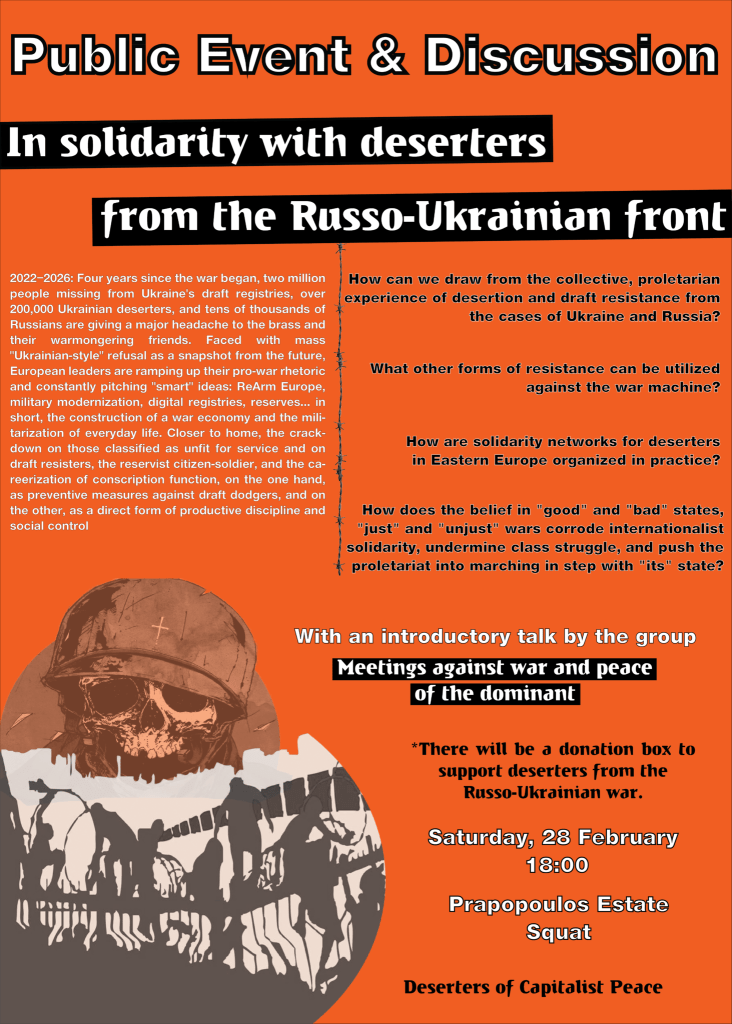
Our event, held together with Meetings against War and Peace of the Dominant, on political support for desertion and practical support for deserters from the Russo-Ukrainian front, took place in one of the few remaining occupied spaces that have managed to hold out against the Greek state’s repressive offensive. The turnout was strong and, overall, the event achieved its purpose. It created a space where part of the politicised anti-authoritarian milieu — those who refuse both the rival imperialist camps and the call to side with supposedly “wronged” states or national liberation struggles— could come together, and it showed that there is real interest in building a pole of war refusal from an internationalist perspective.

We would say that the event took on the character of a preparatory meeting, one that could lead to more practical steps and interventions in public space. On that same day, meanwhile, the bombing of Iran began and the war escalated further. So, the event was very much embedded in the conjuncture itself, and developments since then have moved quickly. Some anti-war calls have already started circulating. Whether our own perspective will also find a public expression — the perspective of a proletarian internationalist refusal of all wars, whether branded “defensive” or “offensive” — remains to be seen, and will be decided in practice.

The substance of the event came not only from the contributions of comrades from groups that support desertion, such as Antimilitaristická Iniciativa [AMI] and Assembly, but above all from the interview we conducted, with the support of Initiative de solidarité Olga TARATUTA, with a Russian deserter. [The contributions and the interview follow at the end.]

We think that focusing on the movement of desertion on the Russo-Ukrainian front, and trying to convey the lived experience of deserters themselves, helped anchor the discussion in a solid material reality. It allowed the discussion to begin from the real movement, from what the working class is actually doing today, instead of drifting into abstract references to the First World War, Lenin’s revolutionary defeatism, and other historical formulas. What concerned the more than sixty people who took part was how refusals of war preparation — and of the possible widening of the war — can be organised, taking support for desertion as a concrete starting point. Being prepared for what lies ahead seemed to be the key priority.

The discussion that followed showed that there is a willingness not to leave things at the level of a general anti-war stance. The question that emerged was whether, and on what basis, a more stable internationalist anti-war intervention can be built in the present conjuncture — one capable of linking the refusal of war preparation here with the real forms of proletarian refusal that are already emerging elsewhere.

Interview with a Russian deserter

At the event held on 28 February 2026 at the Prapopoulou Estate squat, we read out the answers of a Russian deserter to the questions we had sent him through comrades from the Olga Taratuta Initiative, and we are publishing them here. We should note that the questions in this interview are addressed to both Russian and Ukrainian deserters or draft resisters, even though, at this stage, the answers come from a Russian deserter.

[Deserters of Capitalist Peace]

1. At what stage did you desert? Before being officially called up, from a recruitment/training center or from the front? Had you completed your military service before the war? How long have you been away?

I deserted after I had already been sent to the war zone. For about six months I was at the front, working inside the headquarters — not in a trench every day, but still inside the military system, inside the war. I had already completed my compulsory military service before the full-scale invasion, so when the war started, I understood very well what the army is and how it functions. Those six months were the time when everything became clear to me. You see the reality from the inside — not the propaganda, not the television picture. You see how people are treated, how decisions are made, and what this war actually means for ordinary soldiers. From that moment I was just waiting for a real chance to leave. That chance came with my first official leave after half a year. It was the first time I could get out legally and without immediate suspicion. I used that moment to leave Russia and not come back. So, my desertion was not an impulsive act — it was a conscious decision that I carried with me for months while I was still inside the system. Since then, I have been away for more than a year. And for me this is not only about saving myself. It was a refusal to take part in a war that I do not believe in and did not want to support in any way. Leaving was the only way to stay honest with myself and to keep control over my own life.

2. What kind of work did you do before you left? Did the situation regarding jobs and wages change because of the war in your country? What is the situation like after four years of war?

Before the war I had a very typical working-class path, but at the same time I was trying to build something of my own. I worked in sales, I did construction jobs, I repaired washing machines, coffee machines and plastic windows — whatever allowed me to earn and stay independent. My last job before the war was actually my own small business. I was selling clothes through Instagram. It was not a big company, but it was something I created myself, from scratch. It gave me a feeling that my future depended on my own work and my own decisions, not on the state or on the army. After the war started, the situation with jobs changed dramatically. More and more of the economy became connected to the military sector. Defence production started to grow and, in many places, it became the only area where wages were increasing. In civilian industries the opposite was happening — salaries stopped growing, and in some cases even went down. And this was in a country where real income had already been stagnating for years. Now, after four years of war, we are looking at an economy that is deeply militarised. A huge number of people depend directly on military production for their survival. For many families this is the only available work. And this creates a very serious long-term problem. When the war ends, it will not be enough just to stop the fighting. Entire sectors will have to be reduced or transformed, and millions of workers may lose their jobs at the same time. These are people who will suddenly be left without income, without stability and without any clear perspective. So, the war destroys not only lives at the front. It also destroys normal economic life and the possibility for people to build something of their own — the way I was trying to do before everything collapsed.

3. What means were used for recruitment at the time you left? Were they digital or more “traditional”? In what ways can someone avoid being recruited? How do you hide?

First of all, it is important to understand that at the moment there is no open mass mobilisation in the same form as in 2022. But what we see instead is a constant and growing pressure on different groups of the population to sign military contracts. This pressure is especially strong on students. They are often given an artificial “choice”: either you sign a contract or you suddenly face serious problems with your studies — you can be expelled, you can lose your dormitory, you can lose your future profession. Formally it looks voluntary, but in reality, an entire infrastructure is being built where signing a contract becomes the only way to avoid conflict with the university, with your family, and with society. For a young person this psychological pressure is extremely powerful. Recruitment works through both traditional and digital means. On the streets you see posters, banners, leaflets — the visual presence of the war is everywhere. At the same time, online there is an enormous amount of targeted advertising and propaganda that presents military service as something prestigious, heroic and socially approved. So, people are not usually taken directly from the street — the system works in a more sophisticated way. It creates living conditions where refusing becomes risky and socially painful. In some cases, people are also afraid of fabricated criminal charges or administrative pressure, where they are told: prison or a contract. Even if this does not happen to everyone, the possibility itself creates fear and pushes people toward what is presented as the “safe” option. Because of this, there is no universal way to “hide”. Everything depends on a person’s individual situation — their education, their job, their family, their access to documents. For many people the main strategy is simply trying to stay outside of the structures where this pressure becomes direct. So, recruitment today is less about physical force and more about economic pressure, social control and propaganda. And this makes it in some ways even more effective, because it creates the illusion that the decision is voluntary.

4. What consequences do you face in everyday life and at work when you avoid recruitment?

In everyday life, avoiding recruitment does not always lead to immediate criminal punishment — at least not yet. The pressure is mostly social, economic and psychological. You can face disapproval from people around you. Someone may tell you that you are living a normal life while “real men” are at the front. This kind of moral pressure is very common and it affects families, workplaces and social circles. It creates a feeling that you constantly have to justify your decision simply to live a civilian life. The more serious problem is indirect pressure. If the war continues, the economic situation is increasingly structured in such a way that military service becomes one of the few stable sources of income. For many people the choice is not between war and peace — it is between signing a contract and not being able to support your family. So even without formal coercion, the system pushes people toward the army. At the moment, those who avoid signing contracts can still try to stay in civilian life. But there is a strong sense that this space is shrinking. Many people believe that the so-called “voluntary” recruitment resource is not unlimited, and that at some point the state may again move toward harsher forms of mobilisation. And this expectation itself already shapes everyday life. People live with the constant feeling that the rules can change at any moment — that what is technically allowed today may become punishable tomorrow. So, the main consequence is not only the risk of future repression. It is the atmosphere of uncertainty, social pressure and economic dependence, where remaining a civilian becomes more and more difficult and requires constant personal resistance.

5. Before the war, how did you think about the army and desertion? What pushed you to decide to leave?

Before the war my attitude toward the army and the government was already quite sceptical. In Russia every man has to serve one compulsory year when he turns eighteen. I did this service in full, and that experience shaped my view very strongly. I saw an institution that was not preparing people for real defence, not giving meaningful training, and not respecting soldiers’ time or dignity. For a whole year we were mostly doing useless routines that had nothing to do with actual military professionalism. It felt like a lost year of life. At the same time, I grew up in a political reality where nothing really changed. I was born when Putin was already in power, and he is still in power today. So, my distrust toward the state was not something that appeared suddenly in 2022 — it had been forming for many years. But before the war I never thought about desertion. Like many people, I saw it as something abstract, something that happens to someone else. When the invasion started, at first, I was still looking at it in a very rational and even technical way. From my previous experience I knew the real condition of the Russian army, and I did not believe in the image of a fast and easy victory. When I later found myself inside the system, at the front, it became absolutely clear how unprepared, disorganised and inefficient it was — despite all the resources. You see that the army cannot properly supply itself, cannot organise itself, and very often has no clear tactics except sending more and more people forward. And at that moment the question becomes not political but deeply personal: what is your role in this? My decision to leave was not made in one day. It was the result of everything I had seen before — my compulsory service, my distrust of the system, and then the direct experience of the war from the inside. Step by step I understood that staying meant becoming part of something I did not believe in and did not want to support in any way. Leaving was the only way to remain honest with myself.

6. If the war ends, do you think about returning? If yes, how do you feel about returning?

This is a question I think about a lot, and the honest answer is that it depends on many things. The most important condition would be a real political change and a full amnesty for all those who refused to participate in the war. Without that, returning would simply mean going to prison. But even if such changes happened, time is also a crucial factor. If it takes ten years, by that moment my life will already be built somewhere else. I will have a new language, new work, new social connections. Going back would not mean “coming home” — it would mean starting from zero once again. I have already had to rebuild my life once, and it is a very difficult process. I am not sure I would have the strength or the desire to do it again. There is also the question of trust. Russia is a very unpredictable country. Even if an amnesty is officially announced and the political situation changes, there is no guarantee that these decisions will be permanent or that they will actually be respected in practice. For someone in my position, this uncertainty is not theoretical — it is a direct personal risk. So emotionally, of course, the idea of returning home is important. Home is not just a place — it is your language, your memories, your past. But when I think about it in real, practical terms, I understand that most likely I will not have a safe and realistic opportunity to return. And this is one of the hardest consequences of this war — it takes away not only your present, but also your future and your connection to the place where you were born.

7. Beyond desertion, is there a collective anti-war movement that is active; in Russia or in Ukraine right now? If so, in which cities is it most present, and what are its main characteristics? Do you know whether women are organizing anti-war protests? What do they usually demand? Do they play a significant role in preventing basification, i.e. in the case of Ukraine?

At the very beginning of the war there was a visible and active anti-war movement in Russia. There were mass street protests in many cities — Moscow, Saint Petersburg and others — and a lot of public statements from activists, journalists and ordinary people. But the state reacted extremely quickly and very harshly. Thousands of people were detained, many received criminal charges, independent organisations were destroyed, and public anti-war activity became almost impossible. Because of this, the movement did not disappear — it changed its form and became much less visible. Today, open protest in the streets is practically suicidal from a legal point of view. A single public action can immediately lead to a criminal case and a long prison sentence. That is why most anti-war activity is now individual, local, anonymous or happening in exile. One of the most important and visible initiatives inside the country during the war was the movement of the wives and relatives of mobilised soldiers. These were not political activists in the classical sense — they were ordinary women who demanded rotation, proper training, equipment and the return of their husbands. Their protests showed how deep the social tension is. But even this very careful and limited form of protest was gradually suppressed and pushed out of the public space. So, women have played a significant role — not through large political organisations, but through these grassroots initiatives based on care, survival and the protection of their families. Today, if we speak about public anti-war structures inside Russia, they are extremely fragmented and forced to operate in conditions of fear and repression. The price of open opposition is prison, and everyone understands it. That is why the absence of mass protests does not mean support for the war. It means that the state has made open collective action almost impossible.

8. What problems do you face as a fugitive from Ukraine/Russia? Is there a solidarity network among fugitives where you are now? Or a network of locals who support refugees from Russia/Ukraine like yourself?

To be honest, the reality here turned out to be much better than what I had imagined when I was still planning my escape. Before leaving, I expected constant difficulties, hostility and isolation. But when I arrived, I discovered a huge amount of solidarity. I met many people who were ready to help, support and simply treat me as a human being. I have never faced open condemnation or aggression because of my story. The main challenges are not social — they are bureaucratic. Learning how the system works, how to communicate with institutions, how to deal with documents — all of this was difficult at the beginning, because it is very different from Russia. You feel that you have to rebuild your life from zero in a completely new environment. At the same time, there is a real network of solidarity. Among Russian refugees, among Ukrainians, and among local people, I constantly feel support. There is a shared understanding that this war is a tragedy for everyone, and a shared desire to help those who refused to participate in it. This creates a space where you don’t feel alone. The situation is more complicated for Ukrainian deserters. Not because of ordinary people — on the contrary, at the human level there is a lot of empathy — but because of the legal and political framework in many European countries. For them it is much harder to obtain protection, and many are forced to remain invisible and live in fear. This makes their position far more precarious. So, my main problem is not hostility — it is the long and difficult process of building a new life in exile. But what makes this possible is the solidarity I experience every day, from different sides and from very different people.

Statement from AMI for support for an anti-war event and fundraiser in Athens

In September 2022, some anarchists from Central Europe launched the Antimilitarist Initiative [AMI]. It all started with the publication of the text “Anarchist Antimilitarism and Myths about the War in Ukraine.”

Shortly after the publication of this text, an anonymous symbolic direct action took place, in which the Ukrainian embassy in Prague was splattered with red paint. A statement was released accompanying the action, which stated: “It is understandable that Putin and his supporters are criticized for the crimes they are committing against the people of the Ukrainian region. However, the role of Zelensky and the Ukrainian government in these massacres should not be forgotten. At a time when Putin’s army is bombing Ukrainian cities, Zelensky’s government is prohibiting men from leaving the country to seek safety. Under threat of punishment, they are being held in bombed-out areas, and some are being forced against their will to risk their lives on the front lines. Let’s be clear: Zelensky is just as much of an asshole as Putin! Both have the blood of civilians on their hands.”

AMI has never been a formal group or organization, but rather an informal network. We have the most supporters in the Czech Republic, Slovakia, Hungary, and Austria. From the beginning, we have been very critical of war propaganda, which serves to gain more supporters and resources for the Ukrainian state’s war policy. This pro-Ukrainian propaganda is dominant in the regions where we live, even in environments that formally profess anarchism or communism. This makes it difficult for AMI and other anti-militarist groups to organize public activities. Our actions are often sabotaged by “pro-war leftists” who essentially have the same agenda as EU states and NATO member sections.

We are now organizing practical support for deserters and war refugees from Russia and Ukraine. Activities are mainly organized non-public so that we can be more effective and do not have to defend ourselves against the aforementioned attacks. We collect and share money and material aid, and help with the transport and accommodation of refugees. We also publish articles and interviews with people who have fled war zones or actively sabotaged war.

In general, desertion is viewed with great ambivalence, especially in Central Europe. Part of the population theoretically supports deserters from the Russian army, but does not express solidarity with deserters from the Ukrainian army. This tendency is in line with the war policy of EU/NATO/US imperialism. Supporters of this line argue that supporting deserters from the Ukrainian army helps Russian imperialism. However, we argue that “one-sided” support for deserters and support for arming Ukraine contributes to the escalation of war and the spread of interstate conflicts into a global war.

Revolutionary defeatism, which means fighting against all states and all their armies, is now only advocated by militant minorities. However, we believe that the balance of power may soon change, as more and more proletarians on both sides of the war line are avoiding mobilization or deserting. These people often have no experience with self-organization, but it is undeniable that at this moment they are practically sabotaging the war efforts of “their” states. Revolutionary minorities must establish contact with them. In this way, currently isolated minorities can transform themselves into mass movements.

In general, it can also be said that most deserters only pass through countries such as the Czech Republic, Slovakia, or Hungary, or stay there for a very short time. These countries have very poor migration policies. Deserters therefore prefer to live in countries such as Austria, Germany, France, Switzerland, or Belgium, where it is easier to obtain asylum and legal protection from deportation or persecution by the Ukrainian and Russian authorities. Here, they can also apply for relatively large subsidies, accommodation, or generous material assistance from charitable organizations.

However, we see that state policy is trying to integrate refugees into the capitalist economy as cheap labor and domesticate them so that they do not express subversive tendencies. As an alternative, we are trying to create a strong solidarity network that encourages deserters and refugees to organize themselves in resistance.

If you would like to support our activities, please visit our website for more information and contact details. https://antimilitarismus.noblogs.org/

Report from Assembly at the Athens event in solidarity with deserters from the Russo-Ukrainian front, on 28/2/2024

There is already broad resistance to drafting in Ukraine, which we recently compared to the resistance to ICE in our article, “From Minneapolis to Ukraine, only street countering can stop the state-run hunt for people.”

The problem is that, as in the United States, it is not strong enough to change the overall situation. After the complete devastation of our revolutionary field by Stalinism, the tradition of mass street movements disappeared in Ukraine, except in support of some right-wing politicians (1991, 2004, 2014…). Rebuilding it from scratch takes a lot of time and has been underway for two years now, since the law tightening mobilization was adopted on April 11, 2024. However, this process is being delayed by extremely unfavorable conditions, including state brutality, economic ruin, and mass displacement. This is precisely why desertion has become the main form of resistance to the war. It does not require broad organization and is much less likely to lead to punishment than street action. One of the most famous war profiteers, Alina “Mercedes” Mykhailova, admitted a month ago that 20,000 of the 30,000 people mobilized each month are fleeing.

Why do others continue to serve? For the same reasons some civilians support the war: Stockholm syndrome (you may have seen this a lot among the anarchists), a naive belief in the promises of some career other than being an assault trooper, the everyday habit of obeying any authority… A simple example from the working class: a municipal worker’s salary is 12,000 hryvnias, a plant machine operator’s is 20,000, but a concrete pourer on fortification construction has from 60,000 to 100,000! Granting privileges to certain groups, of course, also hinders class solidarity. This does not even include the hundreds of thousands of state officials, law enforcement officers, etc., whose income thanks to the Western financial aid has become higher than ever. They also have family members…

However, since late 2025, we see a new trend: people against the war are moving from self-defense to counter-strike. Almost every day there are news reports of attacks with knifes, shotguns, or grenades against police or enlistment groups, mostly in rear regions like Odessa or West Ukraine. This is no longer like today’s United States, but rather like during the Vietnam War! Details will be in our upcoming article.

Finally, we want to raise awareness about the persecution and imprisonment of those who publicly express their opposition to the war. Some of these people have taken a written stand against the war, like Bogdan Syrotiuk. Others have taken action against conscription. For example, the prisoners in the “Proclamation Case” called on soldiers to unite in “soldiers’ committees” and collectively refuse to participate in military operations on the front lines. Criminal prosecution with heavy penalties is also being brought against civilians who engage in activist acts of resistance to the brutality of men being seized and sent to the front. One such case is that of Angela Gurina, who is facing five years in prison, which was to begin on December 9, 2024, on the false accusation of exposing military quarters, when in fact she was filming and posting a scene of busification. According to the verdict, her video, which has been viewed 8,600 times on TikTok, shows a military installation, the regional assembly point near the Military Law Enforcement Service in Chernivtsi. Depicting such installations on video is prohibited under martial law. The journalist was arrested in August 2024. Her lawyer insisted that she was filming not a military installation, but a potential human rights violation. The video was titled “Saving a guy.” Angela later deleted it. The lawyer also argued that the location of the object was publicly known and that it was neither a combat unit nor a military training facility. But the court disagreed, arguing that: “The applicant’s claim that the person did not intend to harm the internal and external security of Ukraine does not refute the commission of the alleged offense.” Although the trial established Gurina’s dual Romanian citizenship, there is no information about the Romanian government’s efforts to secure her release. Last year’s verdict also indicated that she suffered from mental health issues, including bipolar disorder. At the time of her conviction, the activist was 54 years old.
Reproduced from Tridni Valka – https://www.autistici.org/tridnivalka/report-from-the-solidarity-event-with-deserters-in-athens-on-28-february-2026-by-deserters-of-capitalist-peace/

Capitalist peace is the source of imperialist war!

Source in German: https://astendenz.wordpress.com/2025/10/20/der-kapitalistische-frieden-ist-die-quelle-des-imperialistischen-krieges/

In global capitalism, peace can only be an interwar period limited in space and time. There can be no such thing as “world peace” under capitalism. There are always conflicts somewhere. In times of peace, States prepare for war through military rearmament. And in times of war, military action is taken to secure the conditions for the next peace. In capitalist peace, proletarians are exploited — they produce more money for capital and the State than they themselves cost in wages. And in war, they must kill and die for “their” exploitative capitalist States. Capitalist peace is not an alternative to imperialist war, but its source.

Peace and war in the Ukraine

Between States and blocs of States, peace is the non-military form of competition for raw material sources, sales markets, and geopolitical spheres of influence. Above a certain intensity, this competition turns into war. Thus, the blocs of States of Western imperialism, the EU and NATO, continued to expand their influence against imperialist Russia through their expansion to the east. When Ukrainian President Yanukovych refused to sign the Association Agreement with the EU in 2013, partly due to pressure from Moscow, a social-reactionary movement formed on Maidan Square, which was supported by Western imperialism, with a pro-Western democratic wing and another ultra-nationalist neo-fascist. This social-reactionary movement overthrew Yanukovych in February 2014 and established a pro-Western regime, while Russian imperialism annexed Crimea in March 2014. In eastern Ukraine, pro-Russian “People’s Republics” seceded. A civil war has developed. The Ukraine was supported by Western imperialism, the “People’s Republics” by Russian imperialism. Thus, the civil war in the Ukraine was also an imperialist proxy war between Russia and NATO.

In February 2022, Russian imperialism directly attacked the Ukraine. Since then, NATO and the EU have been waging an indirect war against Moscow in the form of an increasingly intense economic war, as well as the financial, military, and intelligence consolidation of the pro-Western Ukrainian regime. The Ukraine and the collective West are using each other in this proxy war against Russia. The West as a whole is harming its imperialist rival Russia through the Ukraine. The Ukrainian regime is trying to stay in this bloody game thanks to military weapons supplied by the West.

Both Russian and Western imperialism are waging this proxy war at the expense of the world proletariat. At the beginning of the imperialist carnage, energy and food prices rose sharply worldwide. This was also a major burden for the proletariat in Germany. The DGB trade unions supported Germany’s economic war against Russia. Western imperialism’s “solidarity with Ukraine” goes against the wage earners of that country. If they work, they are subjected to harsh capitalist exploitation. In addition, they are being recruited massively by the Ukrainian State. They are expected to kill and die — for the interests of the Ukrainian capitalist regime and the geopolitical game of the collective West. For Ukrainian wage earners, their “own” State and NATO/EU are structural class enemies in the same way as Russian imperialism.

Russia is on the verge of winning the war militarily. US imperialism under Trump is very interested in ending this carnage through an imperialist peace negotiated with Moscow. But this would imply the Ukraine ceding territory to Russia. And Moscow is also demanding Ukraine’s military neutrality. Neither the Ukraine nor the EU/European NATO powers are willing to make major concessions to the Kremlin. And Russia does not really want to end the war yet either. And even the power of US imperialism is not enough to force both sides to make peace. Hence Washington is wavering between peace offers to Moscow and the continuation of the war.

For German imperialism, Russia is the number one enemy. It is arming itself against Russia and preparing its citizens for war. Balancing on the brink of nuclear war is the German State’s agenda. This is class war waged from above against the proletariat. The welfare States management of misery produced by capitalism is bound to deteriorate. Guns instead of butter. And perhaps soon it will also mean for German proletarians to kill and die in the interests of German imperialism. Initially in proxy wars, which greatly increase the danger of nuclear overkill.

World revolution instead of national pacifism

Pacifism often comes across as very nationalistic. While Germany’s ruling politicians are arming the State militarily and exporting lethal weapons to war zones (Ukraine, Israel), national pacifists want Germany to be a peaceful nation. In other words, a world where wolves tell sheep a nice bedtime story but don’t tear them apart. Okay, the ruling wolves do tell the ruled sheep wonderful bedtime stories, but they do so to lull them to sleep so they can devour them more easily. National pacifism is also a sleeping pill. It does not disarm the warring and armed States, but rather the class-conscious proletariat.

Pacifism demands that the States finally stop waging war against each other. They should only cooperate with each other. This demand contradicts the imperialist competition between States, which is carried out militarily in wars. Diplomacy, which pacifists hold up as an alleged alternative to war, is nothing but a special weapon of competition between States. It is based on the economic and military strength of States. It is a special way of imperialist interest enforcement. If States can impose their interests diplomatically and peacefully, so much the better. If not, and if the ruling politicians believe that they can and must wage war for these interests, then they will do so. Diplomacy prepares for war in peacetime and for peace in wartime.

Pacifism demands the States to disarm. But they will not do so now, at a time when the capitalist crisis is intensifying and inter-imperialist competition is escalating. There can only be one realistic form of disarmament: the world revolutionary destruction of all States!

World revolution? Is that realistic?! Well, there is still the possibility that the global class struggle will radicalize in extreme exceptional situations and lead to a planetary social revolution. On the other hand, how realistic is it that States will stop waging war against each other and significantly disarm militarily?

Class struggle against rearmament and arms exports

In Germany, too, proletarian class struggle against rearmament, arms exports, and preparations for war is absolutely necessary. The most effective form of class struggle is the strike. However, strikes against rearmament and arms exports are prohibited in Germany. In this country, “political strikes” are considered illegal. Only strikes organized by trade unions with negotiable goals — such as higher wages and shorter working hours — are legal. The vast majority of trade unions support the rearmament and war course of German imperialism. They are deeply integrated into the German State. Strikes against German imperialism can only be wildcat strikes and organized independently from the unions. We would have nothing against such strikes taking place.

English translation: The Friends of the Class War

https://www.autistici.org/tridnivalka/ast-capitalist-peace-is-the-source-of-imperialist-war/

Minneapolis Murder – Cops ICE Good.

Renee Nicole Good’s State murder by US Immigration, Customs and Enforcement (ICE), and its slanderous cover up, show what they would really like to do to if they could get away with it. In fact, what they would do in any case if push came to shove.

In Minneapolis, the city of the George Floyd’s police murder in 2020 during Trumps first presidency, in the resistance to the assault on migrant workers, push has again become shove.

According to the Guardian newspaper (04/01/26), ICE is responsible for 32 deaths in custody in the last year. Another dozen also estimated being killed since they were sent to occupy the heartlands of what Trump perceives his opposition. 

These primarily being the liberal opposition centres of democrat held governorships and mayoralties such as Los Angeles, New York, Chicago and of course in Minneapolis.

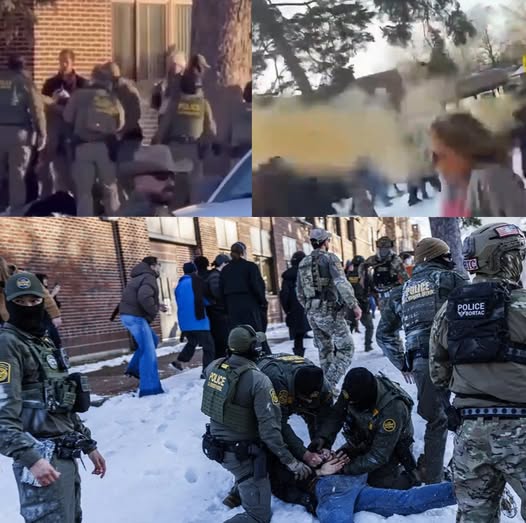
ICE, uniformed, masked, without numbers or other ID resemble Putin’s ‘little green men’ from the occupation of Crimea.  They silently occupy, block, snatch and bring fear.

This is their job, yet these goons of the state have the nerve to claim they were being ‘stalked’ by legal witness Renee Good whilst on intimidation duty.

She had just witnessed them repeatedly pulling to the ground and spraying pepper spray into the faces of a peaceful picket of residents and neighbours protesting the occupation.

4 armed masked men allege ‘fear for their lives’ as they surrounded Renee’s car stuck in the ice before shooting unarmed 37-year-old mother of 3 at point blank range. 

Collapsing at the wheel, her car is seen sliding forward and crashing into another a few yards away as stunned onlookers try to intervene.  Despite ICE agents dragging her out into the snow, their cars prevented access for ambulances for a further 15 minutes.

Renee Good is accused of ‘domestic terrorism’ ostensibly for blocking the road in her attempts to monitor ICE brutality, though in reality for inconveniently dying in plain sight.

Her murder coincides with the closure of a city school after ICE goons went in using force and chemical sprays to disperse high school students at the end of the school day according to local news outlet MPS News.

A school official is quoted as saying: “They don’t care. They’re just animals…I’ve never seen people behave like this.”   The state has both motive and capacity to be violent anywhere, everywhere all at once.

This is less a sign of the times than the times themselves as capitalism unravels in a social decomposition as a result of austerity and its relentless drive to generalised war for profit. 

Peace and War are increasingly indistinguishable as the latter offers annihilation, while the former is a bloody occupation driving us towards it. 

Resistance to the occupation is growing at this time of writing.  All resistance to the state and capitalism at war or peace is more urgent now than ever before.

Article by Dreyfus

Outputs and outcomes of the last several months. New Year’s summary of the social war in Ukraine 2025

Author – assembly.org.ua The following is from our comradesin Ukraine “Assembly”.

The development and continuation of our media depends solely on its audience. Please support our work on this fundraising page to continue enjoying materials like this one. Many thanks to the Olga Taratuta Solidarity Initiative and everyone else involved!

Already the fifth and largest conflict with the territorial recruitment centers (TRCs) in Odessa for the week happened in the early hours of October 30 at the “7th Kilometer” industrial market. A crowd of warehouse workers overturned their bus, broke its windows, and physically injured an enlistment group, forcing them out of the market. The regional TRC also claimed that protesters used batons and pepper spray. According to the market’s deputy director, Irina Tkach, their entrepreneurs and staff were not among these loaders. An asphalt plant, supermarkets, and post branches are also located nearby. There are more people working there than at the market. The Security Service of Ukraine has opened a criminal case on obstructing mobilization activities; the defendants face 5 to 15 years in prison. It could have been the most militant labor protest in Ukraine since Independence Day 1998, when striking coal miners clashed with riot police in front of the Lugansk Regional State Administration.

And two months have passed since then. There’s still no word of any repression in this case, though an investigation is ongoing. It seems the state Moloch still fears the united working masses. Things are much more difficult for those who risk fighting a gang of torturers alone.

The entire country was discussing how, on the evening of December 3 in Lviv, 30-year-old Hryhoriy Kedruk fatally stabbed 37-year-old district TRC employee Yuriy Bondarenko. Bondarenko died by morning from a critical femoral artery injury. The suspect fled and was soon apprehended, with the knife seized at the scene. Hryhoriy admitted that the knife belonged to him and said that he “apparently” dealt the blow when he was being beaten by three or four servicemen. He is originally from the Rivne region, lived in Kharkov for a time and is registered there, then moved to Lviv. He claims to be unemployed and has an IT education. On December 5, the Frankivsk District Court sent him to 60 days in custody without bail. He faces up to 12 years in prison for two counts of intentional infliction of grievous bodily harm. The killed Bondarenko was also born in Kharkov and graduated from the Kharkov Zooveterinary Academy. He worked in the restaurant business and moved to Lviv before the full-scale Russian invasion. He transferred to the bounty hunters in June 2025, allegedly due to serious health issues.


The scene of the kidnapper’s murder. Photos from the Lviv Regional Prosecutor’s Office

On October 20, enlistment team raided the premises of some private enterprise in Kamenskoye (Kamianske). Security guards forced them to leave, but the workers pursued the visitors outside the gates after word got out that TRC had grabbed one of their colleagues. During the conflict, one TRC representative threatened them with a pistol, while another pepper sprayed into the eyes of an employee filming the incident. This is at least the second such incident after Kovel in Volyn.

Two days earlier, on October 18, near a supermarket in the city of Dnieper (Dnipro), police and TRC employees allegedly located a citizen wanted for violating military registration rules. He refused to go with them. Passersby came to his aid and attempted to free the man, striking the military servicemen several times and damaging the service vehicle. However, they were unable to free the kidnapped one.

On the other side of the country, in Ternopil, on the evening of October 13, TRC employees blocked the car of Sergiy Zadorozhnyi, head coach of the local football club Nyva, near a shopping mall. This also led to a mass brawl with civilians. Zadorozhnyi, who had a reservation, later left, but the clash continued amid chants of “Shame!” in the crowd. Police stated that no one contacted them or medical facilities with bodily injuries.

On October 17, around midday, on a road near the village of Plebanivka near Ternopil, two people in a Mercedes Benz G-Class reportedly cut off a TRC vehicle, took a mobilized one who was being transported to a training center, and fled the scene. One of the enlistment agents sustained a leg injury due to hit by a car. Police detained the suspects later that day, according to the regional TRC.


Flames on the central street of Ukraine’s capital: on October 23, tires were set on fire in front of the Kiev City State Administration building. Police detained a local resident born in 1977. From social media


Mobilization bus smashing in Odessa. From social media

Also on October 30, a court in Odessa found guilty an unemployed resident who, on June 12 of this year, used tear gas against a TRC employee and wounded him in the chest with a knife. He was sentenced to five years in prison with two years of probation. The leniency of the sentence was influenced by sincere repentance, a full admission of guilt, the presence of a minor child in his care, and the transfer of 250,000 hryvnias to the Armed Forces of Ukraine.

The same day, in the region of Poltava, police escorted a man kidnapped from the street to the Kremenchuk District TRC’s assembly point. During the paperwork and search, in response to a cop’s question about the presence of prohibited items or substances, he pulled out a pistol and fired several shots. As a result, two TRC representatives were injured in the legs by bullets. The shooter was detained.


Teenage blockade in Poltava. From social media

On the evening of November 16, a 37-year-old resident of a village in the Sambir district of the Lviv region violated traffic rules while driving an Alfa Romeo. During talk to the police near the car, the driver took out a grenade and detonated it. He received injuries and was taken to the hospital. Local media call him a runaway military man.

On November 24, the cops captured a driver on Pirogovskaya Street of Odessa. A crowd of passersby attempted to block the road and the police car, but the man was eventually taken away in handcuffs. The reason for the detention was not disclosed. The next day, a crowd of youth from the 23rd High Professional School in Poltava blocked a police car with two detained men. One allegedly managed to get out, the second was taken away. There were no official comments on the situation.

From the latest news: on December 24, in the Rivne region, a employee of the Sarny District TRC was beaten with a crowbar by a passerby from a group that was trying prevent the kidnapping of a person from the street. He is in serious condition with a broken rib and contusions of the parenchyma of both lungs. On December 25, in the city of Dnieper, a man stabbed two members of a TRC patrol. The suspect, 42-year-old, was detained, and the knife was seized at the scene. On December 28, a suspect in a penetrating stab wound to a TRC employee in early November was identified and detained in the city of Odessa.

On the other side of the Ukrainian South, annexed by Russia since 2022, there is no forced mobilization from the streets. On November 17, about 20 employees gathered in Melitopol near the Russian prosecutor’s office of the Zaporozhye region. Since they work at the Voinikov & Co agricultural enterprise in Berdyansk, they demanded an end to its seizure and payment of wage arrears. Two months ago, on September 25, the company’s territory was seized by representatives of Partner Union LLC. Since that time, salaries have not been paid, and shareholders have not collected rent for the land.


Rally near the prosecutor’s office. From the relocated Ukrainian administration of Berdiansk


Residents of occupied Mariupol and Berdyansk, who were working on construction at a water pumping station, recorded a video message to the chairman of the Investigative Committee of Russia, complaining that they have not been paid their wages for half a year. They claim several dozen people have been affected. “In response to our legitimate demands to pay our wages, Stanislav Vinnitsky threatened physical violence.” At the end of December, the addressee of their statement Alexander Bastrykin demanded from the head of the regional investigative department to report on the investigation

The wave of protests against the rising cost of living, sweeping across the globe for years, has also finally reached our Slobozhanshchina, divided between Ukraine and Russia:

On December 8, displaced persons from border areas gathered for a spontaneous rally outside the Sudzha District Administration building in Kursk. According to activist Vladimir Sinelnikov, 150–200 people arrived, and district chairman Alexei Spiridonov came out to them. The rally was prompted by the governor’s announcement the previous day that monthly payments of 65,000 rubles to people who lost their property due to the Ukrainian invasion will be cancelled starting in January. He claimed the Russian government had decided to reallocate the funds to other needs in order to “give a new boost to the region’s economy.” The protesters brought written appeals from initiative groups to the federal and regional leadership, declaring, “We are being strangled by debt. We are forced to pay mortgages and loans for houses that practically don’t exist, while simultaneously paying our last rent on other people’s apartments.”

With the October 25 (or November 7 according to the new style) approaching, we spoke with another Kharkov resident nicknamed as Red October, who fled from the 122nd Airmobile Battalion of the 81st Airmobile Brigade. “My nickname is more of a reference to my birthday and red leaves. But if someone associates it with the great victory of all workers, that’s also not bad,” he explains. Regarding the state’s countering the avalanche of desertions, the interlocutor tells:

“I went into SZCh [unauthorized leaving of a unit] through the hospital, I had hypertension, they took my blood pressure and took me to the medical unit in Kramatorsk, and from there I took the train home. I’m not hiding, I roam freely around the area. My brigade has so many SZCh that they haven’t even opened a [criminal] case against me. Doesn’t the SBI [State Bureau of Investigation] have any other work? There are already half a million like me. When I first joined the army, no one even knew what is SZCh. Even if it’s not half a million, but 250 thousand, that’s still a lot. No SBI could handle that many cases. Plus, in the units, SZCh cases are handled by ordinary soldiers, usually those who refused [to fight] or wounded. And when they hand over all the cases to the SBI, almost all of them are filled with mistakes, and the SBI returns them to the unit, while the soldiers who handled them have already been transferred, and other soldiers are doing the same. A Sisyphean task. I was mobilized in the summer of 2023, and in the summer of 2024, I went into SZCh, primarily because they wouldn’t give me leave. A month before my SZCh, a guy who had been fighting from the very beginning went out and ran away from training to become an FPV drone operator. They didn’t catch him. Incidentally, I was also an FPV operator. My buddy, who lives in Ternopil, even went over the mountains to Romania after SZCh. I gave the army a chance, a whole year, went to combat [missions], did everything conscientiously, and put up with all the injustice, and now I believe such an army shouldn’t exist.”

Overall, the fugitive drone operator is skeptical about the state’s ability to stop this flow. He continues basing on the own experience:

“I don’t quite understand how drones can be used for these purposes [to combat soldiers’ flee]. And how can they help if the person has already left the front line and is moving away from the front? We don’t have enough drones to properly carry out combat missions. A drone can spot someone fleeing their position. But there’s a problem: that person is holding an automatic rifle, four magazines, and at least a couple of grenades. If they don’t have all that, then there’s no point in bringing them back. But from what I’ve seen, people who abandon the front line aren’t afraid of anything anymore. Personally, when I refused to serve as an infantryman a second time, I said no one would force me to go back; they could shoot me right away, so why bother? And after that, they transferred me to drone operators. There were hundreds of people like me in the battalion; they didn’t leave right after their first combat missions, and command is trying to persuade them to take up other roles, like mortar, driver, mounted anti-tank grenade launcher, or drones, or, at worst, they transfer them.”

As he added us some later:

“At the training ground is worse than in the TRC, only if you resist learning with the horns, and when it comes to shooting, all the instructors become like silk. As far as I understand, dying in training isn’t considered heroic, and there won’t be any payment.”

October 2025 set a new record for unauthorized leaving a military unit and desertion: 21,602 such cases officially, compared to 17,000-18,000 per month during the summer and with around 30,000 mobilized personnel per month. And no one knows yet how many others left their bank cards for their commanders so they could receive money for them and not report them missing. That means, in the time it takes you to send a donation to the Assembly, several more people could have shed their uniforms bearing the fork-shaped slave brand. Since November, statistics on SZCh, desertion, and other crimes against the rules of military service have been classified by the Office of the Prosecutor General. And all this despite the fact that the Armed Forces’ training centers are now like a prison: swarming with sentries, guards with night vision goggles, drones with thermal imagers, ditches, rapid response teams, and so on. Even from a temporary deployment point or a combat line, it can be easier to escape. This was reported to us, in particular, by Irina from Kharkov, whose husband was captured while attempting to go through the mountains to Romania and ended up at the 233rd Combined Arms Training Grounds near Rivne — the same place where, in early summer, 27-year-old Andriy Rybak from Khmelnytsky was beaten to death, according to his parents, for attempted escape.

On December 25, the Ukrainian media was shocked by a video filmed by Russian soldiers in the captured battalion command post of the 106th Territorial Defense Brigade in Huliaipole, Nestor Makhno’s homeland in the Zaporozhye region. The reasons for this were explained yesterday by journalist and military veteran Volodymyr Boiko on his social media: “The territorial defense battalions are probably the most exhausted and war-torn units of the Ukrainian Armed Forces. But their combat capability primarily determines how far the enemy will advance deep into Ukraine. Because only the infantry holds the territory. And that is why the combat losses of the Territorial Defense, the Territorial Defense staffing on a residual basis, and mass desertion of the infantry are three components of Ukraine’s defeat in the war with Russia. […] There was simply no one to defend [that battalion command post]. And a few hours later, 71 servicemen from the 102nd Brigade also deserted: 45 from Sofiyevka and 26 from Huliaipole. Two days later, another 23 servicemen “went on skis”. The reason is no secret: the 102nd Brigade has long been “erased” and with such a shortage of personnel is unable to carry out combat missions. A week before the mass desertion, it was decided to finally withdraw this brigade from the combat zone to restore combat readiness — to give people a rest and at least some replenishment. But due to the catastrophic situation at the front, a new order was received before December 18: no rest, everyone was sent back to their positions. When the fighters found out about this, they simply got in their cars and drove home.”

Along with this, we discovered a real concentration camp for recruits this month near the village of Malinovka of the Kharkov region: the former Figurovka recreation base. According to a Kharkov stormtrooper who fled to Romania after fighting since 2015 and a 2-year prison term in 2023 for SZCh, there is no other training ground like it — it’s hell on earth, where the guards kill those who tries to run away. He claims there are graves in the forest of those who tried unsuccessfully to escape.

Another guy from Kharkov, named Sergei, was shot in a leg with rubber bullets at the end of summer during a clash with border guards while being detained right near the border line with Romania. “My brother was grabbed by 5 people right at the gas station and dragged to the TRC. And now he’s been in the hospital for a year now, they’re collecting into a whole. His legs were severely torn up; he fought in Kursk last year, and has been in Germany since the summer for rehabilitation. So I knew exactly what awaited me. I won’t give up. And I’ll be free,” he told us on October 16, adding that he had escaped from the training center in the Lviv region a week earlier and was packing his backpack for another trip to Romania using recommendations from our site. He received temporary protection there a month ago. On December 4, Sergei told us that he met his son in Germany that day and was applying for new protection.


Sergei’s bullet wounds. Received from him

And his new mountain expedition, crowned with success. Also sent by him

Another amazing story of coming out was shared with us by Mikhail from Gorlovka. In 2012, he was close to anarchism, attended the May Day demonstrations of the Revolutionary Confederation of Anarcho-Syndicalists (RCAS) in Donetsk, and helped distribute their leaflets in his city, without being a member himself. In 2014, he left for Odessa, where he lived and worked as an IT specialist for all those years. That summer, a Shahed drone hit the building where he lived, damaging it and killing several residents. He moved to another apartment, and soon after, he was busified on the street. At the TRC, Mikhail demanded a medical examination, but they simply wrote that he was healthy and fit for service. He was taken to a village in the region of Nikolaev where such recruits are held. But they were not heavily guarded there, so he was able to escape, and then was smuggled out by a man for 4,000 euros. The same man, for 10,000 euros, brought Mikhail to the Transcarpathian region, from where our reader crossed the border and ended up in Slovakia. “There’s a special story about how this escape was organized. I called my parents, who live in Gorlovka. (My father was mobilized in 2022 and served in the DPR units for over a year, then was discharged due to his age. Incidentally, he also served in the Kharkov region.) But he wouldn’t have been discharged if not for my mother’s active spam (a school teacher—a profession that involves regular brainwashing) to various agencies with complaints and calls to officials. My parents contacted their friends living in France, and they, through their connections, found this man. The man himself served in the Ukrainian Armed Forces, and after being discharged, he went into this business. I rented a place from my online acquaintance who’s currently working in Saudi Arabia. He’s a chemist by education. By the way, this acquaintance is a Jucheist in his views. He was educated in Moscow. He’s a Ukrainian from Moldova.” Thus, after escaping, Mikhail lives in Moldova. You can read more details from him at the link in Russian.


Our anarchist readers from the EU countries recently launched a volunteer project Solidarity is the Way to support those who successfully came out in Romania. Those in need are offered free food, clothing, medicine, transportation, temporary accommodation, and legal advice. Two magpies helping each other build nests, according to the author, symbolize this mutual aid

Generally, our native Kharkov is becoming a center of individual terror, like Odessa and Bialystok in the revolutionary 1905. That summer, one of the Novobavarsky District TRC clients burned down their building from the inside, while another one stabbed at once four mobilizers on the street. On the morning of October 24, another young man from Kharkov committed an explosive mass murder in Ovruch of the Zhytomyr region while trying to reach Belarus. In fact, such acts change nothing and after a few days everyone forgets about them.

The local anti-mobilization riots that took place this year also led to nothing even where they broke out. And even in feet voting against the war, people have to rely more on themselves and their closest friends than on relevant activists. On December 9, YouTube deleted the approximately 140,000-subscriber “Alex 18-60” channel, which featured border-crossing video stories from members of the UFM Telegram group, helping so many of His Green Majesty’s subjects not to die for his eternal reign. The admins are currently developing a new channel. All videos are in reserve.

On the other side of the front, the human rights project “Go by the Forest,” which helped Russians avoid war, has not seen a rapid increase in activity in the army for a long time. According to their Telegram channel, while the number of deserters seeking assistance increased tenfold from January 2023 to January 2024 (they helped a total of 2,086 such people), from the project’s inception until December 1, 2025, they provided assistance to 2,652 deserters. In percentage terms, the growth has also almost stopped: deserters accounted for 8.8% of requests in 2023, 19% in 2024, and 22% in June 2025. This is just a drop in the ocean of tens of thousands of runaway Russian military personnel — most prefer not to engage with this organization. Perhaps due to its maximally one-sided anti-war stance: it completely ignores the existence of draft dodgers and deserters in Ukraine, as well as the criminal nature of the border guard service and territorial recruitment centers, while proudly declaring its cooperation with outright bullhorns of Western special services like Radio Liberty or The Insider. It would seem like an ideal opportunity for Russian anarchists to supplant liberals in the anti-militarist arena. However we know nothing about any of their activities on decaying the army from within.

Additionally, in the fall, Ukrainian underground author Elvenor Hoxley released his song Fragging with the following words: “I know one formula, it came to us from Vietnam – I’ll throw a grenade quickly, no one will have time to call mum!” Our news outlet also presented No Escape — the online map of border detentions for planning of safe routes by refugees — in a form of the interview with its developer Dima Photographer.

At this point, our autumn forecast of the worst-case scenario for Ukraine is being confirmed: some heavy military fail opens the way to some kind of compromise, just as the severe military defeats in Donbass of 2014 and 2015 paved the way for the previous peace agreements in Minsk. To ensure that a new ceasefire does not lead to the preservation and strengthening of the Maidan-born right-wing regime, it is necessary to revive the historical memory of the working class about the revolutionary anti-war legacy of 1917, as well as to elaborate its horizontal cooperation, both when it comes to social protests against the hunting down of men by the state on the streets and in leaving of the fenced prison called a “country of freedom and democracy.”

What can we wish for our free-thinking readers in 2025? All the same as last year and the year before. At the very least, please continue to stay with the Assembly. (We do not even ask Ukrainian bank card holders for money; it’s better to spend it on food, just visit our website from time to time. While financial support from the foreign public is vital for us, especially considering that Ukraine, even if the war ends, will try to the last possible moment not to lift the ban on men leaving the country.) For those planning to leave warring countries, we wish you success and to settle in your new place. For those who do not want to leave Ukraine or Russia, we wish you as little contact with the state gang as possible and the opportunity to become as self-sufficient as possible, up to creating autonomous settlements in the rural hinterlands. And, of course, help people and animals in need, stay healthy, develop yourself, and study anarchist communism. Perhaps this will come in handy sooner than you think.

Response to the pro-war left’s “petition”

A statement in support of Solidarity Collectives and ABC-Belarus has been published on the internet,
signed by a number of groups and individuals. https://www.solidaritycollectives.org/en/on-silencingvoices-from-eastern-europe-at-anarchist-events-in-eu/
We are publishing our response, which is not, however, a dialogue with these open and covert
supporters of militarism. We simply want to share our analysis publicly and strengthen the connection
between people with an anti-militarist and revolutionary defeatist perspective.

Compressed by jpeg-recompress

The statement to which we are responding was written by supporters of the war, who reproduce a binary narrative for this purpose: empathetic and supportive Eastern European anarchists versus arrogant and unsupportive anarchists from Western Europe. This narrative is false and manipulative. Those who share this narrative refuse to acknowledge that criticism of pro-war projects such as Solidarity Collectives and ABC (Belarus) also exists within the anarchist milieu in Eastern Europe. The signatories of the statement ignore this anti-militarist tendency in their narrative or lie when they claim that these are Putinists or pro-Russian propagandists. They repeatedly claim that the “Eastern European voice” is overlooked in Western Europe, while they themselves overlook anti-militarist and anti-war voices from Eastern European regions. It should be added that these overlooked voices also come from a relatively large number of people directly from the war zone. By this we mean not only anarchist collectives, but also other working-class people who refuse to support the war efforts of “their” and neighboring states. Let’s look at how many people have deserted from the Russian and Ukrainian armies and how many people in both countries are avoiding mobilization(1). Hundreds of thousands of people are ignored by this “radical left” that tells us it represents the voices of Eastern Europe and fights against the arrogance of the West. Their binary narrative is hypocritical. The contradiction is not between anarchists from the West and those from the East. There is only a contradiction between the revolutionary and counterrevolutionary tendencies, which exist in all regions.

We quote from their statement: “They are writing various kinds of “statements” condemning work in support of Ukrainian resistance to the Russian invasion.”

We respond: We do not condemn resistance to the Russian invasion. We are not even opposed to armed struggle, as long as it does not replicate militaristic logic and is directed against states and their armies. However, we reject the strategy of conventional warfare and militaristic forms of struggle. From an anarchist perspective, resistance to the aggressive policies of one state (e.g., Russia) should not be a practical service in the defense of another state (e.g., Ukraine). We support autonomous resistance against Putinism and Russian imperialism, but also against the Zelensky regime and EU/NATO imperialism. This is anarchist resistance against war.

We quote from their statement: “We believe in the need for dialogue on controversial issues.”

We respond: They have long presented themselves as “experts in monologue”, but suddenly they pretend to be interested in dialogue. This is not at all convincing. People who deliberately avoid face-to-face dialogue, slander anarchists(2), engage in dangerous doxxing(3), and are verbally and physically aggressive(4) are collaborating on these projects. Some signatories also pressure other groups to prevent anti-militarists from attending anarchist events(5) or directly participate in sabotaging anti-militarist activities(6). We believe that the call for dialogue is a manipulative political calculation in this context. They want to gain spaces in which they will receive money and resources for soldiers. We believe that they do not want to listen to criticism from their opponents and discuss controversial issues. Anarchists have repeatedly expressed critical analysis of their militaristic and pro-war tendencies in the past. There has been no self-reflection or acknowledgment of mistakes. So why insist on dialogue with them? It cannot be a constructive process.

We quote from their statement: “We do not consider the work of the “Solidarity Collectives” and “ABC-Belarus” to be in any way pro-war or supportive of state militarism.”

We respond: Both of these groups provide propaganda, financial, and material support to the soldiers of the Ukrainian army, which is at war with Russia. Why do the signatories of this statement refuse to acknowledge that the Ukrainian army and its soldiers are the embodiment of state militarism? There is no structure more militaristic than a state army. Why do these people refuse to acknowledge that they are defending a pro-war position when they support soldiers of the state army involved in the war? Is it insincerity, political manipulation, or do they fail to understand the basic context? They claim to be against militarism, but when soldiers desert the Ukrainian army or men in Ukraine are forcibly mobilized, they do not show practical solidarity with these people. They object to Russia’s militarism, but the militarism of Ukraine/NATO/EU is their main ally. We refuse to cooperate with them because they advocate cooperation with Western imperialism in its war against Russian imperialism. However, we also do not cooperate with those who cooperate with Russian imperialism, because this is not a constructive strategy that the working class could effectively use against American and European imperialism. We reject all one-sided anti-imperialism. We fight against all imperialist states and blocs.

The list of names and titles under the declaration is very long, but that does not mean it is significant. Socially revolutionary groups do not evaluate the quality of practice by quantitative measures. The number of signatures under a manipulative and deceitful statement does not make it a valuable document. Not even the biggest sum of socially reactionary and pro-war groups can never give rise to revolutionary anarchist practice.

The list of signatories to the aforementioned statement includes quite a few liars, manipulators, aggressors, collaborators with the far right(7), as well as dangerous doxxers and nationalists(8). Groups such as Solidarity Collectives and ABC – Belarus discredit themselves by publicly declaring that they maintain contact with these controversial individuals. If they express concern that anarchists do not want to cooperate with them, this is actually a positive sign. While left-wing supporters of militarism are losing support, the revolutionary anarchist tendency is gaining the necessary energy.

– Some anarchists from Central Europe, Eastern Europe, and the Balkans

anarchist_voices@riseup.net

We in the AnarCom Network fully support this statement and call on other internationalists to also support it.

Report from a discussion on the situation of deserters, refugees and practical solidarity

From an article by AMI – https://antimilitarismus.noblogs.org/post/2025/11/23/report-from-a-discussion-on-the-situation-of-deserters-and-practical-solidarity/

What is the situation of proletarians who are listed in official documents as men and Ukrainian citizens? Generally speaking, they are under attack from several different sides. On the one hand, there is the deadly invasion of Ukraine by the Russian army. On the other, they are forcibly mobilized by the Ukrainian army and sent to the front, from where they return traumatized, maimed, or dead. Those who evade mobilization or desert are tortured, persecuted, and stigmatized. Many have also died trying to illegally cross the Ukrainian border, which the Ukrainian regime keeps tightly closed. Ladyslav was lucky to survive. He fled Ukraine through the Romanian mountains. His situation has improved, but new threats and attacks continue to emerge. Zelensky’s government is pushing through repressive laws that will target deserters and opponents of mobilization living in European Union countries. “The regime aims to bring back as many cannon fodder as possible from the EU and will do absolutely everything to achieve this goal,” says Vladyslav. In October 2025, we met with him in an Austrian city to hear about the problems deserters face, and we discussed how to defend against them.

Before we even started the interview, it turned out that sometimes the train journey itself can be a problem, even if you buy a ticket. Vladyslav’s journey became increasingly complicated, and the day before the event, he even had to spend the night in a completely different city than planned. However, Vladyslav reacted to the long series of complications with complete calm: “I almost died when I ran for eight days through the Romanian mountains in winter to escape the army and the war. Since then, nothing has fazed me.” In other situations, too, our guest proved to be truly hardened by life experience. He didn’t stress about things that would stress others and calmly accepted organizational complications that left our crew feeling less than calm.

Upon arrival, Vladyslav first spoke to our circle of friends about why he fled and what reactions he encountered from the police, army, doctors, and border guards. The horror was illustrated by photos showing the injuries he had suffered.

Then the conversation turned to four main topics:

  • First, what repressive methods the Ukrainian state uses to combat desertion and force people to go to the front.
  • Second, how it is possible to avoid forced mobilization or flee to one of the countries of the European Union.
  • Third, what is the status of refugee men in European Union countries?
  • Fourth, what needs to be changed so that refugees who are already in the EU can obtain the best possible status that will “guarantee” that they will not be persecuted or sent back to Ukraine, either during or after the war?

In the ensuing discussion, most attention was paid to the fourth topic. Vladyslav repeatedly mentioned that EU authorities refuse to grant asylum to deserters and other male refugees from Ukraine. They are only automatically granted temporary residence permits. This is disadvantageous for them not only in terms of what they are (not) entitled to in the host country. The problem is also that without asylum status, refugees are at greater risk of being sent back to Ukraine, official harassment, persecution, or criminal prosecution. There was agreement in the discussion that it is first necessary to map the situation and gather relevant information, which will then be published in various languages. Subsequently, it will be possible to organize activities that will put pressure on the relevant institutions to improve the situation of refugees. Specifically, this should mean, for example, ensuring that individuals do not have to prove individually when applying for asylum that they are in mortal danger from the Ukrainian state and its army. Every deserter or man fleeing mobilization is, by definition, in such a dangerous position. This conclusion can be made at a general level, without exception. Our partial goal is to get officials to accept this and automatically grant asylum status to every such person, with appropriate protection from threats from the Ukrainian state, army, courts, etc. However, we are under no illusions: We know that self-defense must primarily come from autonomous structures and activities organized by the working class outside the state and in opposition to states.

We are now continuing the discussion on how to achieve the above and are already taking practical steps. In addition, we also want to develop other related topics from the following list in the future:

  • 1. Documentary and legal support for deserters and refugees

– How to collect and verify documents confirming a person’s identity and status in order to protect them from forced mobilization.

– Practical advice on using EU laws on the protection of refugees and internally displaced persons.

– Support in submitting requests to archives, obtaining birth certificates, death certificates, and citizenship documents.

  • 2. OSINT and information security for deserters and refugees

– How to safely collect and store information about repressive measures taken by the state without the risk of exposure.

– Methods of digital anonymity, minimizing surveillance by special services.

– Tools for verifying the reliability of sources of information about military operations and mobilization.

  • 3. Practical protection and escape logistics

– Advice on safe border crossing, orientation, hiding places, and risk minimization.

– The role of small communities and solidarity networks in supporting people hiding from mobilization.

– Safe transport of pets and psychological support during escape.

  • 4. Studying documentation on war and repression.

– How to analyze and document cases of human rights violations and war crimes.

– Creating archives and files that can be used for defense and advocacy.

– The interconnection between human rights protection activities and anarchist practices of solidarity.

  • 5. Education and communication strategies

– How to convey information about repressive laws and the risks of mobilization to interested parties.

– Methods for teaching safe behavior without involving the state or bureaucracy.

– Organizing seminars, lectures, and publications to expand anarchist solidarity networks.

  • 6. The practice of revolutionary defeatism

– How to oppose imperialist war aggression without defending bourgeois democracy, nationalism, and the state.

– What did revolutionary defeatism mean in past wars, and what can it mean today.

Forcibly mobilised and then killed by drone: the murderous logic of war in practice

Original Article by Anti Militarist Iniative (AMI) – https://antimilitarismus.noblogs.org/post/2025/08/27/how-many-forcibly-mobilized-people-will-your-drones-help-kill

The mainstream media publishes articles about how terribly the Russian army treats deserters. “Chained to trees, locked in metal tanks, or dragged behind off-road vehicles—this is the reality for Russian soldiers who refused to fight in Ukraine,” they note. (1)

As usual, there is not much written about the equally horrific massacres of Ukrainian deserters. One thing is certain, however. The combat capability of both armies is partly based on violent mobilization and torture techniques designed to discourage desertion and force even those who do not want to go to the front to do so. While thousands of soldiers are trying to desert, others are being sent to the front against their will, hoping to live to see another day. That is, unless a “suicide” drone armed with explosives happens to fly into their heads. On the internet, we can see videos of such drones belonging to the Ukrainian army massacring Russian soldiers on motorcycles, in trenches, on roads, in forests, plains, and elsewhere. (2)

In most cases, footage of these events is accompanied by articles that celebrate them and cynically dehumanize the victims. They never ask who these people are or how they ended up in a place where they were mercilessly killed. It is impossible not to notice that even the anti-fascist and “anarchist” movement is organizing collections for drones for the Ukrainian army. And because — like the pro-Western mainstream — this “radical left” environment also presents the war as a defensive action against occupiers, it probably doesn’t worry too much about the fact that its drones may well be massacring Russian soldiers who were forced to the front under threat of punishment. In the logic of a “defensive war,” every Russian soldier on the front line is a Putinist and an occupier. (3) Thousands of deserters and forcibly mobilized soldiers are nothing to the supporters of this logic and can be mercilessly eliminated. (4) But what such an approach has to do with the declared struggle for freedom and justice is something that the proponents of this line will not explain to us. After all, most of them do not have to face fire on either side of the war line. They simply send a financial contribution from time to time from the safe haven of the pampered petty bourgeoisie (or their descendants) and then write an ideological shitstorm full of vague phrases about the struggle for freedom and self-determination of the Ukrainian people.

Footage of terror in the eyes shortly before the drone exploded

In contrast, soldiers on both the Ukrainian and Russian fronts are largely proletarians who do not have access to these privileges. Yes, they are proletarians, because the proletariat has not ceased to exist just because some individuals have decided to remove this word from their vocabulary. The truth is that many proletarians are on the front lines involuntarily and under duress (5). Very few have the means or documents to flee abroad. Many live in illegality: they avoid banks, leave big cities, hide in forests. If anything makes sense from an anarchist perspective, it is to provide them with support, not to build drones that will massacre them or track them down so that someone else can massacre them.(6)

Solidarity with deserters and those forcibly mobilized!
Resistance to those who build machines for their killing!
Class solidarity against the murderous logic of war!

NOTES AND SOURCES:

(1)
Ruští dezertéři jsou brutálně mučeni. Svědectví přináší CNN | Newstream

(2) For example, here
https://cnn.iprima.cz/ukrajinska-droni-elita-v-akci-madarovi-ptaci-vyzobali-rusy-na-motocyklech-ti-zkaze-neujeli-479487
https://cnn.iprima.cz/zabery-ukrajinske-likvidace-okupantu-ruskeho-vojaka-zachranila-lopatka-467046
https://cnn.iprima.cz/zabery-hruzy-v-ocich-kratce-pred-vybuchem-ukrajinske-drony-likviduji-ruske-okupanty-475517

Also here:
https://www.msn.com/cs-cz/zpravy/other/ukrajinsk%C3%A9-drony-ude%C5%99ily-na-rusk%C3%A9-voj%C3%A1ky-v-lese/vi-AA1JzxmT

What do we see in this video? A man in uniform with a backpack is walking through the forest when suddenly he is shot by a drone. To the viewer, it is presented as a sensational video of how Ukraine’s defenders stopped the occupier. However, it is not at all clear from the video who he was, why he was there, and whether he wanted to be there at all or was forced there by officers under threat of punishment. He is dead, and no one will ask him.

(3) Reality speaks for itself. Forced mobilization and high desertion rates in the Russian army prove that not every soldier on the front line is a Putin supporter. On the contrary, many are victims of Putinism, just like those who are being shelled in Ukrainian cities. https://antimilitarismus.noblogs.org/post/2025/02/04/over-russian-18000-soldiers-desert/

(4) The Solidrones initiative, which reportedly manufactures “drones for anti-authoritarian fighters in Ukraine,” states: “Defenders consume tens of thousands of unmanned aerial vehicles every month, because a precise drone strike can take out a significantly more expensive tank and cripple the occupiers’ advance.” https://www.afed.cz/text/8191/solidrones

There is no doubt that they operate drones, which are weapons designed for destruction and killing. But even if someone wanted to argue that they can also use supply or reconnaissance drones, it is important to clarify one thing. Even in such cases, drones serve as a means of support for senseless killing. There is no significant difference between a forcibly mobilized soldier being shot down directly by a drone and being tracked down with the help of a drone and then killed by infantry (often also supplied by drones), artillery, or the air force.

A number of other questions are also relevant.

Can the so-called “anti-authoritarians” who manufacture or operate drones decide how and against whom they will be deployed? That might be conceivable in the case of guerrilla warfare organized autonomously outside the state and against the state. However, this is not the case with these people, who, as they themselves acknowledge, are integrated into the official state army of Ukraine. It is therefore the army authorities who determine how the drones will be used by the “anti-authoritarians,” and there can be no question of autonomy of action. What will these “anti-authoritarians” do when their officers next order them to use drones to track down deserters attempting to escape? After all, this is one of the agenda items of the Ukrainian army, which they voluntarily serve.

(5) According to statements by surviving Russian soldiers, they were not allowed to evacuate because a blocking unit guarding them from behind would not let them leave their positions on the front line and would shoot if they attempted to retreat. Forcing soldiers to advance may therefore be less risky in some cases than retreating and deserting. This cruel tactic was used by the army during the Stalin era, and today the Russian army is returning to this practice.

(6) The forcibly mobilisation and subsequent killing by drones is also well known to the population in Ukraine. However, we do not know of a single case where the production of drones by the Russian army has been financed with money by so-called anti-authoritarians or anarchists. In any case, we must condemn the forcibly mobilisation and murderous use of drones against the working class, whether these practices are used by the Ukrainian, Russian or any other state army.

CAMPAIGN OF SOLIDARITY WITH UKRAINIAN CONSCIENTIOUS OBJECTORS AND DESERTERS

We are not criminals. We are people. Men and women who refused to become casualties of the war of two regimes. We refuse to be held hostage by political contracts and military plans. The Ukrainian government is currently preparing Law No. 13673, which criminalises everyone who has escaped the mobilisation. Anyone who refuses to return to the trenches faces a risk of imprisonment, deportation, and a forceful conscription into the army.

This law entails: 

• mass criminalisation of deserters and conscientious objectors,

• automatic placement into registers,

• collaboration of secret services and courts,

• threat of extradition back to Ukraine.

• This is not a defence of freedom – it is its end.

Ukrainian deserters and conscientious objectors of military service need our solidarity. Their struggle is also our fight for:

• a right to live,  

• a right to not be sent to a battlefront,

• a right to refuse the state and its war.

Therefore, we urge you:

📢 Let’s flood Ukrainian embassies and consulates with protest letters, petitions, emails, phone calls, and faxes. (See the sample of protest letter at the bottom of the article)

📢 Sign an online petition (the link will be posted here: https://www.petice.com/…ku)

📢 Let’s organise public solidarity events in front of Ukrainian embassies and during the visits of Ukrainian politicians in your country.

📢 Download the posters and flyers and hand them out to your Ukrainian colleagues and neighbours – let them know that they should not return to Ukraine and that we approve of their decision not to fight. (The PDF poster is available to download at the bottom of the article, or you can get it by contacting us)

📢 Express your support to Ukrainian men and their families who have left their country so that they would avoid mobilisation and recruitment into war (In Czechia, the estimate is about 150 000 men, in Slovakia it is about 50 000. In the entire EU it concerns approximately 750-800 000 people!)

📢 Translate the appeal into other languages and organise a similar campaign in your country. Keep us informed!

📢 Let’s stand on the side of those who say NO to militarism and war.

Each day of silence is a step further to deserters being deprived of their future. But together we can be the voice that cannot be silenced.

Glory to the deserters! Glory to conscientious objectors!

No to war – never, nowhere.

Anti-militarist journal DEZERTÉR

contact: dezerter@riseup.net

LETTER OF PROTEST SAMPLE

Send a letter and/or email to Ukrainian embassies and consulates in your country. Use both options to increase the pressure.

Subject: A protest against criminalisation of Ukrainian conscientious objectors and deserters

Dear Ambassador,

We are addressing you on behalf of the citizens of [your country] who disapprove of the war and who stand on the side of human dignity. It is with great concern that we observe the Ukrainian government preparing and promoting repressive measures in the form of Law No. 13673, directed against those who refused to be drawn into war. The draft of such laws criminalising conscientious objectors of military service and deserters is an attack on basic human rights.

We reject the idea of sacrificing human lives in an endless war conflict. The people who decided to leave Ukraine in order not to kill or die are not criminals. They are the people who had the courage to say NO to the war.

We ask you to convey our concerns and dissent to the Government of Ukraine and the Ukrainian Parliament, with a demand for:

1. An immediate halt to the preparation of the laws that threaten conscientious objectors and deserters, specifically Law No. 13673.

2. Respecting the right to refuse military service as guaranteed by the International human rights treaties.

3. Ensuring the protection of those who refused the war – whether in Ukraine or abroad. 

We perceive the solidarity with Ukraine as solidarity with its ordinary working people who want to live in peace – not as a support of militarism and repression.

Sincerely,

[Your signature]

Original article/post: https://dezerter.noblogs.org/post/2025/10/02/campaign-of-solidarity-with-ukrainian-conscientious-objectors-and-deserters

Putin trumps Zelensky

From Roosevelt and Stalin’s “Big Two” to Putin and Trump’s ‘Odd Couple’, history might not be repeating itself, but it does feel like it’s having a laugh at our expense.

What happened in Alaska felt less like the deliberations from an encounter between two warring figureheads, and more the choreographed delivery of a joint position statement long held and worked out.

A big reveal of the commonality between capitalism’s war mongers usually lost in the facade of rival narratives.  As such, an actual sneak peek behind the veil. 

Is it conceivable that Trump is imagining an axis with Putin ultimately against China?  Disregarding Europe, already treated as a backwater on the one hand and aligning their own strategic objectives on the other, may well be the best last-ditch superpower throw of the dice for Russia and the necessary counterweight the US needs to fully pivot East.

Together, they meet on a strategic level over their relationships to Europe, and Putin cannot regain the central Asian ‘Stans against Chinese opposition without US support. 

Similarly, detaching Russia from its Chinese chaperone leaves the latter surrounded and alone to face the US in the Pacific.  In this region and potential future conflict theatre, the US has just concluded its biggest war game since the cold war, it involving hundreds of aircraft and 50 locations thousands of miles apart.

The former ‘partnership’ of Europe has seen the writing on the wall.  It has not been idle, though possibly futile, in its efforts to respond.

It has been buying time telling Trump what he needs to hear.  While talk of increased defence spending and rearmament might look like dancing to the US tune, they are more likely a gallop towards an attempt at defence autonomy in the anticipation of the abandonment that is their likely fate.  The realities of the global power competition they’re about to confront alone.

Back to the future?  “Thank God for the French army!”, Churchill said in 1933.  History tells us we are really in trouble when the Anglo-French entente is the answer to a crisis!

Yet here we are again.  Prime Minister Starmer and President Macron held in early July what was effectively billed as a nuclear summit.   They declared a mutual combining of their nuclear capacities against unspecified yet forthcoming, “extreme threats”. 

French President Macron declared this both, “.. a message to our partners, and our adversaries”.  This begging the question: is an Anglo-French nuclear deterrent a salvation or does it bring us closer to war?

If a pragmatic alliance against populism and multi-polarism could find its own slogan of provocative militancy, it might be:

What do we want?  Pragmatism! When do we want it?  Within an appropriate timescale when circumstances are optimally aligned!

Now maybe, the circumstances are urgently aligning for Starmer and Macron.  A patriotic toast in the last chance saloon of Europe making its last mark as a global defining entity.

Each successive conflict seems to dwarf the other in horror.  From Ukraine to Gaza, from Gaza to Sudan; to name only a few.  Whilst they all risk becoming sidelined footnotes on the march to a superpower reckoning.  The horizon of which could be accelerating towards us. 

There will be no history nor analysis after that.  Tragically, given all the potential we have as a species, here will exist, just the ashes of tyrannical hubris.

Whatever our analysis or speculation, we are revolutionaries not journalists.  It is not our role to idly conjecture or to excite the debate.  Our purpose here is to emphasise that whatever the twists and turns may appear to be, no matter how unlikely, the trajectory remains the same.

Capitalism and war are two wheels of the same bike driving inexorably towards global destruction in a compulsive competition for power and resources.  Its detail becomes secondary to the primacy of our solution: Class war!

The focus for their rivaling attentions may chop and change.  Ours, however, remains the same – them and this existing nightmare of a socio-economic system!  Them, the exploiting capitalist class who run the economies and nations in their interests and at our expense.  The system that has no interests except profit, and which exploits and oppresses us to this end.  

We are the world’s producers, the global working class. Without frontiers and beyond borders, we are used as the cannon fodder of their wars of exploitation and domination.  Without us, all wealth and our world, would not exist.  Without them as a ruling class – war, famine, environmental degradation, exploitation and oppression will cease to exist.

Our choice and our task is a fore gone conclusion.  It is also in reality no choice at all. Fight for survival but also for the creation of a truly human community beyond exploitation and destruction.

Article by Dreyfus

Too many wars to notice…

Compassion fatigue is being replaced by stress and trauma as people can no longer bear to focus on so much misery and potential fear. In the wars around us there is a sense that we are not just witnessing the terrible lives of others, but the future that awaits us and gets closer each day and with every news broadcast.   We prefer to notice that we did not change the curtains as the grenade crashes through our own window.

Are we moving from passive voyeur to active anticipant?  More than half of the world’s nuclear powers, six nations, Russia, North Korea, Israel, recently Pakistan and India, and now the US are strutting on the battlefield.

Trump’s attack on Iran’s nuclear sites has changed the rules of the diplomatic game, perhaps to the point of no return. Foreshadowed by Israel’s surprise attack under the smoke screen of forthcoming US-Iran negotiations, the US’s second ‘Pearl Harbour’, punching through the false security of a two-week window for Iran to reconsider its position, has put all of us on an exponential path to military destruction.

This lesson will not be lost on China, which suffered the greatest casualties at the hands of imperial Japan’s 20th century wars, prefigured by the surprise attacks of Port Arthur and Pearl Harbour.  Trump’s new IED – improvised explosive diplomacy – risks detonating the Pacific region in the struggles over Taiwan and strategic sea lanes.

Not lost on other belligerents, Russian strategists observe that, “… on a tactical level there are pluses [for Russia] from the conflict between Iran and Israel”, including, “higher global oil prices and distraction from Russia’s war in Ukraine” (Moskovsky Komsomolets).

The business daily, Kommersant, continued that:  “Any escalation in the Middle East distracts from Ukraine and alters the priorities for Western military assistance,” adding incredibly: “Russia could…play the role of impartial arbiter, helping if not to resolve the crisis, then at least to de-escalate it.”!  Perhaps more realistically it laments conversely that it, “…was unable to prevent Israel’s mass strike on a country with which five months ago, Russia signed a comprehensive strategic partnership agreement.”   That fact will also not be lost in China.

The unclaimed banality is – if you want war, prepare for war!  On the Home Front, “battle ready and armour clad… “, is the Labour government’s echoing of George Washington’s now ubiquitous militaristic slogan, “peace through strength”.  Whose peace whose strength?

In the late 15th century at the birth of European colonial expansionism, Italian military commander Marshal Trivulzio expressed the military maxim for the next 500 hundred years:  “To carry out war, three things are necessary: money, money and yet more money.” 

Cue more austerity and an internal conflict against the enemies within, not just the unions but politically prefigured by the banning of such group groups as Palestine Action. Already the status of people with disabilities, gender dysphoria, social and eco-dissidents of all kinds is being downgraded and rights rolled back. 

As we prepare military bases for migrants or North American nuclear weapons, this hunt for enemies will grow.  That soft fascist echo of reason, “If you have nothing to hide you’ve nothing to fear” is the ‘arbeit macht frei’ of our time.

In the era of Trump, populism, fascism, never has this phrase been more terrifying. Have you ever identified your gender identity, sexual preferences, political allegiances in official documentation or social media?   Times are changing. Tolerance was always an insidious form of oppression and has paved the pathway for the direct repression to come.

Hypocrisy-a return to traditional values.

While the Israeli state’s slaughter of Palestinians is possibly the greatest self-inflicted reputational damage done to a nation in modern times, despite its own experience of genocidal harm, its double standards rival one of the greatest hypocrisies of war in the Iranian theocratic dictatorships’ condemning of the death of civilians as a war crime and a breach of the rules!

Not because the death of civilians or anyone else for that matter in war is not abhorrent, but that if no one had ever coined the term ‘war crime’ before, the Iranian regime has given them plenty of reason and opportunities to invent the phrase in its near 50-year existence.  Now seen as ‘the good guys’ by the liberal partisans of ‘some(any?) wars before the class war’, those, who would be first up against the wall in the fundamentalist dictatorship, choose to ignore its generational atrocities.

Perhaps less well known than its bulldozing of walls onto homosexuals, its stoning of women for religious infringement and running of mass torture centres, is its mass murder of long-held political detainees.  In 1988, in more than 30 cities across the country, 30,000 political prisoners, many of whom had been in custody for years were taken out and murdered by the Islamic regime, the Godly guardians of Islamic fanaticism.

Despite this, the Trotskyists and the Stalinists – 2 cheeks of the same arse – make companionable bed fellows as they call for the ‘left’ to support Iran and defeat for Israel and USA.  This position dubbed, “revolutionary defencism’, is the left-wing of capitalism’s political apparatus’s obligatory anti-working-class side-taking with the bourgeoisie.  They offer us nothing other than an alternative imperialist camp to die for.

While such crises feel shockingly new on our own front doorstep, we’d do well to remember that patriotic calls to commemorate the last great imperialist slaughter of 70 million souls, the older generation still with us remembers well and we should heed their warnings.  As a recent veteran of the Burma campaign commented:

“I’m not here celebrating, I’m remembering.  The biggest crime is war itself.  If there was no war, there would be no more war crimes.”

When we, along with others, say, No War but the Class War, it is a plea for survival.  Everywhere, the tsunami of global conflict is rising inexorably towards the last great imperialist global configuration that will wipe us out as a species.  Classes for businesses on how to survive or plans to resurrect dad’s army and leaflet every home are mocking the graves they are digging for us.

Only the class of producers who make all wealth, the working class, which has no common interest with those who steal the wealth that we produce can either ultimately prevent this war or perish with it.  War or Revolution!  When we say, No War but the Class War, it is a call to arms for the liberation of ourselves, the producers, the vast majority, against the existential crimes of capital and the ruling class, that tiny parasitical minority.

Article by Dreyfus