Articles

State Scabbing and Dirty Tricks

Two things are mounting, strikes by the score and blame by the shit shovel.  Two things are being hidden, the extent and scale of resistance and where the responsibility lies.

A while ago we said it wouldn’t be long until the striking public will be derided as the enemy within.  Perhaps it’s come sooner and more vociferously than we expected, as many workers, once hypocritically praised as heroes of the frontline of a pandemic created by capitalism have been moved from the category of ‘good’ workers to bad ones, inconveniencing the Covid exhausted public. 

This despite the evidence that the more than a million days taken back so far in the current strike wave demonstrate how interwoven the ‘public’ and the ‘strikers’ are.  Whilst strikes are increasing, many are actually deliberately being unreported as most mainstream news agencies are either ignoring all but a few “main” ones, while some, including the BBC as well as the right-wing press, are trying their hardest to turn the public against the strikes and strikers.

The press is concentrating on “pay deals” and how “reasonable” the pay offers have been in these times of financial crisis.  They are forgetting that the vast majority of strikes are also about conditions, safety and cuts.  As Reuters News Agency has reported:

“Workers across a range of sectors have gone on strike in recent months, from rail workers to teachers, postal staff to lawyers, as inflation, which hit a 41-year high of 11.1% in October, squeezes household budgets.

The responsibility for the conditions forcing workers to give up pay by withdrawing their labour lies squarely on the shoulders of the state – its anti working-class ideology practiced through its financiers and policy makers.  The government chooses rather than address hardship and distress, to face down every worker behind a screen of lies and defamations.

The nurse and the postie are traitors “..doing just what Putin wants”;  the train driver and station guard are “..stealing Christmas”;   ambulance staff are ‘bullying the vulnerable’, while firefighters, baggage handlers and the rest of us are “…holding the country to ransom”.  One comrade from the RMT has even reported to us unsolicited contact from his team suggesting he is “lower middle class” and on the wrong side!

Some smaller, mostly private sector disputes, have been resolved, but the government has so far refused to budge on public sector pay and is instead looking to tighten the already draconian anti labour laws to make it harder for those in key sectors to strike”.  Backing this with the rushed training up of military personnel under operation MACA (Military Assistance to the Civil Authority) to cross picket lines and break strikes

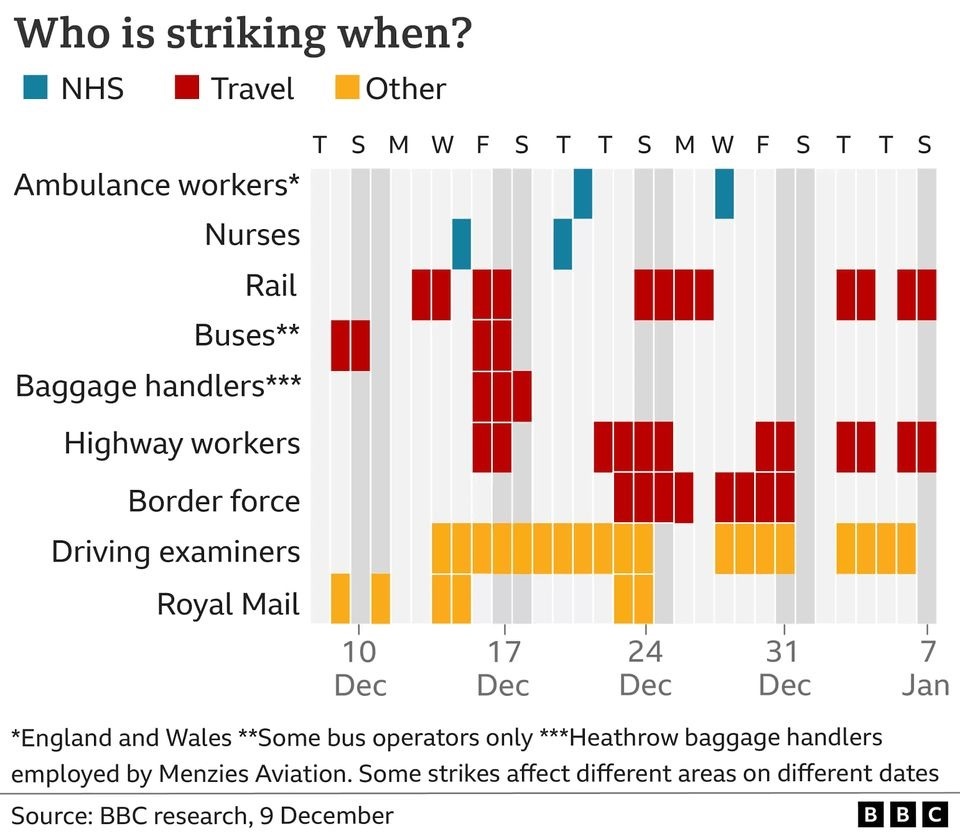
Strikes we are so far aware of (taken from various sources) include:

•           RMT – rail workers

•           RCN – Nurses

•           CWU – postal workers

•           Unite – Shelter staff

•           PCS – Driving Schools

•           UCU – University

•           Unison University support staff

•           Ambulance staff

•           Baggage handlers

•           National Highways staff

•           Bus drivers (various places)

•           Teachers

•           Paramedics

•           Physios, Midwives and Junior Doctors being balloted

•           FBU – Fire services looking to ballot

•           GMB – Energy workers

•           Teachers (in Scotland) in England looking at balloting

We know this list to be far from exhaustive and expanding, reaching, according to the Office of National Statistics, over 400,000 strike days in the last month alone.

The government by refusing or sabotaging negotiations while changing the law and bringing in the army is working from the 1984 playbook of the miner’s Strike, choosing the sledgehammer to crack the nut.  In doing so, the myth of consensus and liberal democracy is blown.  They know the importance of defeating working class resistance to their wealth and power, we need to match this realisation too!

If anyone is emulating Putin, it is the government cronies of the capitalist state, banking on the long winter and worsening conditions of life to cause despair and break morale.  Anyone who doubts their capacity need look no further than its barbaric treatment of refugees, turning the channel into a Berlin Wall and threatening Indefinite detention in camps of concentration formerly known as Pontin’s.

Meanwhile, Belarus is preparing for war under pressure from their paymaster Putin.  Capitalism has its eyes on the prize in the Ukraine war and whilst alleging all our woes are down to Russia, they continue their expansionist planning in the east.  Their war there is being waged necessarily against us here first. The more we fight to win here, the more they risk losing abroad.  We are their enemy within and we should prepare for more lies, more repression and escalation of our resistance.

By Dreyfus

Yorkshire Nazis’ Damp Squib Protest – By FLAF West Yorkshire

On Saturday a handful of no-mark fascists tried to hold an anti-refugee protest at the Britannia hotel in Seacroft Leeds. They met at the Cricketer’s Arms in Seacroft (which turned out to be shut) before waddling over to the hotel with a makeshift banner.

Despite what has been claimed elsewhere, 8-10 miserable looking fash stood in the rain with a banner, protected by the police. No one took any note of them, and they went as quick as they came. Pointless action all round.

There was another group of anti-fascists in attendance. They had the chance to engage the fascist no-marks (being the much larger group) but instead opted to hide in bushes for 20 minutes until the police arrived.

We acknowledge the work of other groups in attendance, and support the fact they mobilised. But we do question why there was a ‘squad photo’ taken, and a write-up/report put out that didn’t represent what happened in any clear or factual way.

We also question what the point is in mobilising a “squad” if you’re just going to stand on a bridge and talk to the police? Posturing isn’t going to put mobilisations of fascists off. We have seen that elsewhere with left-wing groups who poster & shout, but never confront.

We were passed the info on the day by a member of the public and only managed to get a couple of people into the area at short notice to observe. Had the other anti-fascist group approached us in advance, or shared the intel with FLAF, we would have happily backed them up.

By a FLAF Comrade

Happy Birthday Kropotkin (taken from Working Class History)

On this day, 9 December 1842, revolutionary, scientist, and philosopher Peter Kropotkin was born in Russia. He later abandoned his aristocratic background in favour of the working-class struggle.

He participated in the 1917 Russian revolution, and wrote numerous influential works, including Mutual Aid: a Factor of Evolution. In this work he criticised interpretations of the ideas of Charles Darwin which focused on competition, and highlighted instances of cooperation in the natural world. “If we … ask Nature: ‘who are the fittest: those who are continually at war with each other, or those who support one another?’ we at once see that those animals which acquire habits of mutual aid are undoubtedly the fittest. They have more chances to survive, and they attain, in their respective classes, the highest development of intelligence and bodily organisation.”

These ideas continue to be influential today. Evolutionary biologist Stephen Jay Gould wrote of Kropotkin: “I would hold that Kropotkin’s basic argument is correct. Struggle does occur in many modes, and some lead to cooperation among members of a species as the best pathway to advantage for individuals. If Kropotkin overemphasised mutual aid, most Darwinians in Western Europe had exaggerated competition just as strongly. If Kropotkin drew inappropriate hope for social reform from his concept of nature, other Darwinians had erred just as firmly (and for motives that most of us would now decry) in justifying imperial conquest, racism, and oppression of industrial workers as the harsh outcome of natural selection in the competitive mode.”

Kropotkin’s ideas were central in the theoretical foundation of contemporary anarchist communism.

We have made a beautiful new illustrated edition of Mutual Aid, as well as a book about his ideas and more items celebrating his life and work in our online store: https://shop.workingclasshistory.com/…/all/peter-kropotkin

A Call to NHS Workers – for self-emancipation and a better society!

Considering the announcement by Sunak and the apparent support of Starmer regarding restricting and even outlawing certain strikes, calling it a war on the “public” we reproduce this text from the Angry Workers and Health Workers United leaflet on the upcoming NHS strike action.

Inflation is running at 14%, the current pay ‘increase’ by the government is a severe pay cut and the announced increase for 2023 is only 2%. This means more NHS colleagues will leave the job, and staffing shortages will get worse. it’s time to get real!

We haven’t fought in a long time. Apart from the junior doctors there hasn’t been a bigger strike in the NHS for 30 years.

Who has the experience to organise the struggle? A successful struggle needs united action by workers on different bands, in different trusts, in different unions.

If we look at what has been happening in the last month we can see that the unions won’t be able to organise this unity. So, what’s been happening?

After pressure, the Scottish government decided to increase the annual wage by £2,200, compared to £1,400 in England. Given the inflation rate, this would still be a real pay cut. members of most unions refused this pay ‘increase’ and voted for industrial action. Unison officials ignored this, negotiated a lower increase for band 5 and above and recommended that members accept the offer, while the other big union, the RCN, recommended to refuse. In the ambulance service, the GMB and Unite did not coordinate their strike action so as to strike on the same day.

In the end most unions in Scotland called off industrial action and pushed members into yet another ballot. In England, the RCN called for strikes on the 15th and 20th of December, but decided that not all members who voted for strike will actually join. Unison didn’t manage to mobilise more than 40% of their own members to vote and failed to meet the legal threshold in most trusts. Sending emails and calling individual members at home is not enough to create the collective spirit necessary to organise a strike – none of us saw any visible pay rallies in and outside hospitals in the run up to the vote. The government must be happy that the unions keep workers apart like this.

So, what should we do?

We need open & independent assemblies, we need independent and open assemblies in each hospital or department, open to all workers, regardless of profession or union membership, to discuss how this struggle should be organised. In France in the early 90s, health workers managed to coordinate assemblies like this on a national level – before WhatsApp or the internet. Let’s turn the RCN pickets in mid-December into assemblies or organise them independently if necessary.

At the assembly we can take stock of which wards and departments are present and make sure we invite delegates from those that are absent. We can discuss concrete demands and different actions to enforce them, from overtime boycott, work-to-rule, to strike. We can discuss whether to put pressure on the unions to back our decisions or to go it alone. We could figure out how to coordinate with assemblies in other trusts.

During recent hospital strikes in Germany, we could see how strong a strike can be if delegates from each ward coordinate the struggle together. As a result of the strikes, workers now get a day off for every five shifts that have been understaffed. Strikes in hospitals are tricky, but they can be effective without putting lives at risk.  There are other ways to put pressure on the government. If thousands of NHS workers would support the current strikes at royal mail, universities, railways and food factories by blockading sorting offices, station entrances or factory gates, the government would be in trouble. In Argentina, health workers and teachers blockaded main roads to oil fields and tourist resorts to cause financial losses for the government. By doing so, they managed to enforce a massive pay increase.

These are bold actions. It won’t be easy, and there will be plenty of people trying to dampen down any kind of boldness and initiative. But we, as NHS workers, need to be clear what would be necessary to actually win, rather than settle for some crappy deal. 

In the bigger picture we see that more strikes are happening, from universities to railways to the postal services. These strikes are a chance to come together across sectors and discuss what we, as workers, can do to change the current social atmosphere of doom.

Are the current strikes powerful enough to defend our wages against inflation and attacks like ‘fire and re-hire’?  

We often see that strikes by different unions and sectors are not coordinated and end up being isolated. We often see that the unions’ fear to break the strict strike laws make our struggle less effective. We often see that fellow workers get frustrated, because the decisions of how to organise the strike are made not by the strikers, but by the union leaders. We need to reflect on these questions together and independently, as most organisations have their own interest when it comes to strikes. They only want to recruit us as members or voters. They don’t have an interest in us understanding and leading our own struggles.

But it is not all about wages. The law tells us that ‘political strikes’ are illegal. They want to keep us in a box. As workers we are supposed to only care about our bread and butter. But as ‘essential workers’ in health, transport, food production or manufacturing, we know how society is run and we have the potential power, knowledge and togetherness to change it for the better.

The current moment is dangerous. We see an escalating global crisis. The fight over markets turns into wars, the climate crisis looms. The scary thing is that we are in a mess not mainly because powerful and rich people have an interest in keeping things as they are. The scary thing is that even those who we see as powerful, from politicians to big corporations, are not in control of the situation. This society is run in such a fractured way – disjointed by millions of separated companies, government departments, local and national markets, wobbling on fluctuating share and currency values – that no one can claim to be in control.

The chaotic reactions to the pandemic, to global supply-chain issues and climate change prove this.

But the current moment is full of hope. We, as so-called ‘essential’ workers, know how to run things and could do it much better if we would not have to deal with profit margins and management hierarchies. The current strikes are also a chance to discover this potential. we have the social responsibility to take control of the means to produce our lives and wrest them away from this system that no one controls.

If everyone would work only for socially useful purposes, we could all work much less and have time to learn and enjoy our lives.  In the end this is a question of power: Who owns and controls the stuff that we use to produce the conditions for life? If we can lead and coordinate effective strikes, do we use this new power to challenge those who claim to make decisions for us? The current strikes put this question on the table and put a spotlight on our responsibility as workers for the future of society.

Health Workers United – who we are?

We are NHS healthcare workers who want to be able to tell it like it is. We’re not the voice of any political party or trade union we are local health workers. check out our blog: www.healthworkersunited.wordpress.com

These are new times that force us all to learn together. write to us and tell us your thoughts and what is happening at your workplace. we will publish reports anonymously on our blog.

Email us at: healthworkersunited@protonmail.com

New book available from Angry Workers – https://www.angryworkers.org

“Capitalism? No thanks, I gave already..”

Dear Boss,

…it’s not me, it’s you. It really is you, I just hadn’t gotten around yet to letting you know. 

This may feel like it’s come out of the blue, but I’ve been rethinking our relationship for some time now.  I think it may have always been better for you than it was for me, I guess I just felt I had to go along with it. 

Yes, I admit, in terms of satisfaction I was mostly faking it.  To be blunt, I don’t feel you’ve ever been interested in meeting my needs.  Frankly, you’re a little selfish. It’s all take take take with you. 

Date nights were always a strange affair. ‘One to One’s’ as you called them.  You pretended it was about us, you even said once how much you appreciated me, whilst somehow managing to let me know I was never quite good enough.  I was never enough for you – there was a third party in our relationship.  You let slip their initials once, H.R. as I recall.

Did you ever listen to my worries or interests like I listened to yours?  Oh I know you’re always under pressure but why is that my problem?  When I told you I didn’t like getting up early, had a headache or just didn’t feel like it today you made it all about me.  That’s gaslighting and began making me think. 

And then I remember that time you made me do that course, as if ‘Performance Management’ would ever be my choice.  Theatre’s not my thing, and if there’s anyone here acting out, it’s you.  At times, to put it bluntly, you can be pretty passive aggressive! No, a right tosser actually.  There, I said it and I’m glad!

It pisses you off that I’ve never heard of the KPI’s or the Targets, and I don’t care how many records of theirs you have, it’s just another example of how little we’ve got in common, despite what you said and how nice you seemed when we first met.  But thinking of it, I had just left school and probably didn’t know better.

I realise now you were probably grooming me.  I should have known when you approached me online, I mean, who does that!  I assumed you wanted to play when you asked if I was up for a challenge.  I should never have listened to that person at the Job Centre, I think they may have put you up to it, but you knew what to say and what you were doing.

The final straw is when you cut my house-keeping and still expected me to be grateful!  Now I just feel cold, not just towards you, but just cold.  The flame has gone out and I can’t afford to replace it. 

I told my friends down at the ‘Prole & Picket’.  They said I should leave you, that I look bored and have done for some time. I know they’re right, they know me so much better than you. 

I’m not interested in your overtime, just time to get one over on you.  Oh, and by the way, you can keep your records collection, maybe H.R. would like them!  But I’ve had enough of dancing to your tunes, I gave already!

No longer yours,

Gill O’Teen

By Dreyfus

Strike!  If they want war let’s give them the Class War

Government has two key jobs to deliver on, ‘bread and circuses.  Keeping people fed and distracted is essential to its survival.  We know it is in crisis when the circus takes place in the seat of power and the bakery shuts.  Hunger and chaos are the death knells of dictatorship.

With the end of preoccupation caused by the demise of Queen Liz and Prime Minister Liz, the government is turning all guns blazing on us.  If it can’t deliver, it has to crush.

This will present us as workers with the greatest challenge of the current wave of strikes.  As union leaders pause momentum, calling truces for dead monarchs and promises of talks, the government is not preparing to pull its punches.  Instead they are training the army to strike-break while escalating legislation to sack and even criminalise strikers.

The government has already got away with criminalising environmental direct action and curbing protest, preparing the ground and precedent to face down the strikers.  They are pressuring rail and postal bosses not to make deals that the unions can claim as victories.

The press is already on side.  The Times declared “there is no more urgent challenge than to head off the wave of strikes that threaten to cripple large swathes of the public and private sector.”  With the Sun revealing plans for. “..new emergency powers to break a winter of strikes”,  looking at  “..more options to disrupt unions’ co-ordinated bids to paralyse Britain.” This includes amending legislation going through Parliament “…to ensure a minimum level of service on strike days in key industries, such as rail ….making it easier for bosses to replace strikers.”

So far, 500,000 workers have beaten the strike ballot thresholds.  With nurses and ambulance staff walking our later this month to join dockers, transport workers, baggage handlers, university staff, and communication workers amongst others, barely a day in December will be strike free. 

Whilst public support is high – strikers are the public too – government plans will demand new resolve and new tactics.  Apart from the traditional reluctance of the organised Trade Union movement to put their necks on the line by breaking the law and risking their position and finance, union officials are already being targeted.  Royal Mail claims this week that 90 CWU reps are now facing serious allegations that have led to suspensions and reports to the police.

Many actions and walkouts are already being coordinated across sectors but this ‘generalisation’ of strike activity in itself may also become a target of legislation. Because it is effective!  What should be our response to this and other government threats and attacks?  Do it anyway!  The TUC and Labour establishment will oppose this, but so far, the staggered ungeneralised walk outs risk bleeding worker’s morale and finances by a thousand cuts. 

Negotiations alone, if at all, whatever union leaders say, will not bring victory.  Where effective defeat sold as a win may happen, compromise by compromise, it will be at the expense of solidarity and other workers demanding what is theirs. So far strikes have effectively been costly demonstrations of protest.  They must step up to resistance.  Across sectors and communities, risking the law and demanding change through direct action, against union bureaucracy if necessary. 

If the glove is off the fist – let’s step up to meet the challenge – direct action not protest!  As the anarchist initiator of the Wall Street Occupation, David Graeber put it: “Protest is like begging the powers that be to dig a well.  Direct Action is digging the well and daring them to stop you.”  If they want a war against our class, let’s escalate the class war!

Article by Dreyfus

No War But The Class War!

What might it be like to have no pain free dentistry or flushing toilets?  What is an urban ice age like with no lighting, heat or running water? How could it feel to sleep beside your dead?   All the safe assumptions of the post war West are being dismantled in real-time in the war in Ukraine. 

In the developed metropolitan centres of the West we have become accustomed to a concept of ‘normality’.  A relationship to technology, growth and consumption sold to us as the evidence of the civilising role of commodity capitalism.  A normality, that while excluding millions at its margins, beguiles most of us alongside ‘loose celebrities’; ‘coronation soaps’ and ‘who doesn’t want to be a pauper’ quiz shows. 

For most Europeans and North Americans at least, this has been presented not just as inevitable, but the promise to all societies seeking development and progress. 

For the global majority, millions of people in the deliberately underdeveloped post-colonial world, reality has demanded a bloody price for this fantastical lie since WW2.  Western postwar peace and prosperity has been maintained by proxy wars across the globe.  From Korea to Vietnam, the Great African War of the late 90’s to Iraq and Syria. 

Its wealth underwritten through increasing exploitation of predominantly Asian labour and environmental degradation.  The un-sustainability of this has been writ large since the financial collapse of 2008 and the rollback of globalisation.  The short-lived post-Cold War consensus died with it. 

We had been led to believe the the horrors of the Yugoslav wars with the destruction of Vukovar and the Srebrenica massacre were an aberration born out of the collapse of the West’s rival bloc.  The defeat of the Arab Spring with its impact on migration and the now hot war on the border of the EU shows it to have been business as usual but getting closer to home.  Capitalism’s bloody fault line is ablaze. 

The deliberate destruction of the technological infrastructure of a modern European economy is an abyss the we are staring into.  While Ukrainian workers face an increasingly perilous winter of suffering and militarisation, conscripted Russian workers taken from the poorest sections of society, untrained and ill equipped, are thrown into Putin’s meat grinder “….in human waves..”, with elite forces at their backs to shoot them should they retreat according to opposition sources. 

As capitalist barbarism is increasingly unmasked at home, we are told to do our bit by getting hungrier, colder, poorer and closer to Armageddon.  Every act of resistance we take, every strike, occupation and refusal to participate in the great lie is a blow against the war and it’s slaughter.  Every demand, every act of solidarity, every gain is a blow for peace.  

Resistance to their wars is our only hope of survival, and our daily struggle to survive is our class war.   The Class War is the peace movement to end all wars.  We must do our bit, resist, strike, no war but the class war!

Article by Dreyfus

Going for Broke

In Gordon Brown’s last budget just before the 2008 financial crash, he declared that the state had effectively resolved the instability of capitalism promising “we will never return to the old boom and bust”.

Since then we have seen a banking collapse, 10 years of austerity, a flight from Europe, a pandemic, a war, a government inflicted fiscal catastrophe, a return to austerity and the promise of the longest recession in our history.  All against the backdrop of mounting climate emergency.

Far from being resolved, capitalist crisis and the depth of their cycles are intensifying.  The government tells the truth on one thing, it’s not just Britain.  Capitalism’s crisis is global and it’s war against us all intensifies in equal measure.

The latest emergency budget presents a bill of £50 billion in cuts and tax hikes to workers and the poor already facing a 10% real term cut in living standards due to supply-driven inflation.  This sum equals the combined war profits of UK gas and oil producers for this year leaving no doubt of the political and class nature of this choice.

That this is a war against our class, against all of us, is more evident day by day to people struggling to survive. 500,000 workers are actively in dispute or on strike at the moment with many more actions pending, not least amongst nurses and elsewhere in the NHS, the U.K.’s largest employer.

The need for resistance is clear but the need for planning and tactics clearer.  Unless we link our demands, be they wages, conditions, housing or bills, social care, environment or benefits, we will be pulled apart and defeated piecemeal.  Solidarity, unity and coordination are everything.

The slogan of the ‘Enough is Enough’ campaign that “It’s time to turn anger into action” will be pissing in the wind if we abandon our own struggles at the first offer of talks as the RMT decided to do without consulting its members.  The role of such truces is to break momentum and spirit. 

If the RMT cave in now, it says ‘stuff you’ to the other transport workers, posties, nurses.  If the bosses pull the rug, they risk ‘crying wolf’ when they call their members out again.  This is why union leaderships and the Labour establishment TUC are a real and present danger to their rank and file members.

Strikers, activists and supporters should begin grassroots networking to develop alternative cooperation and decision centres away from union structural leadership to ensure solidarity is maintained and fragmentation avoided.  Where possible, electing delegated liaison committees or councils for coordination and mutual support to bypass bureaucratic maneuvering. 

It is clear that the Loyal Opposition Labour Party offers nothing but betrayal and commitment to more austerity.  Or worse, plain anti-working-class racism to divide and defeat the threat of class struggle to Labour’s pretensions.  Starmer say’s “…we’re recruiting too many people from overseas into…the health service.’  That’s why you won’t see him on a picket line then!

But it’s not about the Tories or Labour, it’s their rich greedy puppet master boss-class capitalists, managing their class war on the social, economic and military fronts across the globe. 

Likewise, it’s not about transport workers, nurses, renters or migrants, but about us all.  As an Albanian woman recently put it “They say there’s not war here, but there’s a big war.  The economy is weak and prices are too high…we cannot live.”. 

Article by Dreyfus

International Workers Struggles Digest #1 (13/11/22)

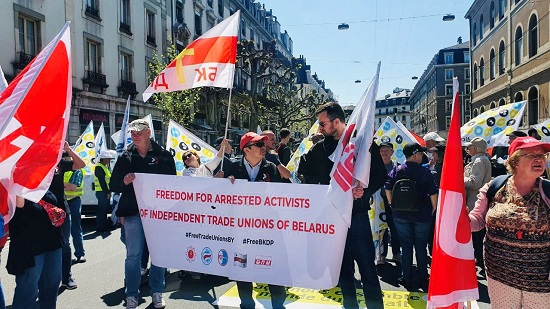
Belarus outlaws’ unions:

An entire trade union movement in a European country is now facing extinction as courts declare unions to be “extremist” or “Western agents” — simply for doing what unions do.  

That is the situation today in Belarus.  A national trade union centre and major unions have been made illegal.  Union leaders are in jail facing long prison terms.  The regime has unleashed defamation campaigns targeting unions and their allies. Pressure on the regime in Belarus is intensifying. We join them in demanding the immediate release of all the jailed activists and the restoration of independent, democratic trade unions in the country.

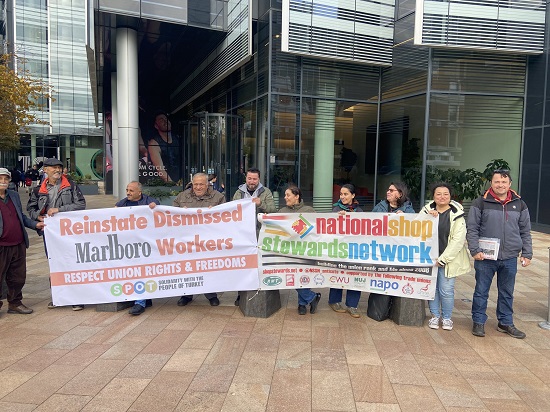
Marlboro workers continue protests at union busting factory in Turkey:

Workers at the Philip Morris factory in Izmir, Turkey, are paid less than the poverty threshold — despite the company earning massive profits. The workers’ incomes are dwindling as a result of the country’s economic turmoil. Furthermore, there is discrimination between permanent and subcontracted workers, though they perform the same tasks and use the same machines. 

Recently, almost all the workers joined the union — but the company then sacked 124 of them in a brazen attempt at union-busting.  While the workers conduct daily protests in front of the factory, the company refuses to negotiate.  

Kate Sharpley Library collective interviewed by the Tyneside Anarchist Archive

1. – Can we have a brief history of the Kate Sharpley Library?

A: The Kate Sharpley Library was established in 1979 by comrades connected with 121 Bookshop in Brixton. Originally it covered a broad range of subjects of interest to anarchists. After it moved out of London in 1992 the focus changed to be a collection of material by and about the anarchist movement. In 1999 the physical library moved to California, but with the same focus on preserving anarchist history and the stories of the people who made the movement.

2. – As with other archives, we share a passion for collecting and preserving past printed anarchist material. With (predominantly) instant online reading these days… are the days of physical literature numbered?

A: We are constantly getting newspapers/pamphlets/leaflets etc. that have been recently produced. These are coming from across the world and seem to me to evidence that anarchists are not moving to a (purely) digital movement but are staying loyal to printed matter and physical objects.

3. – I’ve seen previous online comments from some who say that now the KSL is mainly based in California, with much of the UK anarchist archive based there too, then why donate material (or even support) when such aforementioned literature ‘should be available/ accessible in the UK’ What do KSL say?

A: If people don’t want to donate that is fine. It is their material and they have every right to decide where it goes. I think/hope that scanning material which is available to all may appease some people’s worries. We’re very grateful to everyone who does support us, in particular the Friends of the KSL who have set up regular donations.

4. – There was discussion quite some time ago of making the KSL archive available online somehow, or a listing of what it holds, is this still planned?

A: I am not certain that we would need to scan our whole collection. Some of what we have is replicated online by other groups/libraries/archives etc. To scan what is already available wouldn’t serve much purpose. What we do scan, more often than not, can’t be found anywhere on the web and we see that as being a service that helps people. We could certainly do much more: papers like IconoclastRational ReviewThe Syndicalist etc. etc. as well as historic personal correspondence certainly could do with being put on line. We could also, we sense, supplement what is already available. For example, we have a lot of 1940s Anarchist Federation correspondence that could supplement the Syndicalist Workers Federation material up at The Sparrows Nest; or a collection of Freedom Press leaflets from 1912 onwards that might be better placed on the Freedom Press website. That needs talking about with them and others, of course. Sometimes seeing scanned material sitting in isolation from any context doesn’t really help! We do have a catalogue and we are a little embarrassed by our earlier entries in it. To be fair to us we were a lot less experienced and far too casual with it in those long ago days. We want the catalogue to be an educational tool with as much detail as we can add for each item. We also want it on line.

5. – You have moved from producing regular pamphlets to (in conjunction with AK Press) releasing some great books. What forthcoming titles are planned? any future pamphlets?

A: Our next publication with AK is Agitated by Joni D., a translation of a great work on the Spanish Autonomous groups during the 1970s. Readable and thoughtful it adds to our knowledge as well as expanding our understanding of anarchism. We have a project underway on the writings of Camillo Berneri and one or two other topics and we are always on the lookout for interesting material that can be translated into English. We may also publish more on-line such as our work on the 1945 split in British-anarchism,   http://katesharpleylibrary.pbworks.com/w/page/139511268/The%201945%20split%20in%20British%20anarchism which makes available scans of contemporary documents and newspapers which people may find useful.

6. – We have previously talked about our ‘encroaching old age’ and lack of ‘younger comrades’ eager to ‘take over the reins of running an archive’ what can be done to encourage the next generation to realise the importance of ‘dusty old anarchist papers’?

A: There are young people who are interested in the KSL. They’re a bit like ourselves in the beginning: we were excited by the content and not so much by the means of conserving and protecting the material. And that still is very common. In the past students writing on anarchist history have helped us. That said, we are all volunteers and we understand that the problem has been maintaining the ability to regularly work with us, either on site or remotely. As we all know the throughput within anarchism is a distinct phenomenon and we suffer as much as anyone.

7. – With the last question in mind, what projects have the KSL planned, and what is the future for the KSL itself?

A: As outlined above, we do have lots of plans. As an ageing affinity group we are looking to add younger people and with ideas. Covid affected our work quite badly – especially in terms of people being able to work in the archive. Much of what we do isn’t necessarily public facing. It’s the ordering and cataloging of material together with constant work on the conservation of old newspapers, pamphlets and leaflets etc. We are still working on a sizeable backlog. We have mentioned plans for scanning and working on the catalogue for putting on line above. There is always the Bulletin which takes time to put together as well as individual bits of writing Collective members might want to do. Never mind the regular search for publications and the constant work on those we think are good! Please bear in mind that we are a small affinity group some of whom have full time jobs. Consequently, we are wary of promising what, in the end, we can’t deliver. The KSL plans to be here for a long, long time and as people can see from our replies there’s a lot for us to do. The public facing projects we will be working on will need some prioritizing. Some of these plans may change.

8. – Thank you for answering. Is there anything you would like to add / say?

A: If people want to know more about the KSL or explore what we have already put online, our website is www.katesharpleylibrary.net