Articles

Nationalisation is Not the Solution

Nationalisation is often proposed by state so called ‘socialists’ as the answer to some of the problems we face. At the moment it is often being put forward as a remedy to the current energy price crisis. But in this article, I attempt to lay out why nationalisation is not really a solution for the working class.

Nationalisation is often described as ‘public ownership’ but this is not the case. With nationalisation it’s not the public that owns the industries and infrastructure, it is the state and therefore the ruling class and the nationalised industries and infrastructure will be run in the interests of the ruling class and their capitalist system, not in the interests of the working class.

Nationalisation is often, wrongly, seen as socialist, however nationalising industries increases the profits of capitalists which is why it was done by the Atlee government of 1945-51 and why it has been popular with the statist left ever since. In return for their ownership of particular firms, the ruling class were given lavish compensation which could then be invested in other, more profitable industries. A good example of this was the nationalisation of the Bank of England.

Workers on the other hand, according to Herbert Morrison, could only get the benefits of social insurance, “by increasing the total national income … it could only be done by work, thought, drive and initiative.” (Times, September 6th 1945). What this meant of course was increased productivity, greater exploitation to extract more surplus value out of the working class – in return for which a few crumbs would be thrown off the bosses table.

And I’m afraid The Labour Party and the Unions were hand in hand with the bosses, aiming to extract more out of the working class by conning them that the promised land had arrived.

Notable features of the Atlee government were the building of the British atomic bomb and Hydrogen bomb, the rising of the cost of living by 30% and the demand that workers exercise ‘restraint’ and not ask for pay rises. Wartime rationing was kept in place, which ensured that money was spent not on consumption but on investment. This meant not only less for workers, but a drabber, more monotonous existence. In fact, between 1947 and 1951 working class people suffered a drop in their real wages.

The Atlee government gave little to the working class. In this it revealed once again just whose side it was on. This time its membership began more closely to reveal this fact too. In 1945 more than 40 of the Labour MPs were lawyers…… “between 20 and 30 were business men, and a good sprinkling of farmers, accountants, consulting engineers and other professions” were among the rest. Arthur Greenwood, the Labour Lord Privy Seal, said at the time, “I look around among my colleagues, and I see landlords, capitalists and lawyers. We are a cross-section of

the national life, and this is something that has never happened before. A party originally set up to protect the unions had acquired a constitution written by middle class intellectuals and was now being run by a coalition of union bureaucrats and traditional members of the ruling class.

Nationalisation is not socialism. Socialism means the common ownership of the means of production and distribution. It means getting rid of the bosses, getting rid of working for a wage or salary, getting rid of the whole rotten buying and selling system. It means that people will freely come together to produce what is needed if they can and will freely take from the abundant products of their labour. It is based on human need not on the privileges and interests of a minority and not on profit margins.

It will involve the abolition not only of the ruling class, but also their state.  It will not mean that state being replaced by a new state. It would be a decentralised and libertarian structure run from below for the common benefit of humanity. This can also be described as anarchist communist and an economy and society based on these principles is much more likely to be of real help to us and be fairer and more efficient and innovative while giving us more freedom.  

This may be new to many of you out there but it’s not a new idea and there has really always been one version of it or another that has manifested throughout human history and people are conditioned to think that it couldn’t work while also being conditioned that the best we can do is capitalism, despite the very grave problems that come along with that system and that only get worse and direr and more urgent. As for nationalisation it is just one form of state capitalism.

It is hardly surprising that the Labour Party and the unions ended up as the firmest supporters of state capitalism. Trade unions do not exist to change society, they are to get a larger slice of the capitalist cake, not take over the bakery. Indeed, without the buying and selling economy, based on wage labour, there is no role for a trade union. With no role for a trade union, there is no job for a union official.

However, the power, privileges and status of the union bureaucrats are very much determined by how much their status is recognised by the capitalist class. To protect their position, it is natural for unions to look for a more regulated capitalism, a capitalism based on partnership between employers and labour organisations. It was to achieve this that the Labour Party was set up in the first place.

Their position was recognised and they were welcomed as junior partners in the state machine during the First World War. It was a logical step for them to go beyond mere regulation and favour full blown state ownership, with the state as the major employer working in partnership with the unions.

Thus, Clause Four was adopted as a means of selling this to the working class at the same time as the Unions’ control over the party was established. Their function as part of the state machine was re-emphasised during the Second World War, and continued afterwards with the various tripartite commissions, quangos like the National Economic Development Corporation, and the routine appointment of Trade Union General Secretaries to the House of Lords.

As part of the state wanting more state control the party attracted to itself those sections of the ruling class who would benefit from it.  This helps explain the number of lawyers and other professionals in the Attlee governing party. By the 1940s even the leaders of the party came from this social group. We can clearly see that in this sense as well that the Labour Party is not a party of the working class – and yet neither are any of the state capitalist parties that claim to be socialist – they are always bourgeois in one form or another and if this is not obvious they simply become the new bourgeoise when they gain power as with the various so called revolutionary “socialist” or “communist” political parties.

By Tom Hughes 01/09/2022, adapted from Labouring In Vain: A critical History of the Labour Party by Wildcat.

Enough is enough for whom?

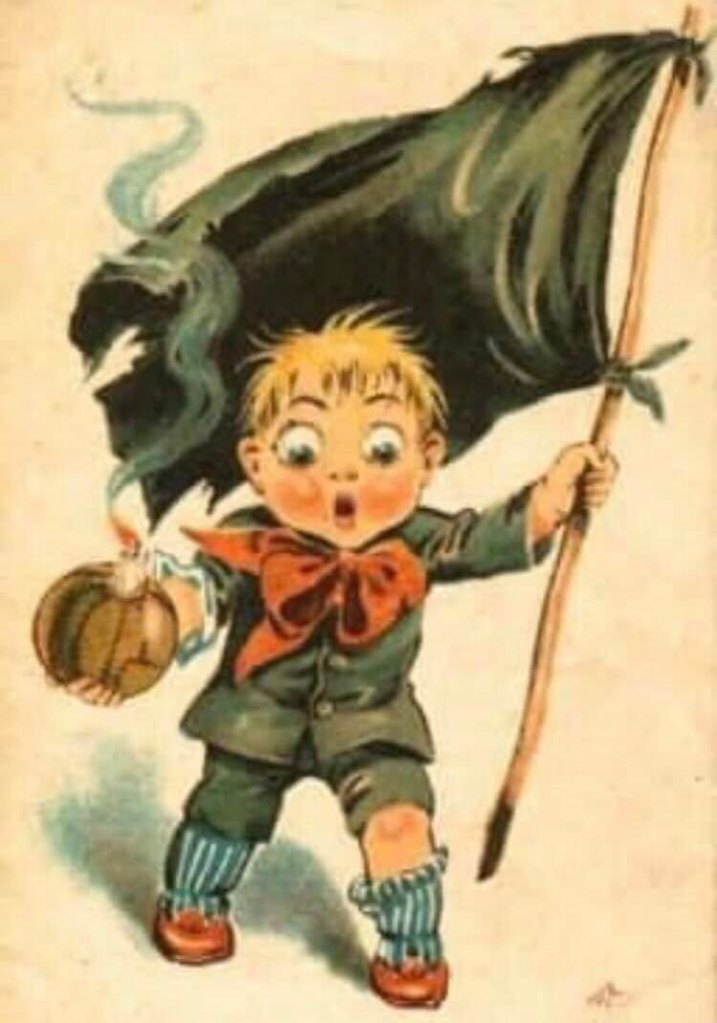
Postcard caricature of an anarchist produced between the two Russian revolutions of 1917

Against the background of an austerity onslaught and a rising tide of militancy through strikes, ballots and preparations for strikes, the currently cross-union led ’Enough is Enough’ campaign, launched its nationwide tour in Clapham, London on August 17th, following up with the second of 50 such planned events, in Manchester on August 30th. 

The packed and oversubscribed rally was attended by AnarCom Network giving us an opportunity to share solidarity and communicate our ideas with other working-class militants.

It is the first time since the ‘84 Miners Strike we have seen an energised, concerted, organised labour attempt at unity and mobilisation against capitalist crisis and its attack on our class in the UK.

It had an energy and fervour reminiscent of the blush of ‘false dawn’ optimism that accompanied and beguiled so many Corbinistas.  What marks this as real dawn potential is that it is currently unhobbled by the Unite Union dubbed “get a spine” Labour government in waiting or an overarching TUC collaborationist bureaucracy. 

For all of the regressive rhetoric about the ‘70’s, these union spokespeople are not the left establishment hacks of the Wilson/Callaghan/Foot era.  The unions taking part are genuinely articulating the expressed needs of their members.  So far, language has been committed, uncompromising, and many of the current generation of union leaders are critical of the Labour leadership, wary of the formal role of the TUC, and articulate exponents of their members demands.

For all of that, it remains limited by its clearly trade union minded consciousness. While leaders spoke, picket line workers didn’t, and while their demands are understandable, their resolutions were the lowest common denominator of social democratic, even liberal, policy:

– End poverty, real terms pay rise, £15 minimum wage, benefits increased above inflation; 

– End fuel poverty, nationalise energy   and restore pre-April price cap; 

– End food poverty, restore Universal Credit uplift; free school meals and community kitchens; 

– Homes for all, capped rents, 100k annual social housing units, scrap right to buy, renters charter and holiday let limits; 

– Tax reform, scrap NI increase and raise wealth and corporate tax.

These in themselves demonstrate the as yet limited level of consciousness, assertiveness, and aspiration.  Despite their slogan of ‘It’s time to turn anger into action’ and the insistence that the campaign will go on with or without Labour, historic limitations remain.  Labour Mayor Burnham says “Westminster needs to wake up” – that’s the problem, it is awake and doing its job.  Nor is Labour spineless, it is a capitalist animal with a capitalist spine that needs breaking not fixing. 

With exhortations to support strikers picket lines and get out on the streets, the emphasis that the unions will take the lead and show us the way risks the same compulsory muscularity of the Miners strike, a potentially alienating factor.  Nothing was said on the limited nature of the demands nor of the need to raise them through the coordination and unification of struggle and demands across sectors and communities, or of escalation in scale and tactics.  Enough maybe enough to start with, but we have to ask, enough for whom?

As anarchist communists we don’t want to cause ripples in the capitalist pond, we want the tsunami that drowns it.  That means going beyond calling for solidarity and support to advocating the struggles of all to come out in the open, in streets, factories, schools, workplaces, communities, towns, village and country.  Build on action committees to community and workplace assemblies and share, not just support, in solidarity. 

Unification, coordination and escalation, not pacification through the limited demands of concession and reform, and never for one sector to claim the leadership to tell us when that has been achieved.  It is time to demand the impossible and let only our imagination set the limits.

Article by Dreyfus 31/08/2022

Why we loathe the Labour Party (or any political party)

You can allow superficial class characteristics to fuel your prejudice in favour of a particular faction of the ruling political class, yet the reality is that the specific role of the Labour Party in maintaining the dominance of capital is to divert and smother working class anger and potential to act. And they have ALWAYS done it while carrying out heinous anti-working-class policies – they did it under Callaghan as well as Blair, they did it under Corbyn as well as Starmer. They did it with the Atlee and Wilson governments. This is why they are a particular enemy of the working class and why we should reserve so much hatred for them. These are very real reasons to have contempt for the Labour Party.

Singling out the Tories is misleading and damaging. The problem is the capitalist system, not a particular faction of its administration wing.

Labour Party members and supporters create the false impression that we can fix our problems by reforming the present system and by getting the so called “right party” or “right Individuals” into government. This diverts working class energy that could be put into building autonomous alternatives from below.

And there will be people who criticise Labour a little bit, but when an election comes around they’ll be basically campaigning as if getting them into power is the most important thing in the world (this is the same whether the Labour Party, Green Party, SNP or whoever). These people are no real alternative, they are just for another niche part of the established order. Despite what they say they don’t have a socialist bone in their body!

If we’re going to make comparisons, as far as harm to the working class cause goes, we say Labour are considerably worse than the Tories.

We’re not into comparing them though, they act in partnership with each other and with capital. The whole thing is a single enemy. Like all the parts in an engine for example, they are all part of the same device and work in unison all with the same goal – to maintain and preserve capitalism and enact bourgeois rule and wield bourgeois power – this is always done at our expense.  

At the end of the day the Labour Party, whether it is acknowledged or not, and whether we are talking about the left or right of that party, has always been a party of capitalism and have always been anti-working class and this fact is proven when looking at its history.

Article by Ben Henderson 24/08/22

Why Liberalism won’t solve this crisis.

Liberalism is an ideology not an ideal.  At the heart of its concept is the idea of a benign state that offers protection, freedom, rights, participation, order and justice in return for our consent and obedience. 

This is the so called ‘Social Contract’ articulated by its philosophical founder, John Stuart Mill in the early 19th Century.  Something we allegedly bind ourselves to at birth.  It is the utopian origin myth of western capitalist democracy. 

Masquerading as liberty, liberalism is a contract aimed at binding capitalist factions to a common alibi for the exploitation of the working class.

As philosopher Bertrand Russell puts it: “Advocates of capitalism are very apt to appeal to the sacred principles of liberty, which are embodied in one maxim:  The fortunate must not be restrained in the exercise of tyranny over the unfortunate.” 

The dilemma however is that the ‘unfortunate’ (The exploited mass of producers, the working-class,) must be governed, and this is done better with the illusion of participation. 

Rarely granted however through commitment, but largely through expedience, the calibrated need to stifle dissent or stave off a social crisis, the 19th century saw the forced concessions of the fundamentals we associate with contemporary liberalism: Freedom of speech, press, property, religion, and politics, and of course, an increasing franchise in the vote. 

The latter, of all the lies that pervade liberalism, is perhaps the biggest.  The idea that the ballot box makes us equal, that the banker and the beggar somehow share power in the voting booth – at least every 5 years!  The other, “lesser” auxiliary freedoms largely exist in order to perpetuate this myth. 

The press is only free to those who own it.  It is the mouthpiece for capitalist factions to speak for power or shape and control our understanding of it. As the Mexican revolutionary Zapata reportedly replied when criticised for shutting down American papers,

‘…what point is a free press in a nation that cannot read!’  Or whose thought is pre-shaped by it.   

The only real freedom liberals truly care about, capitalists truly care about, is that of property ownership. The more you own the freer you are.   And whilst freedom of speech might allow us to criticise it – the anarchist Proudhon was allowed to say “property is theft” – the State will ensure, through the promised ‘order’ it provides, that we can’t do anything about it! 

As The popular song lyric puts it “freedom’s just another word for nothing left to lose”. It is the triumphant illusion of liberalism.   Its dull familiarity creates the attitude in most of us summed up as “I don’t believe in politics” or “what has politics got to do with me?”  And that is exactly what they want us to feel.   Distanced and docile. 

Liberalism Is designed to enthrall not liberate us.  The false debates and fake alternatives it offers us, through its auxiliary freedoms:  right, left, Tories, Labour, starve by debt or starve by poverty, blinds us to what it’s destruction through our solidarity in class struggle has to offer

Instead of the right to complain that we have no job, no housing, no food, no heating, no health care, we should instead be controlling our Labour, our wealth, our communities, our planet through the abolition of capitalism and property, and the liberal mythology that sustains it.

Article by Dreyfus 22/08/22

Towards a ‘Summer of Solidarity’!

The war against our class is being waged relentlessly and now officially endorsed by the government’s bankers, the Bank of England.  According to the bank’s new governor Andrew Bailey, organised workers should not flex their collective muscle against inflation and poverty wages because if they win, it will be at the expense of those less organised without muscle. 

For this we read ‘if you fight against our profits and austerity, we will punish your elderly, you’re sick, your children and your poor.’  As we write, pretty well every sector of transport is preparing to strike, with the government already calling those who simply refuse overtime, of taking illegal industrial action. 

The government knows the stakes are high but while it accuses workers of harming the public, the public (nurses, posties, teachers, refinery workers, firefighters and the mass of other producers) look on in solidarity and hope.  Imaging what winning might look like is turning this into a summer of solidarity!

A distinct set of circumstances created by capital is coming together at the same time and is, out of necessity, not just affecting everyone but unifying their demands.  This hasn’t happened since the ‘70s with Callaghan’s Labour government pay-freeze policy. It’s not us harking back to the 70s, it’s those in power. Their wars and their inflationary attack on wages have put us all in the same boat and they wonder why people are beginning to row together.

Assuming that fuel calculation is modestly right, all workers, if we don’t win, will watch our exploitation grow as our standard of living rolls back. 

This is life or death for those of us without work, but even those of us on minimum or ‘living wage’ will not earn enough in one day to meet our basic needs with 20% inflation for lowest earners on heating, cooking and hot water.  We will have to work one day a week solely to not starve or freeze!  What else has to be met in a debt led, rental economy with spiraling inflation to satisfy them?

Labour, our apparent ‘legal’ alternative, has shown its true colours sacrificing our struggles for their quest for power through respectability.   “We are not a party of a protest but a party of government” they proudly proclaim.  We hear you, we all hear you, those without work, those on poverty wages, we the public, inconvenienced by our need to struggle against you as well as the Tories. 

Demands are shaping on a collective scale as crisis continues to affect us all.  The bosses intend to win, but we intend to win too and what they call inconvenience, we recognise as our common struggle.  Our class IS bringing solidarity to a summer of action and discontent.

Article by Dreyfus 19/08/22

DON’T FORGET TO MENTION THE WAR…

As the class war rages at home and abroad, it is fed by the same capitalist crisis that has brought us to the superpower brinkmanship of the conflict in Ukraine and the consequent global food crisis. 

Less in the eye of the media than when it started 6 months ago, the scale of its casualties are now approaching those of the Bosnian war in the ‘90s, whilst the high risk stand-off around the Ukrainian nuclear facility at Zaporizhzhia puts the whole of Eastern Europe and Turkey in clear and present danger.

Actual figures are a closely guarded state secret on both sides.  Each working to downplay its own statistics whilst inflating that of the other.  But between these figures on each side, from the lowest to highest estimates and from all sources, a median figure of around 70,000 dead and double that wounded or missing is a conservative figure for the Russia Ukraine war.   Even at this level, Russia has lost more in battle than in all its conflicts post WW2 put together.  

The cost in damage to trade, infrastructure and armaments on both sides is now thought to have reached the trillion-dollar mark.  More than a quarter of the entire value of the UK economy or nearly 10% of the cost of the global pandemic – this without factoring in the cost to rest of the world of its repercussions.

The demographic impact is equally obscure with a broad brush estimation of a fifth of the country under Russian occupation and an estimated 25% drop in the total settled population.

While appearing to be stuck on most fronts, the cost and casualties are rising exponentially as high value western technology now pours into Ukraine and Russia draws reserves from the length and breadth of its empire to hold its own. 

Opposition to the war is harder to gauge in Ukraine but even given the level and control and censorship in Russia, mounting legal cases against returning to the front, sabotage at recruitment centres and cash payments to the bereaved to keep them quiet, demonstrates it’s visibility and potential, however small, however stifled.  

This war is very far from over.  All Parties, with the notable exception of those fighting and dying,  have their own vested interest in keeping their side of the conflict going.  Even apparent ‘honest brokers’ like Turkey, hosting peace talks, enabling the renewal of food shipments and International Atomic Energy Agency access to threatened sites, keeps selling its effective drone weaponry to Ukraine while refusing to follow NATO in sanctioning Russia.  

As revolutionaries, we must continue to fight and escalate the class struggle at home as a means of opposing imperialist war abroad – an act of strength and solidarity with each other and the workers of both combatant countries. The war it’s not an appendix of the class struggle, it is one of its most brutal expressions, currently presenting the most immediate existential threat to our class and planet.  We must continue to think globally and act locally, no war but a class war!

Article by Dreyfus 20/08/22