
Source: https://capitalistpeacedeserters.noblogs.org/2026/03/24/report-from-the-solidarity-event-with-deserters-in-athens-on-28-2-2026/
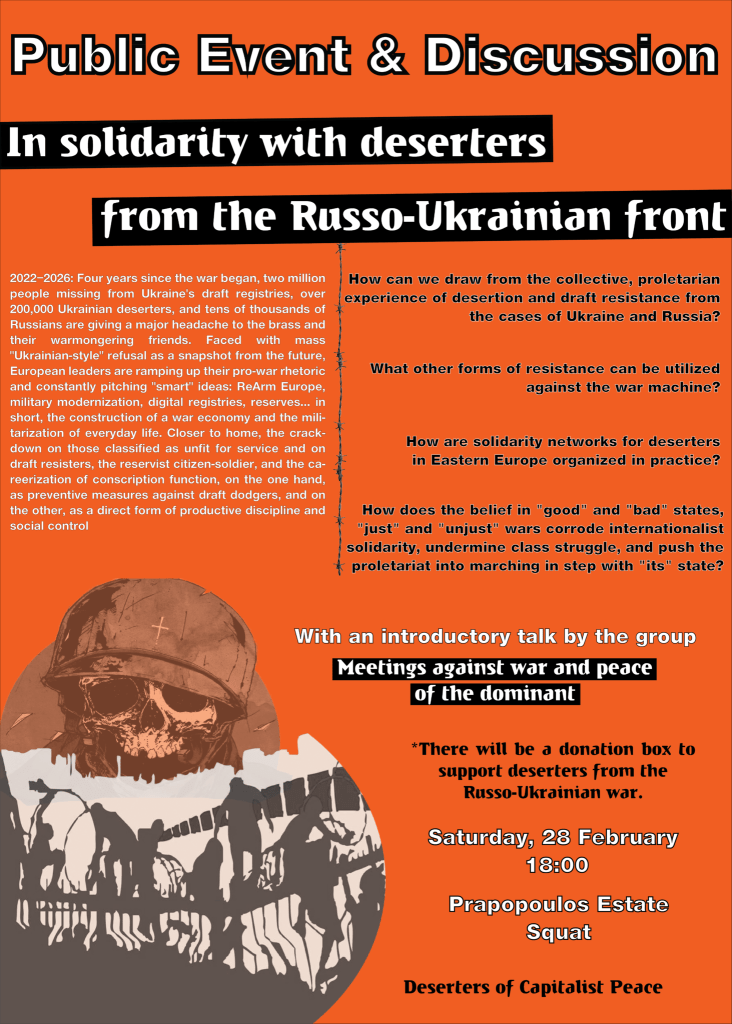
Our event, held together with Meetings against War and Peace of the Dominant, on political support for desertion and practical support for deserters from the Russo-Ukrainian front, took place in one of the few remaining occupied spaces that have managed to hold out against the Greek state’s repressive offensive. The turnout was strong and, overall, the event achieved its purpose. It created a space where part of the politicised anti-authoritarian milieu — those who refuse both the rival imperialist camps and the call to side with supposedly “wronged” states or national liberation struggles— could come together, and it showed that there is real interest in building a pole of war refusal from an internationalist perspective.
We would say that the event took on the character of a preparatory meeting, one that could lead to more practical steps and interventions in public space. On that same day, meanwhile, the bombing of Iran began and the war escalated further. So, the event was very much embedded in the conjuncture itself, and developments since then have moved quickly. Some anti-war calls have already started circulating. Whether our own perspective will also find a public expression — the perspective of a proletarian internationalist refusal of all wars, whether branded “defensive” or “offensive” — remains to be seen, and will be decided in practice.
The substance of the event came not only from the contributions of comrades from groups that support desertion, such as Antimilitaristická Iniciativa [AMI] and Assembly, but above all from the interview we conducted, with the support of Initiative de solidarité Olga TARATUTA, with a Russian deserter. [The contributions and the interview follow at the end.]
We think that focusing on the movement of desertion on the Russo-Ukrainian front, and trying to convey the lived experience of deserters themselves, helped anchor the discussion in a solid material reality. It allowed the discussion to begin from the real movement, from what the working class is actually doing today, instead of drifting into abstract references to the First World War, Lenin’s revolutionary defeatism, and other historical formulas. What concerned the more than sixty people who took part was how refusals of war preparation — and of the possible widening of the war — can be organised, taking support for desertion as a concrete starting point. Being prepared for what lies ahead seemed to be the key priority.
The discussion that followed showed that there is a willingness not to leave things at the level of a general anti-war stance. The question that emerged was whether, and on what basis, a more stable internationalist anti-war intervention can be built in the present conjuncture — one capable of linking the refusal of war preparation here with the real forms of proletarian refusal that are already emerging elsewhere.
Interview with a Russian deserter
At the event held on 28 February 2026 at the Prapopoulou Estate squat, we read out the answers of a Russian deserter to the questions we had sent him through comrades from the Olga Taratuta Initiative, and we are publishing them here. We should note that the questions in this interview are addressed to both Russian and Ukrainian deserters or draft resisters, even though, at this stage, the answers come from a Russian deserter.
[Deserters of Capitalist Peace]
1. At what stage did you desert? Before being officially called up, from a recruitment/training center or from the front? Had you completed your military service before the war? How long have you been away?
I deserted after I had already been sent to the war zone. For about six months I was at the front, working inside the headquarters — not in a trench every day, but still inside the military system, inside the war. I had already completed my compulsory military service before the full-scale invasion, so when the war started, I understood very well what the army is and how it functions. Those six months were the time when everything became clear to me. You see the reality from the inside — not the propaganda, not the television picture. You see how people are treated, how decisions are made, and what this war actually means for ordinary soldiers. From that moment I was just waiting for a real chance to leave. That chance came with my first official leave after half a year. It was the first time I could get out legally and without immediate suspicion. I used that moment to leave Russia and not come back. So, my desertion was not an impulsive act — it was a conscious decision that I carried with me for months while I was still inside the system. Since then, I have been away for more than a year. And for me this is not only about saving myself. It was a refusal to take part in a war that I do not believe in and did not want to support in any way. Leaving was the only way to stay honest with myself and to keep control over my own life.
2. What kind of work did you do before you left? Did the situation regarding jobs and wages change because of the war in your country? What is the situation like after four years of war?
Before the war I had a very typical working-class path, but at the same time I was trying to build something of my own. I worked in sales, I did construction jobs, I repaired washing machines, coffee machines and plastic windows — whatever allowed me to earn and stay independent. My last job before the war was actually my own small business. I was selling clothes through Instagram. It was not a big company, but it was something I created myself, from scratch. It gave me a feeling that my future depended on my own work and my own decisions, not on the state or on the army. After the war started, the situation with jobs changed dramatically. More and more of the economy became connected to the military sector. Defence production started to grow and, in many places, it became the only area where wages were increasing. In civilian industries the opposite was happening — salaries stopped growing, and in some cases even went down. And this was in a country where real income had already been stagnating for years. Now, after four years of war, we are looking at an economy that is deeply militarised. A huge number of people depend directly on military production for their survival. For many families this is the only available work. And this creates a very serious long-term problem. When the war ends, it will not be enough just to stop the fighting. Entire sectors will have to be reduced or transformed, and millions of workers may lose their jobs at the same time. These are people who will suddenly be left without income, without stability and without any clear perspective. So, the war destroys not only lives at the front. It also destroys normal economic life and the possibility for people to build something of their own — the way I was trying to do before everything collapsed.
3. What means were used for recruitment at the time you left? Were they digital or more “traditional”? In what ways can someone avoid being recruited? How do you hide?
First of all, it is important to understand that at the moment there is no open mass mobilisation in the same form as in 2022. But what we see instead is a constant and growing pressure on different groups of the population to sign military contracts. This pressure is especially strong on students. They are often given an artificial “choice”: either you sign a contract or you suddenly face serious problems with your studies — you can be expelled, you can lose your dormitory, you can lose your future profession. Formally it looks voluntary, but in reality, an entire infrastructure is being built where signing a contract becomes the only way to avoid conflict with the university, with your family, and with society. For a young person this psychological pressure is extremely powerful. Recruitment works through both traditional and digital means. On the streets you see posters, banners, leaflets — the visual presence of the war is everywhere. At the same time, online there is an enormous amount of targeted advertising and propaganda that presents military service as something prestigious, heroic and socially approved. So, people are not usually taken directly from the street — the system works in a more sophisticated way. It creates living conditions where refusing becomes risky and socially painful. In some cases, people are also afraid of fabricated criminal charges or administrative pressure, where they are told: prison or a contract. Even if this does not happen to everyone, the possibility itself creates fear and pushes people toward what is presented as the “safe” option. Because of this, there is no universal way to “hide”. Everything depends on a person’s individual situation — their education, their job, their family, their access to documents. For many people the main strategy is simply trying to stay outside of the structures where this pressure becomes direct. So, recruitment today is less about physical force and more about economic pressure, social control and propaganda. And this makes it in some ways even more effective, because it creates the illusion that the decision is voluntary.
4. What consequences do you face in everyday life and at work when you avoid recruitment?
In everyday life, avoiding recruitment does not always lead to immediate criminal punishment — at least not yet. The pressure is mostly social, economic and psychological. You can face disapproval from people around you. Someone may tell you that you are living a normal life while “real men” are at the front. This kind of moral pressure is very common and it affects families, workplaces and social circles. It creates a feeling that you constantly have to justify your decision simply to live a civilian life. The more serious problem is indirect pressure. If the war continues, the economic situation is increasingly structured in such a way that military service becomes one of the few stable sources of income. For many people the choice is not between war and peace — it is between signing a contract and not being able to support your family. So even without formal coercion, the system pushes people toward the army. At the moment, those who avoid signing contracts can still try to stay in civilian life. But there is a strong sense that this space is shrinking. Many people believe that the so-called “voluntary” recruitment resource is not unlimited, and that at some point the state may again move toward harsher forms of mobilisation. And this expectation itself already shapes everyday life. People live with the constant feeling that the rules can change at any moment — that what is technically allowed today may become punishable tomorrow. So, the main consequence is not only the risk of future repression. It is the atmosphere of uncertainty, social pressure and economic dependence, where remaining a civilian becomes more and more difficult and requires constant personal resistance.
5. Before the war, how did you think about the army and desertion? What pushed you to decide to leave?
Before the war my attitude toward the army and the government was already quite sceptical. In Russia every man has to serve one compulsory year when he turns eighteen. I did this service in full, and that experience shaped my view very strongly. I saw an institution that was not preparing people for real defence, not giving meaningful training, and not respecting soldiers’ time or dignity. For a whole year we were mostly doing useless routines that had nothing to do with actual military professionalism. It felt like a lost year of life. At the same time, I grew up in a political reality where nothing really changed. I was born when Putin was already in power, and he is still in power today. So, my distrust toward the state was not something that appeared suddenly in 2022 — it had been forming for many years. But before the war I never thought about desertion. Like many people, I saw it as something abstract, something that happens to someone else. When the invasion started, at first, I was still looking at it in a very rational and even technical way. From my previous experience I knew the real condition of the Russian army, and I did not believe in the image of a fast and easy victory. When I later found myself inside the system, at the front, it became absolutely clear how unprepared, disorganised and inefficient it was — despite all the resources. You see that the army cannot properly supply itself, cannot organise itself, and very often has no clear tactics except sending more and more people forward. And at that moment the question becomes not political but deeply personal: what is your role in this? My decision to leave was not made in one day. It was the result of everything I had seen before — my compulsory service, my distrust of the system, and then the direct experience of the war from the inside. Step by step I understood that staying meant becoming part of something I did not believe in and did not want to support in any way. Leaving was the only way to remain honest with myself.
6. If the war ends, do you think about returning? If yes, how do you feel about returning?
This is a question I think about a lot, and the honest answer is that it depends on many things. The most important condition would be a real political change and a full amnesty for all those who refused to participate in the war. Without that, returning would simply mean going to prison. But even if such changes happened, time is also a crucial factor. If it takes ten years, by that moment my life will already be built somewhere else. I will have a new language, new work, new social connections. Going back would not mean “coming home” — it would mean starting from zero once again. I have already had to rebuild my life once, and it is a very difficult process. I am not sure I would have the strength or the desire to do it again. There is also the question of trust. Russia is a very unpredictable country. Even if an amnesty is officially announced and the political situation changes, there is no guarantee that these decisions will be permanent or that they will actually be respected in practice. For someone in my position, this uncertainty is not theoretical — it is a direct personal risk. So emotionally, of course, the idea of returning home is important. Home is not just a place — it is your language, your memories, your past. But when I think about it in real, practical terms, I understand that most likely I will not have a safe and realistic opportunity to return. And this is one of the hardest consequences of this war — it takes away not only your present, but also your future and your connection to the place where you were born.
7. Beyond desertion, is there a collective anti-war movement that is active; in Russia or in Ukraine right now? If so, in which cities is it most present, and what are its main characteristics? Do you know whether women are organizing anti-war protests? What do they usually demand? Do they play a significant role in preventing basification, i.e. in the case of Ukraine?
At the very beginning of the war there was a visible and active anti-war movement in Russia. There were mass street protests in many cities — Moscow, Saint Petersburg and others — and a lot of public statements from activists, journalists and ordinary people. But the state reacted extremely quickly and very harshly. Thousands of people were detained, many received criminal charges, independent organisations were destroyed, and public anti-war activity became almost impossible. Because of this, the movement did not disappear — it changed its form and became much less visible. Today, open protest in the streets is practically suicidal from a legal point of view. A single public action can immediately lead to a criminal case and a long prison sentence. That is why most anti-war activity is now individual, local, anonymous or happening in exile. One of the most important and visible initiatives inside the country during the war was the movement of the wives and relatives of mobilised soldiers. These were not political activists in the classical sense — they were ordinary women who demanded rotation, proper training, equipment and the return of their husbands. Their protests showed how deep the social tension is. But even this very careful and limited form of protest was gradually suppressed and pushed out of the public space. So, women have played a significant role — not through large political organisations, but through these grassroots initiatives based on care, survival and the protection of their families. Today, if we speak about public anti-war structures inside Russia, they are extremely fragmented and forced to operate in conditions of fear and repression. The price of open opposition is prison, and everyone understands it. That is why the absence of mass protests does not mean support for the war. It means that the state has made open collective action almost impossible.
8. What problems do you face as a fugitive from Ukraine/Russia? Is there a solidarity network among fugitives where you are now? Or a network of locals who support refugees from Russia/Ukraine like yourself?
To be honest, the reality here turned out to be much better than what I had imagined when I was still planning my escape. Before leaving, I expected constant difficulties, hostility and isolation. But when I arrived, I discovered a huge amount of solidarity. I met many people who were ready to help, support and simply treat me as a human being. I have never faced open condemnation or aggression because of my story. The main challenges are not social — they are bureaucratic. Learning how the system works, how to communicate with institutions, how to deal with documents — all of this was difficult at the beginning, because it is very different from Russia. You feel that you have to rebuild your life from zero in a completely new environment. At the same time, there is a real network of solidarity. Among Russian refugees, among Ukrainians, and among local people, I constantly feel support. There is a shared understanding that this war is a tragedy for everyone, and a shared desire to help those who refused to participate in it. This creates a space where you don’t feel alone. The situation is more complicated for Ukrainian deserters. Not because of ordinary people — on the contrary, at the human level there is a lot of empathy — but because of the legal and political framework in many European countries. For them it is much harder to obtain protection, and many are forced to remain invisible and live in fear. This makes their position far more precarious. So, my main problem is not hostility — it is the long and difficult process of building a new life in exile. But what makes this possible is the solidarity I experience every day, from different sides and from very different people.
Statement from AMI for support for an anti-war event and fundraiser in Athens
In September 2022, some anarchists from Central Europe launched the Antimilitarist Initiative [AMI]. It all started with the publication of the text “Anarchist Antimilitarism and Myths about the War in Ukraine.”
Shortly after the publication of this text, an anonymous symbolic direct action took place, in which the Ukrainian embassy in Prague was splattered with red paint. A statement was released accompanying the action, which stated: “It is understandable that Putin and his supporters are criticized for the crimes they are committing against the people of the Ukrainian region. However, the role of Zelensky and the Ukrainian government in these massacres should not be forgotten. At a time when Putin’s army is bombing Ukrainian cities, Zelensky’s government is prohibiting men from leaving the country to seek safety. Under threat of punishment, they are being held in bombed-out areas, and some are being forced against their will to risk their lives on the front lines. Let’s be clear: Zelensky is just as much of an asshole as Putin! Both have the blood of civilians on their hands.”
AMI has never been a formal group or organization, but rather an informal network. We have the most supporters in the Czech Republic, Slovakia, Hungary, and Austria. From the beginning, we have been very critical of war propaganda, which serves to gain more supporters and resources for the Ukrainian state’s war policy. This pro-Ukrainian propaganda is dominant in the regions where we live, even in environments that formally profess anarchism or communism. This makes it difficult for AMI and other anti-militarist groups to organize public activities. Our actions are often sabotaged by “pro-war leftists” who essentially have the same agenda as EU states and NATO member sections.
We are now organizing practical support for deserters and war refugees from Russia and Ukraine. Activities are mainly organized non-public so that we can be more effective and do not have to defend ourselves against the aforementioned attacks. We collect and share money and material aid, and help with the transport and accommodation of refugees. We also publish articles and interviews with people who have fled war zones or actively sabotaged war.
In general, desertion is viewed with great ambivalence, especially in Central Europe. Part of the population theoretically supports deserters from the Russian army, but does not express solidarity with deserters from the Ukrainian army. This tendency is in line with the war policy of EU/NATO/US imperialism. Supporters of this line argue that supporting deserters from the Ukrainian army helps Russian imperialism. However, we argue that “one-sided” support for deserters and support for arming Ukraine contributes to the escalation of war and the spread of interstate conflicts into a global war.
Revolutionary defeatism, which means fighting against all states and all their armies, is now only advocated by militant minorities. However, we believe that the balance of power may soon change, as more and more proletarians on both sides of the war line are avoiding mobilization or deserting. These people often have no experience with self-organization, but it is undeniable that at this moment they are practically sabotaging the war efforts of “their” states. Revolutionary minorities must establish contact with them. In this way, currently isolated minorities can transform themselves into mass movements.
In general, it can also be said that most deserters only pass through countries such as the Czech Republic, Slovakia, or Hungary, or stay there for a very short time. These countries have very poor migration policies. Deserters therefore prefer to live in countries such as Austria, Germany, France, Switzerland, or Belgium, where it is easier to obtain asylum and legal protection from deportation or persecution by the Ukrainian and Russian authorities. Here, they can also apply for relatively large subsidies, accommodation, or generous material assistance from charitable organizations.
However, we see that state policy is trying to integrate refugees into the capitalist economy as cheap labor and domesticate them so that they do not express subversive tendencies. As an alternative, we are trying to create a strong solidarity network that encourages deserters and refugees to organize themselves in resistance.
If you would like to support our activities, please visit our website for more information and contact details. https://antimilitarismus.noblogs.org/
Report from Assembly at the Athens event in solidarity with deserters from the Russo-Ukrainian front, on 28/2/2024
There is already broad resistance to drafting in Ukraine, which we recently compared to the resistance to ICE in our article, “From Minneapolis to Ukraine, only street countering can stop the state-run hunt for people.”
The problem is that, as in the United States, it is not strong enough to change the overall situation. After the complete devastation of our revolutionary field by Stalinism, the tradition of mass street movements disappeared in Ukraine, except in support of some right-wing politicians (1991, 2004, 2014…). Rebuilding it from scratch takes a lot of time and has been underway for two years now, since the law tightening mobilization was adopted on April 11, 2024. However, this process is being delayed by extremely unfavorable conditions, including state brutality, economic ruin, and mass displacement. This is precisely why desertion has become the main form of resistance to the war. It does not require broad organization and is much less likely to lead to punishment than street action. One of the most famous war profiteers, Alina “Mercedes” Mykhailova, admitted a month ago that 20,000 of the 30,000 people mobilized each month are fleeing.
Why do others continue to serve? For the same reasons some civilians support the war: Stockholm syndrome (you may have seen this a lot among the anarchists), a naive belief in the promises of some career other than being an assault trooper, the everyday habit of obeying any authority… A simple example from the working class: a municipal worker’s salary is 12,000 hryvnias, a plant machine operator’s is 20,000, but a concrete pourer on fortification construction has from 60,000 to 100,000! Granting privileges to certain groups, of course, also hinders class solidarity. This does not even include the hundreds of thousands of state officials, law enforcement officers, etc., whose income thanks to the Western financial aid has become higher than ever. They also have family members…
However, since late 2025, we see a new trend: people against the war are moving from self-defense to counter-strike. Almost every day there are news reports of attacks with knifes, shotguns, or grenades against police or enlistment groups, mostly in rear regions like Odessa or West Ukraine. This is no longer like today’s United States, but rather like during the Vietnam War! Details will be in our upcoming article.
Finally, we want to raise awareness about the persecution and imprisonment of those who publicly express their opposition to the war. Some of these people have taken a written stand against the war, like Bogdan Syrotiuk. Others have taken action against conscription. For example, the prisoners in the “Proclamation Case” called on soldiers to unite in “soldiers’ committees” and collectively refuse to participate in military operations on the front lines. Criminal prosecution with heavy penalties is also being brought against civilians who engage in activist acts of resistance to the brutality of men being seized and sent to the front. One such case is that of Angela Gurina, who is facing five years in prison, which was to begin on December 9, 2024, on the false accusation of exposing military quarters, when in fact she was filming and posting a scene of busification. According to the verdict, her video, which has been viewed 8,600 times on TikTok, shows a military installation, the regional assembly point near the Military Law Enforcement Service in Chernivtsi. Depicting such installations on video is prohibited under martial law. The journalist was arrested in August 2024. Her lawyer insisted that she was filming not a military installation, but a potential human rights violation. The video was titled “Saving a guy.” Angela later deleted it. The lawyer also argued that the location of the object was publicly known and that it was neither a combat unit nor a military training facility. But the court disagreed, arguing that: “The applicant’s claim that the person did not intend to harm the internal and external security of Ukraine does not refute the commission of the alleged offense.” Although the trial established Gurina’s dual Romanian citizenship, there is no information about the Romanian government’s efforts to secure her release. Last year’s verdict also indicated that she suffered from mental health issues, including bipolar disorder. At the time of her conviction, the activist was 54 years old.

 AnarCom Network