The AnarCom Network is a group of like-minded individuals organising in local groups (where possible) under a loose national network.
We are a revolutionary anarchist communist working-class organisation that advocates the abolition of the State and capitalism in favour of a horizontal network of voluntary associations through which everyone will be free to satisfy their needs.
“…insanity is doing the same thing over and over and expecting different results.” – Albert Einstein.
2023 turns into 2024, just as 2020 did into 2021. Let’s not even go there with 2022!
“Smile..” they said, “..it could be worse!” We did, and so did ‘it’! The only difference now is that smiles are even harder to find. What are we expecting to change?
That we become less ‘austere’ than we have been for 15 years? That our debt be more addressable than our health needs? That painless dentistry will one day be available when you need it?
That the next roof over our heads is more affordable or lasts longer than the last one? Or that we even get a roof at all? Perhaps that our lungs will finally draw fresh breath, or that we are marched no closer to the edge of extinction through nuclear oblivion?
To coin an old Welsh working class idiom: “Wish in one hand and shit in the other, see which fills up first!” We all know which one, we’ve always really known and see the proof of it as night follows day – as ’23 turns to ’24.
Expectations, wishes and change are not givens. At some point we have to decide, choose and act! To cast out the hamster wheel along with the cage.
No one reading this, unless you are on the wrong side (you know who you are), has heartfelt belief that we are on the right track, that this is the best humanity can be, or deserves.
We the working class create all wealth and produce all things. We dominate the world in vast numbers and through that energy to create we can destroy the world of war and exploitation.
We deserve better and can create a truly human community through choice, organisation and action. And resolution!
If you have one New Years Revolution to make, make it…the clock is ticking. Happy Revolution everyone, don’t miss out…the offer is for an increasingly short time only!
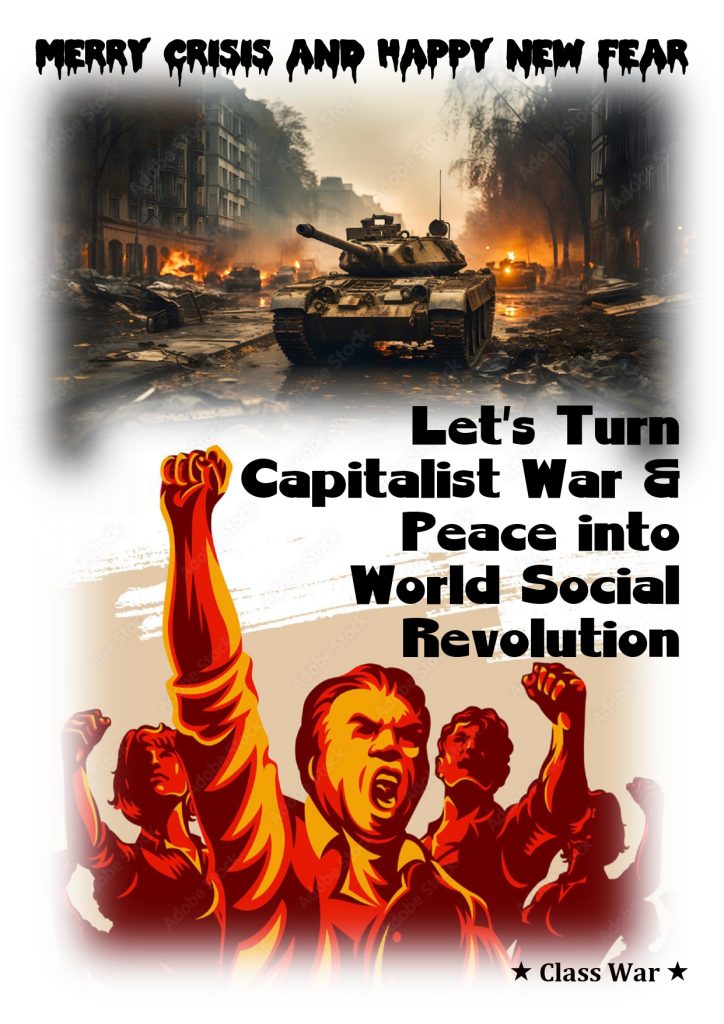
From 20 to 26 May 2024, Prague will host the Action Week, whose motto is:
“Together against capitalist wars and capitalist peace.”
Each weekday during this week will see a different event. There will be presentations, discussions, fundraisers, protests and various types of direct action. Then the end of the week will be devoted to a bookfair and an internationalist conference, where we will try to shift from theoretical matters towards the coordination of concrete anti-war activities.
The overarching theme of the days of action was not chosen at random. It is a topic of global importance. The inter-state wars that have escalated in the last few years are bringing humanity closer to the possibility of another world war breaking out. Millions of people are already being sacrificed in wars and the situation will get worse if there is no adequate response. Therefore, in the spirit of proletarian internationalism and revolutionary defeatism, we seek to give individuals and groups from different parts of the world the opportunity to meet, to associate and to coordinate their joint efforts.
The bourgeoisie and its allies talk about war so that they can turn us into cannon fodder or into those whose life energy keep the wheels of war production spinning.
For our part, let’s talk about how to sabotage the war, how to prevent the proletarians from being sent to the slaughter, how to block the supply and transport of weapons, how to organize desertions, mutinies and fraternization among the proletarians in uniform on both sides of the front line, how to turn our guns against the organizers of the massacre, i.e. against “our own” bourgeoisie and its lackeys…
Let’s talk about how to turn the imperialist war into a revolutionary war for the abolition of the class society of capital based on misery.
Our only answer to the capitalist war is revolutionary defeatism, that we organize ourselves and work for the overthrow of “our own bourgeoisie” and therefore of the world bourgeoisie and capital as a whole.
Let’s discuss and share this call, let’s get organized.
THIS CALL IS ADDRESSED TO:
To anyone in the world who is struggling against the attacks of capital, against all wars and against all bourgeois states with the aim of destroying capital and all social relations resulting from it, as well as all forms of exploitation.
To all those who are aware that there is no such thing as a just war or a defensive war. There is no camp that represents barbarism while the other represents civilization, there is no camp that is more aggressive than the other, and there is no democratic camp against a dictatorial or fascist camp. All wars are capitalist wars, where different bourgeois factions are pitted against each other. Every war is a war of the bourgeoisie against the proletariat!
To those who do not support either faction of the bourgeoisie against the other, but fight against each of them. Those who do not defend or participate in inter-class fronts.
To those individuals, and groups, who fight against the policy of “defense of the national economy”, and “sacrifice in favor of the war economy”, to those who do not accept the expansionist tactics of their own bourgeoisie, even if it faces an economic, political or military attack.
To all those who do not consider themselves pacifists but revolutionaries. To all those who do not aspire to a bourgeois peace where the exploitation of our labor force can continue in slightly different conditions.
To all those who want to turn the inter-bourgeois war into a revolutionary war, the war between states into a struggle for the destruction of all states.
To all those who recognize in their practice that the proletariat has no fatherland to defend. Our enemy is not the proletarians driven into the trenches on the other side of the front, but the bourgeoisie – in practice, above all, the bourgeoisie “in our own country”, “our own” bourgeoisie, the one that directly organizes our exploitation.
And finally, to those who, according to their strength and situation, fight against the bourgeoisie by promoting the development of the proletariat as a revolutionary class and contributing to the building and development of proletarian internationalism.
THE FOLLOWING GROUPS AND PROJECTS WILL BE INVITED TO PARTICIPATE IN THE ACTION WEEK:
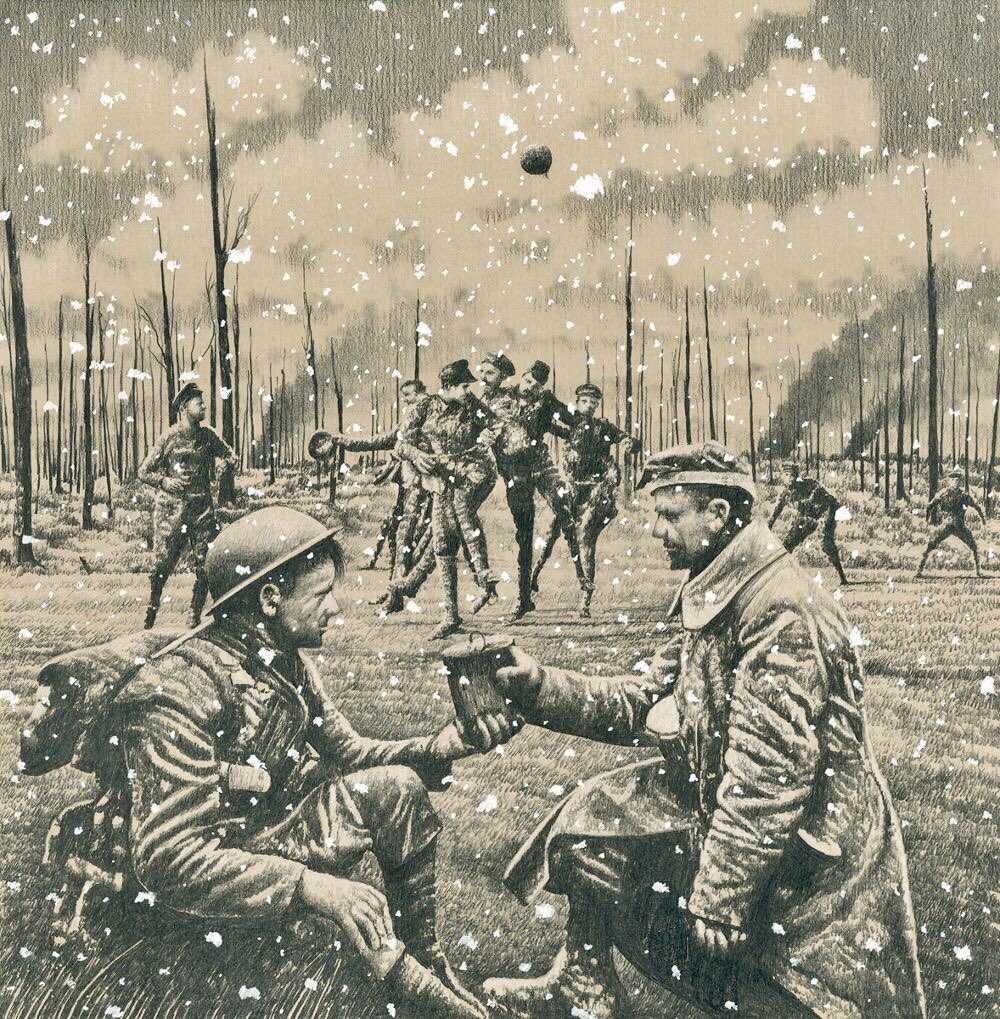
“All of a sudden, lights appeared along the German trench. And I thought this is a funny thing. And then the Germans started singing ‘Stille Nacht, heilige Nacht’. And I woke up, and all the sentries did the same thing, all woke up the other people to come along and see this and what the Earth is going on…They finished their carol and we applauded them and we thought we should retaliate in some way. So, we replied with The First Noel.
And along that line we were suddenly able to see Germans doing exactly the same thing all out in the open. And we just looked at each other for some time and then one or two soldiers went towards them. They met, they shook hands, they swapped cigarettes. They got talking. The war, for that moment, came to a standstill.” Rifleman Graham Williams, 5th London Rifle Brigade
“Suddenly a Tommy came with a football… And then began a football match. We marked our goals with our caps. Tommy did also. And we had much kicking. And then, after all, the Germans won the football game 3-2.” Johannes Niemann, 2nd lieutenant, 33rd Saxon Regiment.
“Several of them spoke English. They rather expressed their dislike… for the whole war in fact. They weren’t aggressive at all. Some of them said they had been to London, been to England, in fact, they gave every indication of being glad to meet.” Col. Scott Shepherd.
‘War is peace. Freedom is slavery. Ignorance is strength.” 1984
What happened in Israel three weeks ago on October 7th was an unmitigated atrocity. It exposed the horror and brutality of the Islamist fanatics of Hamas against Israeli Jews and non-Jews alike.
Not just in slaughter, but in the most egregious and indiscriminate taking of hostages since the Islamic State’s enslavement of the Yazidis of Northern Iraq in 2014.
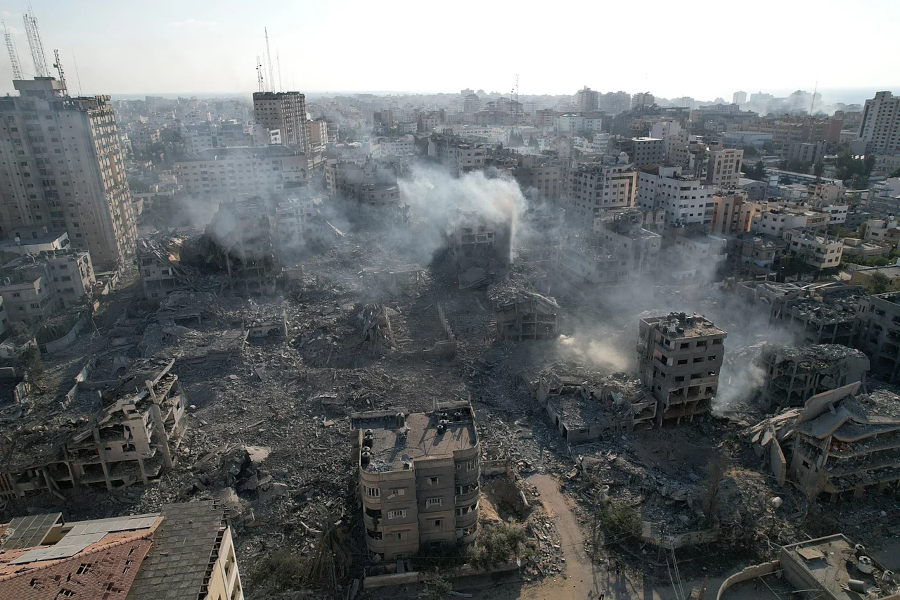
What has happened since is a continuing surreal nightmare taking horror to new heights. If not a genocide in legal terms, a de-facto attempt at an annihilation of a society.
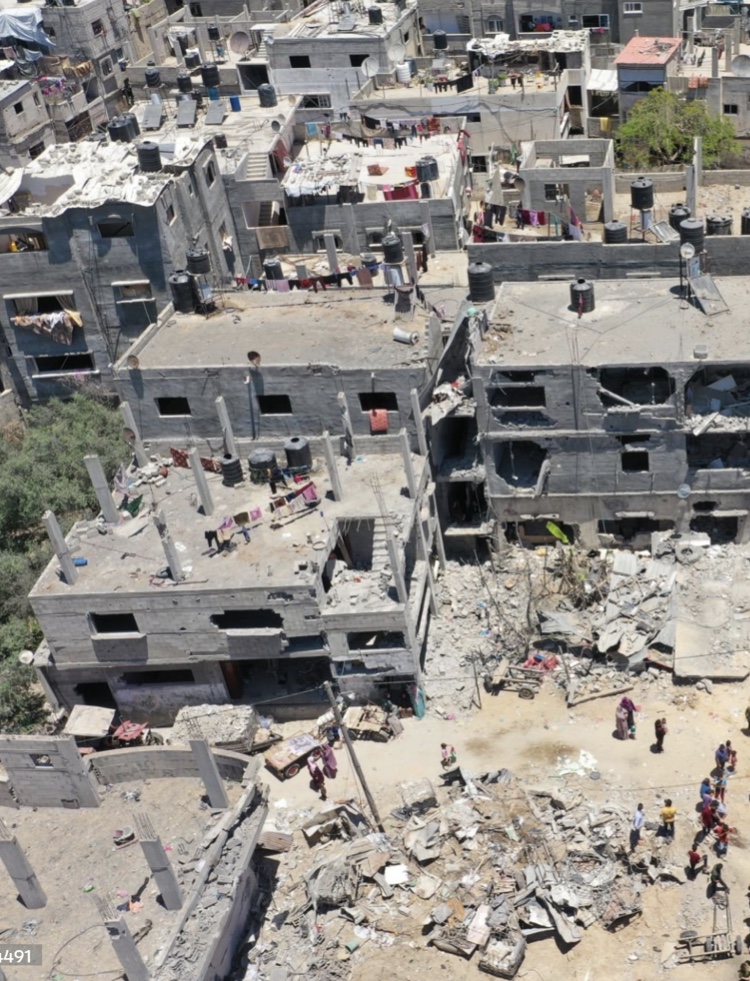
Total darkness, no water, food, medicine, power or shelter. Just the choking smoke amongst the raging fires and roar of tanks and missiles. The bombs that rain down sanctified as legitimate self defence by the West.
Yet still the press asks ‘is this the real invasion’ as if there is something else to see! We have long been misdirected to see or not see things in the Middle East to suit the narrative of capitalism’s rival power blocs:
A peaceful liberal secular democracy, ‘like us’, instead of a rabidly right-wing theocratic entity armed to the teeth, dividing its own people.
An insatiable refugee rabble clawing with ruthless violence at the face of civilisation rather than the wretched impoverished diaspora of three generations of State engineered trauma.
All the bluff, lies and delusions of the Ukraine war are exposed in the hypocrisy of the Gaza war. The two-faced solution to who is being slaughtered, how and where, is the politics of capitalist barbarism.
The scale of this catastrophe dwarfs what has come before. The displaced of this Nakba (‘Catastrophe’) is twice that of 1948. Gaza deaths are already more than 2/3rds the recorded civilian deaths in the 20 months of war in Ukraine. 7,500 compared to 10,000 according to the figures of OHCHR, (the Office of the High Commissioner for Human Rights) and the Gaza Health Ministry.
While Israel disputes these figures from a Hamas source, a wide range of international NGOs and the UN are saying that in general they have found their figures and those of the Gaza Ministry of Health tend to tally and are credible. 40% of these deaths are children.
The workers in the ‘open air Gaza prison’ are not Hamas, who number around 30.000 out of 2.6 million people. The workers of Israel, Jews and Arabs, are not the Israeli State. On the eve of invasion only 29% polled supported a land incursion!
Peace negotiator Gershon Baskin said in an interview on the hostage negotiations “A state’s primary function is to provide security to its citizens”. A State’s primary definition is it’s ‘monopoly on the use of violence.’
Both have found themselves not satisfied with merely monopolising their violence within their own borders, and both have proved unwilling or unable to ‘protect’ our class whatever side of the divide.
The ruthless potential to unleash violence against us everywhere is another defining element of the Capitalist State, the local franchise of global superpower rivalry and conflict.
Israel and Hamas are far from the only combatants. Despite escalating, though restrained so far, assaults by Iranian proxy Hezbollah in Lebanon, Iran may not be ready yet to squander its deterrent force there against an Israeli attack on their nuclear program.
This assumes that Israel does not want to provoke the opportunity while it appears to have such unconditional Western support. The US is already exchanging fire in Syria and Iraq. Everywhere our class is in jeopardy with nothing to gain and everything to lose.
We are experiencing this conflict not just virtually, but within our own class here and now. The tribal politics of division are being stirred to divert us from our own interests as workers and producers.
We do not want to fight and die in their wars for their profits and their power. We do not want to pay for it through their imposed austerity and war profiteering.
Their interests and ours are not the same. Their interest is imperialist war, ours is Class War, our only weapon against their brutal exploitation, division and slaughter!
In Ukraine and Russia, in Gaza and Israel, in the US and Iran, our class has no nation! On the home front and internationally: No War But The Class War!
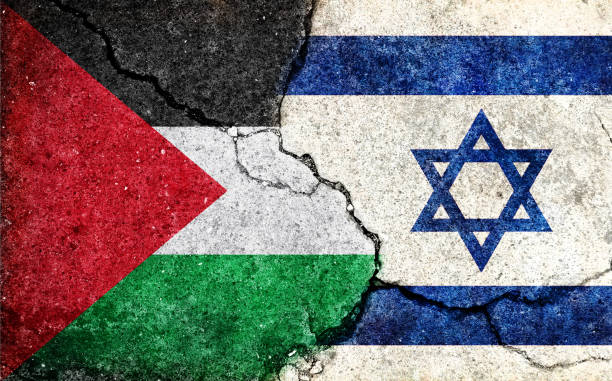
On 7 October, southern Israel was invaded by Hamas forces in an astounding, and largely unexpected, coordinated attack with militants breaking through the Gaza border, whilst air strikes reached as far as Tel Aviv in central Israel. For many Gazans, this was their first time outside their open-air prison, tearing down border fences, and the Israeli military’s first time on the back foot in 50 years to the day since the Yom Kippur War. From a Palestinian liberationist perspective, this looked like triumph. But over a thousand civilians were indiscriminately massacred throughout the day. One Kibbutz lost 10% of its population. Reportedly, nearly 200 Israelis were found at the site of a now-famous desert rave. Pictures were shared of a family of four all dead, and others found out their loved ones were dead from news footage. Around 150 estimated Israelis, soldiers and civilians, are being held hostage in Gaza as Hamas demand Palestinian prisoners freed in exchange for the hostages. Many pro-Palestinians have leaped to defend the massacre and consider ordinary Israelis to be settler-colonialists, including children, descendants of refugees, and even anti-occupation activists. Even if this were somehow true, the deaths of Bedouin, Nepalese students and Thai migrant workers make it hard to believe in justified murders. Before the end of the day, Iran and Hezbollah had made clear their support for Hamas and rival Palestinian Islamist faction Islamic Jihad.
The Israeli state wasted no time in calling a war a war. The security failure had left Israel’s leading politicians and military officials embarrassed. The success of Netanyahu, the Likud party, and the right-wing generally relied on a confidence in national security. The fault popularly attributed to the ever-depleting capitalist left in Israel was not economic mismanagement, but a willingness to secede land at the risk of security at borders. In one morning alone, Hamas had debunked the myth for the Israeli public that they were safe with Netanyahu in charge. Netanyahu and his ministers predictably ramped up the nationalism, and made clear that Palestinians should expect vengeance, and that Hamas were to be completely eliminated. Tens of thousands of reservists were drafted into the army as the language of politicians stopped just about short on calls for genocide.
As landed fighting continued around the border towns, Israel unleashed its harshest violence through air strikes on the Gaza Strip, striking hospitals and refugee camps, wiping out a family of 19, and all generations of 45 families, and almost razing an entire town. A blockade was put in place denying water, electricity, food and fuel, an act since condemned by the UN. The densely populated Gaza Strip allows for little movement or evacuation for ordinary citizens and after an Israeli air strike had destroyed the Rafah border crossing with Egypt, Gaza is now under total siege. The thorough displacement of the Palestinian people continues as Israeli authorities ordered 1.1 million in the north of Gaza to move south in what is already a tightly-controlled ghetto. Even the UN have called for this demand to be rescinded. Casualties in Gaza are now approximately double those in Israel and the death toll of Palestinians grows larger and larger as Israel’s military infrastructure dwarfs that of Hamas and Islamic Jihad, despite Qatari and Iranian financing. Though ethnic cleansing has long been an accurate description of Israeli attacks on the Palestinians, the scale of this war, and the reports of white phosphorus being used, are unapologetically genocidal. Rocket fire escalates on the Lebanese border between Hezbollah and Israel. The now-normal bouts of violence from far-right and religious fundamentalist Israelis in the West Bank have become intensified by increasing access to guns as the war spreads.
As the bloodshed accumulates, the stories that carry the highest tragedy are those of working-class people, Israelis and Palestinians. Political and military leaders make snap decisions that cost thousands of lives just to cling onto electoral popularity. Until the outbreak of war, the biggest movement in Israel has been the persistent mass demonstrations against Netanyahu’s government, in particular his self-serving and totalitarian attempt to weaken the judicial process. His campaign and support has relied centrally on national security issues so the initial Hamas massacre and subsequent hostage situation has severely undermined this claim. A disproportionate amount of military bases are focused on the West Bank, allowing the religious far-right to provoke and attack Palestinians, and protect them from any violent response. In the South, Hamas military prowess was underestimated, with urban working-classes, immigrant communities, and kibbutzniks left in the line of fire. Comparisons have been drawn with the 1973 Yom Kippur War which ended Golda Meir’s career in office. Netanyahu however has already spent years becoming more and more accommodating towards the far-right. Annexation of the West Bank, Trump’s decision to move the US embassy to the contested East Jerusalem, the passing of the Basic Law, softness on settler violence all have solidified Israel’s shift even further to the right. There are now high-ranking ex-Kahanist cabinet ministers, a movement so extreme that it’s still officially deemed terrorist by both Israel and the US. So far, nationalism is prevailing in full force and calls for the annihilation of Gaza are getting louder, at least under the guise of eradicating Hamas. In Tel Aviv however, families of hostages and casualties have been protesting and holding vigils outside the Defence Ministry. These are patriotic protests and neither anti-war, anti-occupation, nor economic in their demands, but they hold Netanyahu accountable for military failure, not doing enough to rescue hostages, and his totalitarianism more generally.
Most criminal is Netanyahu’s own recent (cynical) assistance to Hamas. The semi-state represented by the Palestinian Authority functions primarily in the West Bank and is not recognised by Hamas who control the Gaza Strip. The Palestinian Authority is represented by Fatah and the PLO. Officially a peace treaty exists between Israel and the PLO, and the PLO in turn favours a two-state solution and opposes terrorism whereas Hamas reject a two-state solution and the existence of Israel and favour armed struggle. The Palestinian Authority is largely secular and carries a political face while Hamas are extremist Islamists. In amongst the bizarre developments of imperialism, Netanyahu realised that Hamas could be useful; the moderate Palestinian Authority, headed by Mahmoud Abbas, were more likely to enter into political negotiations with the West and campaign for the slightly more realistic two-state solution, promised in the 1993 Oslo Accords. For as long as Hamas condone violence, Islamism and a one-state solution, they have little chance of getting Western support, and their largely ineffective rocket attacks in the South were manageable for the IDF. Netanyahu’s government has granted an increasingly growing number of work permits to Gazan labourers to appease Gazans and indirectly facilitate more money into Gaza. Blind eyes have been turned to Qatari cash entering Gaza in the millions. Bezalel Smotrich, Israel’s extremist far-right Finance Minister, put it in so many words: “The Palestinian Authority is a burden, Hamas is an asset […] No-one will let it put forth a resolution at the UN Security Council.” Only three decades ago, the two-state solution was a moderate plan advocated by Prime Minister Yitzchak Rabin (before his assassination by a far-right extremist). Now, the Israeli state would rather ally with those who want Israel’s total destruction than risk political negotiations for a two-state solution.
For Hamas, this attack is an attempt to assert itself as the representative of the Palestinian people. Fatah maintain their peaceful face against increasing destruction in the West Bank, and resistance goes little further than demonstrations, skirmishes and individual attacks. Through this major attack, Hamas has presented itself as a force of resistance, in military strategy and funding as well as initiative. In July of this year, thousands took to the streets across Gaza in economic protests against Hamas. With Hamas taxing Qatari donations to impoverished Gazans, it’s no surprise that Palestinian workers were burning Hamas flags. On other occasions, Hamas have been more tactical in successfully laying the blame for economic unrest at Israel’s door and turning the protests towards Israeli soldiers at the border. The other major contender for power in Gaza is Palestinian Islamic Jihad, which is more extreme and violent even than Hamas. The initial invasion may have garnered Hamas its renewed and reasserted popularity but it’s not hard to imagine that some Palestinians now facing Israel’s horrendous onslaught will be wondering whether the 1,400+ Israeli casualties are worth the new situation.
The Wider Imperialist Web
Under capitalism, no war is isolated and it doesn’t take long before ancient ethnic, national and religious conflicts are hijacked by major powers in an imperialist scramble. The USA and, for the most part, the EU wasted no time in announcing support for Israel, while Iran and Hezbollah did the same for Hamas. Though Israel’s vengeance in Gaza is drawing humanitarian condemnations comparable to Russia’s actions in Ukraine, a war between Israel and Palestine threatens a proxy war between Iran and the USA. It’s likely that imperialist economic treaties played a part in the attack in the first place. In the Abraham Accords of 2020 Israel signed Normalisation Treaties with UAE, Bahrain, Morocco and Sudan, mostly to benefit economic trade links. This was a step closer towards the West for those Arab states but has intensified rivalries elsewhere. Morocco and Algeria, for example, severed ties shortly after, committing to their respective imperialist blocs. Over the course of the year, a Normalisation Treaty between Israel and Saudi Arabia has looked more and more likely, again cementing Saudi Arabia’s alliance with the West but affronting Islamists as their main place of pilgrimage is in Saudi Arabia. As war continues between Russia and Ukraine, and conflicts escalate between Armenia and Azerbaijan, Turkey and Kurdistan, China and Taiwan, and Serbia and Kosovo/Albania, the major Imperialist powers adopt smaller states to exert their influence across the world for military strategy and economic resources. The lines are not always clear-cut. It remains to be seen how Russia and China will respond to this new war given their strong economic ties with Israel and their growing closeness with Iran. Turkey have condemned the forced displacement of Palestinians with a moderate line seeking peace and mourning casualties on both sides, attempting to appease for the time being its uneasy alliance with both Israel and Hamas. States may politely call for peace but the logic of imperialism dictates generalised war is on the horizon. Religion and ideology may be the language of conflict but in reality, they play little part in the imperialist divisions of the world; the current violent competition is more to do with the economic crisis of the global capitalist system.
For Zionists, the security of Israeli Jews is threatened by Palestinian nationalism and the state and military must continue to defend its people. For us, it is axiomatic that security is not provided by the capitalist state. That state exists to protect the wealth of its ruling class. The military sends workers to die and be tortured for a pittance in the name of the homeland while the rulers sit around working out economic foreign treaties and, motivated by power-greed, duplicitously assisting the homeland’s very enemy. Nor is a healthy and safe life afforded by protecting one nationality and bullying another; such a policy only exacerbates a cycle of war. Rami Levi, a major Israeli supermarket chain, has been recruiting ‘volunteers’ as retail assistants to assist in the war effort as reservists leave for military duty and Israelis stock up for emergency. Working for a profitable supermarket chain is unpaid labour yet amid the nationalism, it somehow becomes commendable. The Israeli proletariat will continue to be exploited even as they cheer on soldiers. As already evident with Rami Levi, the work will become harder as staff are lost to reserve duty, evacuation, or death, and wages will decrease as the government puts all its money towards war. Any strikes or economic protests will be immediately crushed under the weight of betraying the national cause. The enemy of the Israeli worker is not the Palestinian worker but the Israeli ruling-class.
Workers Have No Country
For Palestinian nationalists, quoting Franz Fanon, decolonization is necessarily violent. If Palestinians are to achieve an end to occupation and an independent state, it must come at the cost of Israeli lives. Unlike the Zionists, this is the most popular stance within the UK’s capitalist Left. Decolonization is not a communist demand. In the first place, colonialism is a specific economic organisational form that does not apply to Israel. Israel is expansionist and uses military occupation and violence to destroy Palestinian homes and replace them with Israeli homes — this does not constitute an attempt at growing an empire. Moreover, of anti-colonial struggles in Algeria, South Africa, China, or indeed Israel, to name a few, not one has resulted in a proletarian revolution but merely new reactionary forces exploiting workers and being drawn into imperialist camps. Ben Bella, the first President of Algeria after fighting for its national liberation, later reflected that national liberation movements “have all failed. As long as we have not broken the world capitalist order, we remain exploited by the mercantile relations of production.”(1) Even if a Palestinian state somehow came into being, whether it were to become an Islamist state, a secular social-democracy, or a Stalinist regime, it would bring Palestinian workers no closer to communist revolution. Only a stronger Palestinian bourgeoisie would emerge, exploiting its own and oppressing others. Nationalist movements dictate that workers put aside class struggle and join with their bosses to fight for the nation. That has never been a prerequisite of communism. That so-called socialists gather to wave a national flag and gush over Islamist massacres that have detracted from recent anti-Hamas economic protests is shameful.
As for the few remaining liberals that call for a two-state solution, their committed optimism towards peace under capitalism is naive. Two states are no better than one as two sets of capitalist exploiters are no better than one. The fall of Apartheid did not end the white South African capitalists but only added a black South African bourgeoisie that could continue the exploitation of workers while presenting as equal representation. A two-state solution multiples the standing armies, the imperialist contestation, and ultimately bloodshed.
Our position is, and has always been, internationalism with no exceptions. No exceptions, not out of abstract idealism but out of a consistent materialist opposition to capitalism and its imperialist survival strategies. Proletarian revolution can only be internationalist and this requires all workers in solidarity against all ruling-classes as the enemy. In capitalism’s imperialist epoch no true internationalist could suspend their class struggle to fight alongside their ruling-classes, their inherent enemy in the division of labour, to establish their ‘own’ new nation in which they can once again be robbed, but now by their own ruling-class and not another. Even Lenin’s advocacy for self-determination, with which we part from Lenin, was a tactical policy, based on the belief that national independence was a necessary step towards an independent working class movement in the colonies. As we always have, we call on Israeli and Palestinian workers to turn their guns away from each other and towards their real enemies: the ruling-class. Many accuse this of being a pipe-dream and it’s true that in the current situation, nationalism prevails on both sides. Our politics are consistent rather than opportunistic and we affirm the right choice for revolutionary workers rather than uselessly hijack popular movements until we are absorbed by them. We translate and spread our literature rather than re-appropriate national liberation for our own cause and give up on the class struggle. Besides, it is not such a pipe-dream. Mass demonstrations against Netanyahu have lasted throughout the year and not dwindled in number. These were patriotic liberals flying their own flag, the same flag waved by ultranationalists and the same flag that now adorns coffins. Nonetheless, there is internal discontent within Israeli society. Mass demonstrations against Hamas made clear their opposition to Hamas’ control and economic exploitation. These too included nationalists and nonetheless, these too prove discontent within Palestinian society. Workers oppose their political leaders. That is not a pipe-dream but reality.
We are somehow rare voices in our genuine internationalism but we follow in a revolutionary tradition. Let us hear from Pyatakov, Bosch and Bukharin, writing as early as 1915.(2)
It is therefore impossible to struggle against the enslavement of nations other than through a struggle against imperialism. Ergo a struggle against imperialism; ergo a struggle against finance capital; ergo a struggle against capitalism in general. To turn aside from this path in any way and advance “partial” tasks of the “liberation of nations” within the limits of capitalist society diverts proletarian forces from the true solution of the problem and unites them with the forces of the bourgeoisie of the corresponding national groups. … Therefore it follows that in no case and under no circumstances do we support the government of a great power that represses the insurrection or rebellion of an oppressed nation. At the same time, we do not mobilize proletarian forces under the slogan of “the right of nations to self-determination.” Our task in this case is to mobilize the forces of the proletariat of both nations (jointly with others) under the slogan of civil, class war for socialism and to propagandize against mobilization of forces under the slogan of “the right of nations to self-determination.
Shraga Communist Workers’ Organisation 17 October 2023
(2) From the theses written in November 1915 and submitted to the editors of Sotsial-Demokrat, the central organ of the RSDLP. To our knowledge, the theses were never actually published in the 1915 Kommunist. libcom.org
Continuing our series speaking to comrades about what being in the ACN means to them we speak to Rachel from Leeds
How did your first encounter anarchism?
I first encountered Anarchism when I met my partner 10 years ago. I was ignorant about politics, I have always been raised to believe that everyone is equal and I didn’t understand why we needed money and why we didn’t help those who where poor or suffering. I had voted labour a few times but then Tony Blair got in and the Iraq war happened. At this point I started to spoil my ballot paper as there was no-one I felt I could vote for but I believed at this point that voting was the only way of changing things.
When I met my partner, he explained to me what anarchism was and I told him he was naive and laughed at him as I thought it was a nice utopian dream.
This started long period of heated debate and sometimes screaming arguments. I got so annoyed with him in the end as he always “won” the debate I decided to educate my self to prove him wrong.
Well I started with the political compass and learned about left and right, authoritarian and libertarian where the political parties sat on the compass. My partner would answer my questions if I didn’t understand a term or a historical point. I started reading about different political theories and borrowing books from my partner on Anarchism.
To cut a long story short the more I read and understood our debates became conversations then agreement and to my chagrin I realised that I agreed with him I then wanted to be active and do things. It has changed my life and has filled a hole I didn’t realise was there. I have been an “ active” Anarchist now for around 7 or 8 years now.
Do anarchists support terrorism?
For myself I think that direct action that is targeted at the elite or those that are actually the problem big corporations, banks, Govt.
Terrorism seems to me to be about spreading terror and often seems to target the working class and harm innocent folks.
Why is class important?
It is important to recognise the distinct inequalities in our society today and the basis for that. The fact that the gap between the rich and the poor is getting bigger all the time. Big corporations are getting more and more control over our lives. Capitalism is unsustainable and the planet cannot support ever expanding growth and this headlong greed and drive for profit. The COVID pandemic showed what has always the case in that without the WC and certain key workers society grinds to a halt yet these key workers are often the lowest paid and seen as “unskilled”.
Folks are working 40+ hours a week and still cannot afford to heat their homes or feed their families. Governments are using poverty as a weapon to force folks into low paid bullshit jobs that just increase the profits of the capitalist class and keeps folks stressed and tired jus trying to survive. This combined with right wing biased media means that folks are not inclined to fight back and they remain disunited.
It is important to recognise how class still divides us and the multiple ways this violence is used against us. We must unite in the struggle to overthrow capitalism
Anarchism, activism and health. How do you remain active when struggling with various physical and mental health problems?
I believe that mutual aid, solidarity are essential. For me knowing that I am not alone, that I am part of a community that sense of belonging and being supported is essential.
So how do we begin making the connection between health and the class struggle, and to what end? I could begin by telling you my personal story about my battles with poor health and other related issues. But as therapeutic as that may be, it would individualise what is in part a societal problem. Our emotional and psychological problems are often consequences of social stratification, patriarchy and the other dysfunctional elements of society.
Just understanding this doesn’t help much in finding ways of coping with the battles we face every single day.
I am sometimes unsure being political is a help or a hindrance. Sometimes when I am having a bad time, the general status of the world just adds to it. I cant bear to watch or read the news. However I also feel that it is very optimistic we are fighting for freedom and equality so that everyone can live the life they choose and for the world’s resources to be shared equally and in a sustainable way.
So knowing that I’m not the only person who thinks we should be doing it differently and who is angry and appalled at the state of the world, feeling part of a community, having Comrades and friends who think and feel the same as I do It gives me hope. Also feeling that we are trying to make the world a better place helps to feel more in control of a situation where it is easy to feel powerless.
The end
Not sure how I am supposed to conclude but can’t think of anything else so I will simply say
The horror of the (largely one sided) slaughter in the Israeli-Gaza war has seized the attention of the world opinion, funneled into this channel by politicians and a salacious media machine.
Have we forgotten the other war in Europe? Did we ever remember the dozen other wars raging from the Sahel through to Sudan; the (DRC)Congo to Yemen, Nagorno-Karabakh to Myanmar?
The slaughterhouse is worldwide. Where our attention is led is as political as the conflicts themselves. The Ukraine is the West’s new bastion on Europe’s eastern frontier, Israel, it historic one in the Middle East.
That the Islamist jihadis of Hamas committed unspeakable atrocities can only be denied by fellow Islamist fanatics, fascists and anti-Semites. The more important question than how did they get out from the Gaza siege is how they ended up controlling Gaza in the first place? The answer paradoxically is Israel.
For 30 years from the 1970s onwards, Israel’s Palestine policy backed by the West, was the eradication of the secular resistance to the occupation. National Liberation and Pan-Arabism was seen at the height of the Cold War as a military arm of Soviet foreign policy.
Their war against the Fatah and the Popular Front for the Liberation of Palestine (PLFP) factions of the Palestine Liberation Organisation (PLO), included mass detentions without trial, assassinations at home and abroad and the bloody invasion of Lebanon in 1982. Their successful expulsion of the PLO cost 30,000 lives, including 3.000 civilians massacred by their Christian militia allies at Sabra and Shatila refugee camps in Beirut.
It suited this policy to encourage the emerging Islamist opposition to sow division to further undermine the PLO and force them into negotiations. The Oslo Accords from 1993 turned fighters into civil administrators of what became the Palestinian Authority.
30 years of peace withering on the vine followed with broken promises, continuing evictions and illegal settlement, backed by brute force and discrimination. A de facto two tier one state system rather than the two state ‘solution’.
The analogy of the South African ‘Apartheid’ regime is often drawn. Racism is as rife in Israel as anywhere else. It also has a hierarchy of European Jews, East European Jews, airlifted East African Jews, and ‘other’ Jews. The relations inside it are torn by racism even within the Jewish communities. Racism is even more focused on the 20% of Israelis who are Arabs, against whom the far right – with representatives in the government – is calling for attacks on, regardless of age.
The occupied Palestinian diaspora don’t even register enough for categorisation for a ‘separate development’ plan as under apartheid. Analogy serves less well than the reality of occupation, racism and discrimination. Whatever words one searches for to describe it are less relevant than the impact – pain, dislocation and despair. Hopelessness defies analogy.
Against this background emerged a largely compliant Palestinian administration and the rebellious zealots of Hamas and Islamic Jihad in Gaza and Hezbollah in Lebanon. Occupation, periodic rebellion, terrorism and repression have ruled ever since.
Israel’s decade long march to the populist right has added fuel to the tinder and October 7th saw the ignition. The Israeli Rights hubristic sense of superiority through provocation left it blind to this barbaric assault.
“This is the battle of civilisation” Nentanyahu announced on the eve of invasion that will hugely add to the 16,000 existing casualties, including 4,000 dead in Gaza and 75 on the West Bank.
The assault is already relentless. While the culprit of the Al-Ahli Hospital bombing may be disputed, that Israel has continued to bomb southern Gaza despite forcing 1 million people to move down there for safety, is not.
Hamas has said it is not holding hostages, just “prisoners of war”, including children, babies, the elderly and disabled. Both sides see everyone as a combatant. The workers of the ‘Palestinian Street’ are as vulnerable (if more numerous) as the youths slaughtered by Hamas at a peace festival to the warmongers of the Israeli state and the Hamas Islamic Statelet.
The ruthless hypocrisy of capitalist power and their wars is demonstrated in the Wests response. While suspiciously quiet about their war in Ukraine – perhaps grateful for the diversion from Ukraine’s failing offensive – they line up as Gaza is flattened to praise Israel for what they denounced war crimes in Ukraine.
That two nuclear armed states are invading their neighbours should terrify us all. Especially as this conflict risks drawing Iran in, Russia’s s principle ally in its invasion and an aspiring nuclear power itself. Such a situation could tempt the US, through its proxy Israel, to kill two birds with one stone while protecting Israeli skies and quietening Russian forces in Syria with its carrier fleet off the Israeli coast.
They want us to see only one war. We might start joining the dots if we linked the totality of what’s going on. Their drive to war is real and growing, the casualties on all sides of those conflicts will be the same. People like us, workers and producers with no stake in the system and everything to lose.
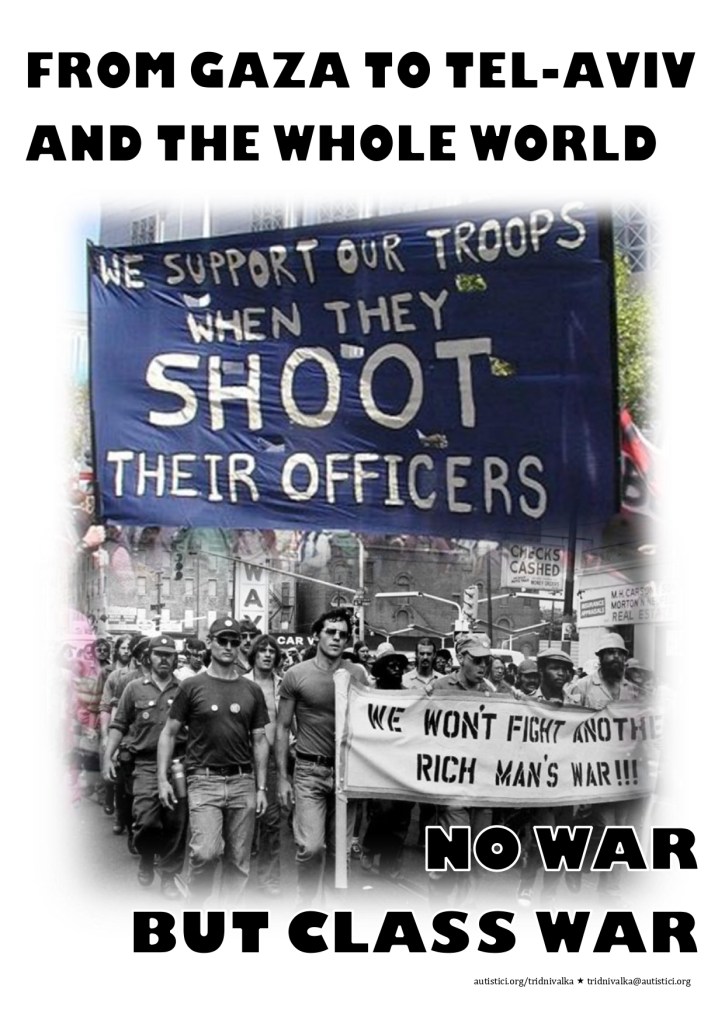
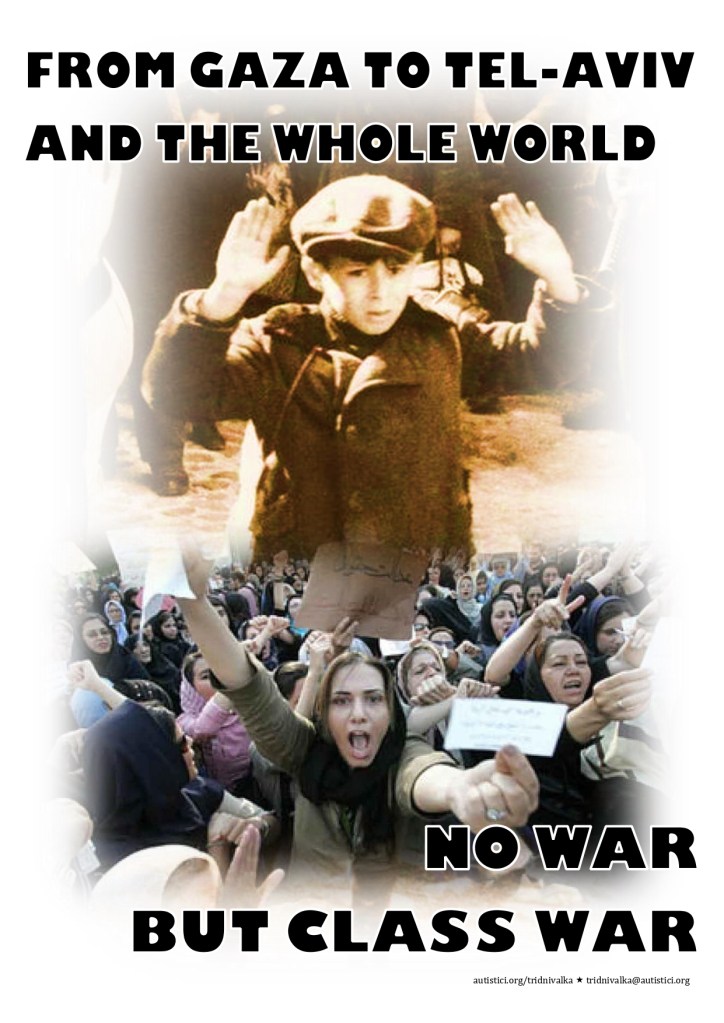
At home we pay through austerity, our will fight against it is also the fight against their wars, their capacity to fight war, our refusal to fight it for them. No war but the class war must be our response!
The attack by Hamas on Israel on Saturday, October 7, has provoked an immediate military response from the Netanyahu government, which has declared a state of war and has begun the systematic bombardment of the Gaza Strip. Meanwhile, under the cheers of the regime of the Ayatollahs’, Hezbollah has taken advantage of the situation by launching missiles into Israel from the Lebanese border. The confrontation has already (October 9) caused more than a thousand deaths between the Israeli State and the Gaza Strip, in addition to thousands of wounded and kidnapped. The coming days and months will see the misery and suffering of the workers on both sides increase, aggravating the harsh general conditions of the majority of the population, both those of the Strip and the impoverished proletariat of Israel.
And in addition to the misery that the Palestinian proletarians have to endure both inside and outside the Strip, under the existing segregation regime in Israel, there is a more general process of pauperization of the proletariat in the region as a whole after the covid pandemic and the beginning of the war in Ukraine: a rise in the price of raw materials, of energy and of food which already keeps half of the Arab families in Israel, more than a fifth of the Jewish families and practically the entire population in Gaza —that large refugee camp that maintains itself with the crumbs of the United Nations— under the threshold of poverty.
What has led Hamas to act now? Certainly not the defense of the interests of the proletariat in Gaza, who once again find themselves under Israeli bombardment. Its surprise attack, which has come to intensify an already long-standing conflict, cannot be understood as a response motivated by popular rage against the Israeli occupation. There is no “Palestinian people”, nor an undifferentiated unit of aggrieved people who respond heroically to their old aggressors. The proletariat in Gaza which just a few months ago was protesting against the Hamas regime, against power cuts, food shortages and the government’s fierce repression, does not share the same interests as the apparatus subordinate to the Ayatollahs’ regime, nor the “brave” militias that use the civilian population of both sides as human shields. The Israeli response to the attack may revive the nationalist closing of ranks on both sides of the conflict, but it cannot deny this fact.
Because it must be said clearly and distinctly: the forces at work on both the Palestinian and Israeli sides are profoundly reactionary. Since the very formation of the State of Israel in 1948, the region has not ceased to be one piece more on the chessboard of the global inter-imperialist struggle. Israel quickly positioned itself as a pawn in the service of U.S. interests. Since then, whether under Ben-Gurion’s Labor Party or under the various conservative governments, it has pursued a systematic segregation and repression of the Palestinians within and outside of its borders, as well as a militaristic and securitarian policy that has served up til now to divert attention from the profound social inequalities within the Jewish population. For their part, the various factions of Palestinian nationalism after the British Mandate emerged under the auspices of the pan-Islamism of the Muslim Brotherhood in Egypt and later under the secular umbrella of Stalinism under Nasser, to pass on after the fall of the USSR to be under the orders of Iran as a regional power. In the form of political Islamism or Stalinism, the military apparatus of Palestinian nationalism has always been linked to the most reactionary manifestations of the 20th century. After all, it could not be otherwise: As Rosa Luxemburg had already pointed out decades earlier in her debate with Lenin, any nationalist movement can only, outwardly, fall under the wing of one of the great powers in the imperialist struggle, and inwardly repress all class expression in order to fix internal cohesion against the national enemy.
For reaction feeds reaction, and both need each other. Whether Netanyahu had any knowledge or not of the Hamas attack, whether he ignored or underestimated its magnitude or directly decided to allow it to happen, in any case it has not failed to be very convenient for him to favor a closing of ranks in the midst of a political crisis of his government while he himself is threatened with a corruption trial.
For their part, Hamas and Hezbollah, like the Iranian regime itself, obtain as such a moment of respite from the growing social discontent in the three territories, which in Lebanon was expressed by the slogan of All of them means all of them —that is, also Hezbollah— during the 2019 protests and which in Iran has been propelling strikes and mobilizations since 2018, exploding last year in the protests against the hijab mandate following the assassination of Mahsa Amini.
In its terminal crisis, capitalism not only drives social misery and the devastation of the planet to ever greater levels, thus motivating processes of social polarization, but also accentuates the confrontation between the different powers for the domination of a world market with ever greater dysfunctionalities. At the same time that capitalism expels labor and makes the material reproduction of our lives more and more difficult, it turns us into cannon fodder at the service of the interests of one fraction of the bourgeoisie against another. In this logic of inter-imperialist struggle, Hamas has acted with the aim of torpedoing the rapprochement between Israel and Saudi Arabia, hindering a new regional configuration in accordance with the tensions between the imperialist blocs. Under the banner of the “Palestinian resistance”, it simply obeys the necessities of a part of the regional bourgeoisie. The blood that is spilled however, will continue to be that of the Palestinian and Israeli proletariat. Any concession to nationalism, any deference to one nation over another in this process, implies placing oneself on the other side of the barricade against our class, which has no homeland and whose only real possibility of improving its living conditions is to put an end to the very system that threatens it, in an increasingly flagrant manner. The Israeli-Palestinian conflict will not find its solution in the creation of a single bi-national state, nor in the constitution of an independent Palestinian state. It can only find its solution in a revolutionary process that breaks with every nation and every border.
When at night the anti-aircraft sirens sound, and the Israeli and Palestinian military apparatuses hold their population hostage under bombs, we revolutionaries oppose this barbarism with all our strength. To the flags of nationalism, no matter the color of each one, we counterpose the joint struggle of the Palestinian and Israeli workers. For the Israelis, their bitterest enemy is the apparatus of the Jewish state, just as the PNA and Hamas are implacable enemies of the Palestinians. Only by confronting them directly will they be able to get out of the hellish labyrinth in which they find themselves. In short, against imperialist war – and this is one – there is only room for its transformation into a class war.





 AnarCom Network
