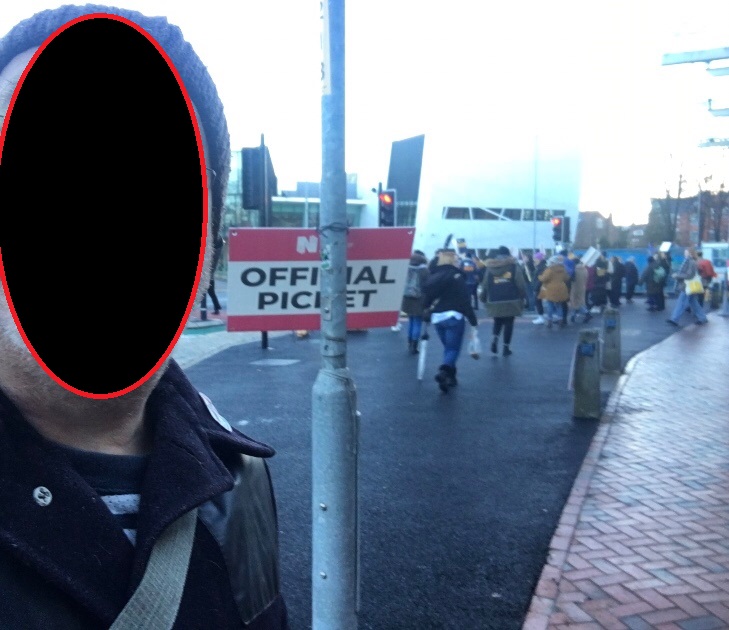
AnarCom joined the first day of the nurses picket outside Manchester’s world famous hospital The Christie today. Despite the noisy and continuously tooting car horns in solidarity, discussion was widespread.
With a turnout of around 70 for the 8am start it continued in high spirits through the day averaging around 30 at any one time. Mainly striking Christie’s staff but also nurses from other locations on their day off and other workers and well-wishers showing solidarity. Our ‘picket line solidarity’ stickers proved popular with sheets being taken and shared around.
Nurses we spoke too weren’t just striking for the NHS and better patient care, as the Union’s sanitised official version goes, but for themselves and each other, fed up of low morale, over work, under pay and being cold and increasingly vulnerable to debt and hardship.
Russia trumpets victory in Soledar – a name translated as ‘gift of salt’. A town no more than a dot on a landscape that once held 10,000 residents, primarily working in the salt mining industry. Slightly smaller than the old ex-mining town of Bargod in the Welsh valleys. Thousands of workers have died in a deadly Stalingrad cosplay for dust and rubble. The strategic significance is negligible. The significant consequence is disproportionate in its dramatic escalation.
The desperate Putin military machine will accept any portrayal of victory no matter how small, after 6 months of abject failure piled on retreat just weeks before the war’s first anniversary. It also pilots a resurrected military project of franchising out imperialist conquest to private capital in the form of the Wagner Group.
Once a small elite of experienced military adventurers that could grace any Bond film, it has become a ruthless and desperate army of violent criminals promised riches and freedom in exchange for unquestioned obedience and sacrifice. Now their estimated 40,000, accounting for a quarter of effective Russian combat forces, has become a law unto itself with the political implications that go with it, like Caesar letting in the barbarians to protect it from barbarism.
The value to Putin is clear, their desperate dead is not officially a Russian body count and more than that, this paid mob are not bound by the so called ‘rules of war’. Atrocity has been privatised and not a government issue. A successful model of colonial expansion in the 17th-19th centuries.
This onslaught, aided by an estimated $1 billion worth of 2,400 Shadad (meaning ‘Witness’) drones from Iran’s blood-soaked Islamist regime, demonstrates the unholy nature of barrel scraping before escalation.
The West has recognised Russian weakness for the opportunity it offers. Rather the defeat them, leaving a vengeful adversary in intact, Russia can be bled, impotently, to death. The piecemeal upgrading of Ukrainian military technology – always sufficient to avoid defeat but never enough to win – now has added tanks.
No longer Soviet T72 leftovers from the Poles or the Czechs (backfilled but the UK and US with our sophisticated yet outdated upgrades) but 14 British Challenger 2’s. Insufficient in themselves but lifting the escalation taboo, anticipating a Europe wide tithe that could see around 300 first line (primarily the ubiquitous German Leopard) tanks equalising ground forces as the war grinds on. The aim is prolongation not end, though when that happens, Western capital plans to be the victor in every sense.
As the stakes are raised, crisis ridden Iran has decided to shackle itself to Putin’s fate, squaring another circle for Western imperialism. Russia is believed to be paying with technology not just cash for this alliance, just at the point Iran’s nuclear program reaches critical mass.
While it’s workers revolt, the Mullah’s seek to create a unifying external crisis by waving a red flag at bullish markets eying their downfall. It would be hard to imagine that Israel, so long eager for a preemptive strike and emboldened by its new nationalist government, is still being kept on as tight a leash by its military underwriter, the USA.
At home we get colder and poorer, in line with our fellow workers either side of the war’s frontiers. The war is meant to distract us from our rulers abuse as much as it is in Russia and Iran.
Our hope lies neither in the success of millionaire Zelensky’s fire sale of his country’s resources to western bankers than it does in mullahs or authoritarian dictators. The conflict escalates towards our annihilation with every victory and defeat on the battlefield.
Our victory lies in the defeat of everyone planning their fortunes on the corpses of our class. We keep on about the war because it is always aimed at us, by bombs or poverty they scrabble for riches from our lands and our labour, our picket lines are a tank trap against their plans. At home and abroad we have to refuse their call for unity in the national interest. Our interests are only internationalist, against boss’s greed, robbery, militarisation and crises, whatever the side of their frontiers we find ourselves. Their war is stepping up, our resistance through class war must too.
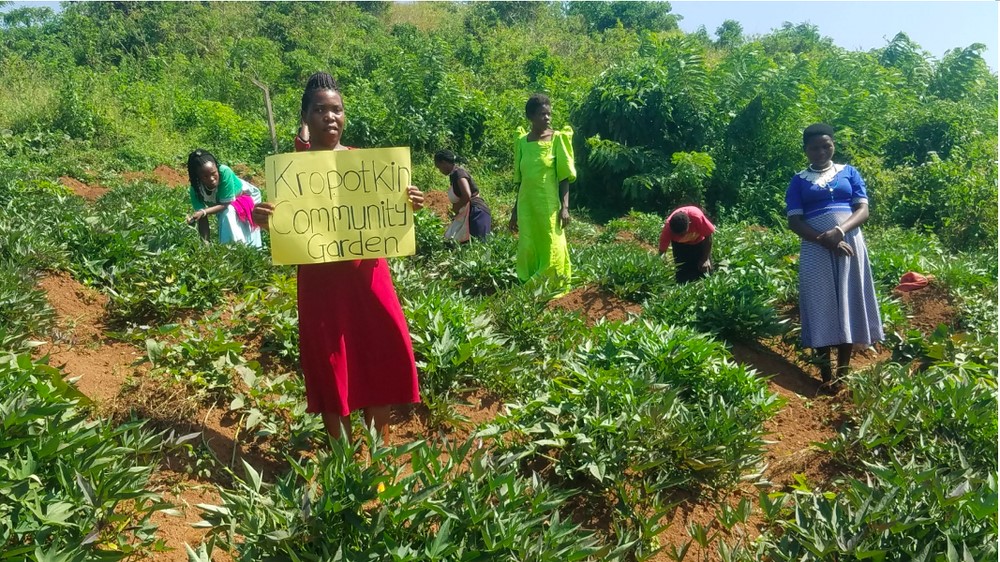
Kropotkin Community Garden is located in Mpigi district, in central Uganda, on 6 acres. It is organic, free from pesticides and fertilizers, with 3 inter-cropping planting seasons. Crops grown are sweet potatoes, kale, maize, soya beans, cabbage, passion fruits and beans.
The food feeds victims of gender-based violence and orphans at the nearby ShelterMi Safehouse & Orphanage, with surplus sold to pay tuition fees and buy school supplies for the orphans.
Oloo Livingstone – director of the garden – says
“I find the works of Peter Kropotkin most interesting especially his Mutual Aid: A factor of Evolution. His model if adopted in Africa would propel development and improve the quality of life in our societies. We are excited to put into action his ideas to help our communities.”
Kropotkin Community Garden needs organic fertilizers, seeds for soybeans, cow peas, maize, and passion fruit, and it wants to expand an additional 4 acres.
In the red heat of the greatest strike wave in 50 years, the Trade Union bosses walk once again into a trap choreographed by the state and its capitalist masters.
We warned about this in November when the RMT, without a mandate from its members, paused it’s successfully mounting actions on the ‘promise’ of meaningful talks. That con effectively bought a month’s breathing space for the then reeling rail industry.
In the state’s latest trick to buy time for training up more army strike breakers and introducing a ‘sack not clap’ essential workers bill, almost every active sector has found an open door for a cozy chat with their respective government overlords. All later emerging claiming disappointment or insult.
Both sides knew, the government had been very clear, that only productivity, not wages, would be on the table. However insulted or disappointed union leaders profess to be, they have actively served the bosses propaganda agenda!
The months of sacrifice by hundreds of thousands of workers hasn’t been for the right to access the top table, but to win against the onslaught on our communities, wages and terms and conditions. What the unions are demonstrating is their inability, if not unwillingness, to meet the needs of our class.
With a million workers predicted to be on strike by February, 2023 should be a new year of renewed commitment and militancy! Workers are clearly up to the task, but their ‘representatives’ are feeding the government narrative of listening, caring but constrained by crises not of their making. A reason for us all to be quiet and on the same side – it worked so well when their hive queen died in September.
Our eyes must remain on the prize despite the unions obsequious demonstrations of weakness. We are in a unique situation. We are all being brought together not just by assault but through our struggle against it.
Everyone knows someone impacted by Covid, everyone knows someone who’s too cold, everyone knows someone who’s going hungry, and everyone knows someone striking or thinking about it.
We are usually manipulated to not see how much we have in common. Now though, reality is asserting itself above the spin. We are not isolated individuals but a community of shared experience, need and action. Nothing in our response says we are failing or getting weaker. On the contrary, our community of resistance and solidarity is growing.
Every day of implied concession feeds our bosses, not us. The shameless groveling masquerade and humiliation of the organised Trade Union leaderships should be called out for what it is, cowardice bordering on collaboration, in effect if not intent.
More and more of our class are fighting back, each worker is recognising their struggle in their solidarity with another. The government is mobilising not conceding and will soon confront us with the challenge of criminality – where we don’t already face it through hunger and extortion.
Trust your class, not your Union leaders with their eyes over their shoulders on their bureaucratic corporate interests. Spread the word, spread the struggle, spread the solidarity – build a unity of resistance in strength.
The ACN will be attending as many bookfairs as we can. So far we are confirmed at Sheffield and Bradford. Unfortunately we cannot make the Weston Super Mare one.
Sheffield:
Weston Super Mare
Following the success of the first radical bookfair in WSM, we have set a date to co-host again with the wonderful team at North Somerset LGBT+ Forum on Sunday 12th Feb, 11am to 4pm.
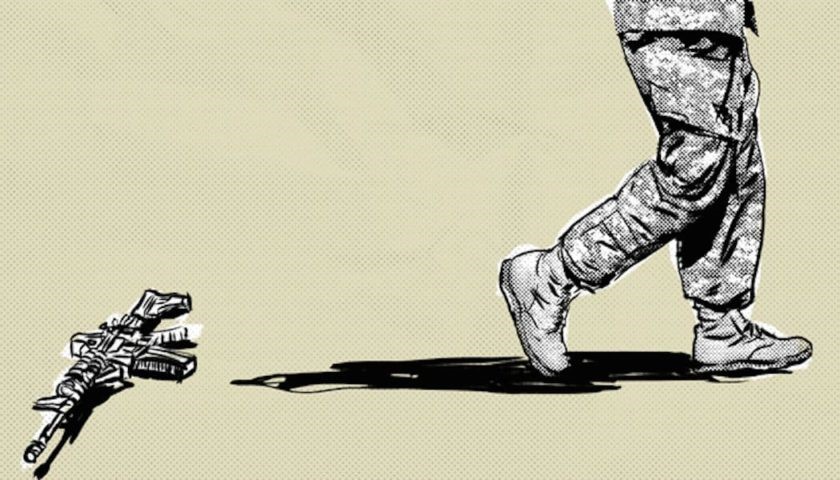
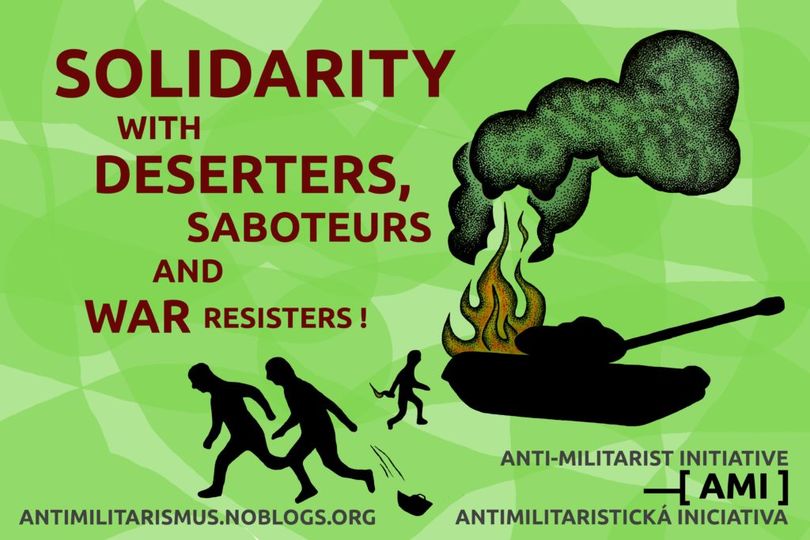
The war in Ukraine continues with all the negative consequences for much of the world. However, acts of desertion and draft evasion also continue, which, if widespread, could lead to the end of the war. Anarchists from the Central European region are therefore publishing this call to organise active support for deserters. Wherever we live, let us make every other day a day of international working-class solidarity and resistance against the war. Let us organise in workplaces, schools and streets to strengthen the influence of desertions. Let us fight for dignified conditions for all who refuse to serve as a cannon fodder in the inter-imperialist war.
At least 200,000 people are fleeing Russia to escape Putin’s military mobilisation, and tens of thousands more are avoiding mobilisation in Ukraine. Yet some voices claim that “the number of deserters is so negligible that it is strange to even begin to talk about it.” These cynical attempts to “make invisible” people who choose not to serve in the army, to defect or to emigrate for political reasons, must be opposed. Their voices must be heard and practical help must be given. Anti-war speeches do not yet have the subversive power needed to stop the war, which is why it is necessary to create conditions that make it easier for other people considering a desertion to move from reflection to action. It is not a question of standing on the front line between the tanks of both armies and thinking that this will make the soldiers lay down their arms. It is about achieving the conditions at the international level that ensure that deserters can safely defect and live in another country without a risk of prosecution and social stigmatisation.
At present, opponents of the war in Russia and Ukraine have almost nowhere to go. They are trapped between national borders by their ‘own’ governments, while neighbouring countries refuse to accept them and provide them with decent material conditions. If people’s choices remain limited to the options of ‘either being forced to serve in the army or face persecution’, we can hardly expect an increase in desertions. It is necessary to achieve the opening of borders not only for civilian refugees, but also for deserters from the armies on both sides of the war line. This is precisely what can significantly weaken the dynamics of war.
But this will never be done by negotiation with the various governments which are only the local minions of the world capital state, nor will it be done by a social-democratic call to “make concessions in the area of migration policy”. Our only weapon for us, the proletarians, is the class struggle, it is the mobilization in the streets, it is the sabotage of the economy, and it is the direct action against permanent war… It is then, and only then, that the frightened ruling class is forced to let go, which will never constitute for us the goal of the struggle but only a moment from which new offensives must be carried out against the whole of this world of misery and war…
After all, the proclamations of politicians criticising the aggression of the Russian army are an expression of hypocrisy whereas they refuse to share material conditions and resources with people who refuse to serve in the army. And besides, why and how would they act otherwise, these worthy representatives of the bourgeois order!? It is necessary to stand consistently against Putin’s aggressors, as well as against the statesmen of other countries who, through their own policies, allow the army to retain its war potential. It is the governments of the countries in which we live that effectively make it more difficult to desert, and thereby they contribute to the continuation of the war.
Those who are concerned about saving lives should be thinking about how to weaken the fighting capacity of armies, how to get soldiers off the front lines, how to get them to disobey, how to motivate them to use their weapons against those who force them to go to war. Let us think about this and organise direct actions that will turn these considerations into concrete results.
SOME ANARCHISTS FROM THE CENTRAL EUROPEAN REGION (NOVEMBER 2022)
As 2022 comes to an end we celebrate the founding of our organisation. In just 4 months we have come together and formed an amazing network which while small has produced a lot of articles, 2 pamphlets as well as our newsletter Rebel Rose. We have attended demo’s, pickets and held our founding conference (in December 2022):
Below is a report of our founding conference and the subsequent Aims and Principles (for our full constitution please see the associated page).
Here is to growing and carrying on our revolutionary role.
AnarCom Network Founding Conference
The outbreak of war in the nuclear capitalist heartlands; the climate catastrophes of the last year; the unfolding consequent barbarism of total hunger and destruction, and the resurgent global struggle of our class has added urgency to our challenges as revolutionists.
Last summer, a group of us started discussions on how a new network could better contribute to the wave of resistance we as workers were already involved in. From this came the idea of the AnarCom Network and our discussions to develop it.
Unfortunately delayed due to climate and righteously reconfigured due to striker’s militancy, the conference’s inaugural meeting to establish it took place online on December 18th, 2022.
Our aim was to create a structurally flexible network around a concise and coherent set of agreed revolutionary principles we would define as Anarchist Communist.
A flexible network to enable comrades from other traditions, local groups and non-aligned to manage their route to engagement with us.
Coherent because lessons from centuries of revolutionary class struggle are not open to endless debate or unlearning with fleeting fads or expedience.
Anarchist Communist because our consensus lies firmly within this tradition while recognising members bring their own rich experience from the traditions of other anarchist movements, council, left and libertarian communism.
Our aims and principles were formulated and discussed ahead of the conference and unanimously ratified at it.
Aims and Principles:
1. We are committed to the class struggle and liberation through our own collective action and organisation.
2. It follows that we reject the state, political parties and leaders of every persuasion. All are the source of our organised repression and subjugation.
3. We therefore oppose parliamentary democracy and the sham of elections as a deliberate deception to paralyse and subdue working class choice and action. The idea that the ballot box makes us equal, that the banker and the beggar somehow share power in the voting booth is a spectacular deception.
4. It follows that in refusing hierarchy and power, we reject the god concept and religion. While hope, faith and spirituality are humanistic qualities, their organised manipulation is not. We seek a truly human community free from delusion or fantasy.
5. We recognise the importance of the trade union movement in defending working people whilst acknowledging their inability to be the organisations capable of ridding society of the scourge of capitalism. It follows that we are opposed to the action-limiting role of trade unionism and its Labour establishment.
6. The capitalist class divides and exploits us internationally. Consequently, we must struggle for its overthrow through resistance and solidarity across the globe. It follows that we reject illusory ‘national’ solutions and the concept of national liberation.
7. We refuse to play along with reformism, cross class alliances, fronts and collaboration that seek ultimately to divide our class and dilute our struggle.
8. We do not shy away from confrontation and support the right of working people to defend themselves. We also know that individual acts of violence- under any banner – cannot destroy the social relationship we fight against; capitalism. The fight against capitalism and for a liberated society is founded on organisation, education and agitation.
9. Our struggle is both practical and urgent. The generation that may witness our extinction is probably here. We face a binary choice of capitalism’s war against us in all its forms, or its revolutionary abolition. War or Revolution!
10. We are revolutionary internationalists. We reject sectarianism and work for principled cooperation with other class struggle revolutionary activists, groups and Internationals at home and abroad.
AnarCom members today (24/12/22) joined the CWU (Royal Mail) picket line at the Wellington Road Sorting Office in Leeds.
We handed out our picket line stickers – which everyone took and they were really appreciative of our support.
We talked to the pickets who told us that at this office that support for the strike is still strong with only 2 scabs (along with a few agency staff) out of 70 in total working.
We were also told that the Armley, Leeds Office (Tong Road) it is a different picture with only 10 out 30 staff supporting the strike, and with the union rep resigning and becoming a scab.
Elsewhere in Leeds the strike is solid with very few scabbing.
A picket talked to a couple of agency staff explaining why it was wrong for them cross the picket line and that it was undermining the strike. They did say they understand and apologised but still went into work.
This is the last official strike day as the workers now legally have to be balloted again, the expectation is they will again overwhelmingly vote to strike.
Manchester:
RMT Picket Line Manchester
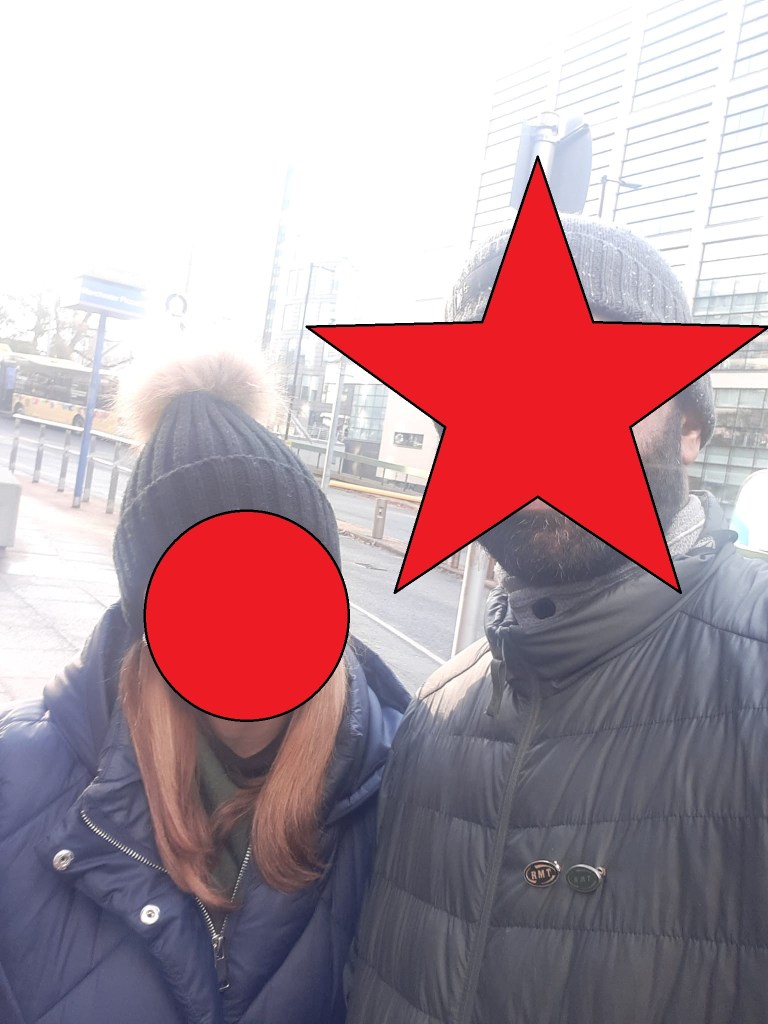
An AnarCom RMT member attended the December picket on the Piccadilly Approach to Manchester’s principal train station which also houses both Northern Rail and one of the largest Network Rail centres in the country.
Around 80 people attended bringing together a range of workers from disparate sections of the transport sector many of whom were new to each other, lacking opportunities outside of the strike to meet.
The atmosphere was celebratory with lots of support expressed by other workers and passers-by, including the local high street chain coffee shop that provided free refreshments to the picket throughout the day. The public clearly knows which side it’s on! Solidarity was warmly shared and new friendships made.
A festival of freedom from the daily grind of wage labour!








 AnarCom Network