We reproduce the article from Tridni Valka from their blog CLASS WAR see link at the end
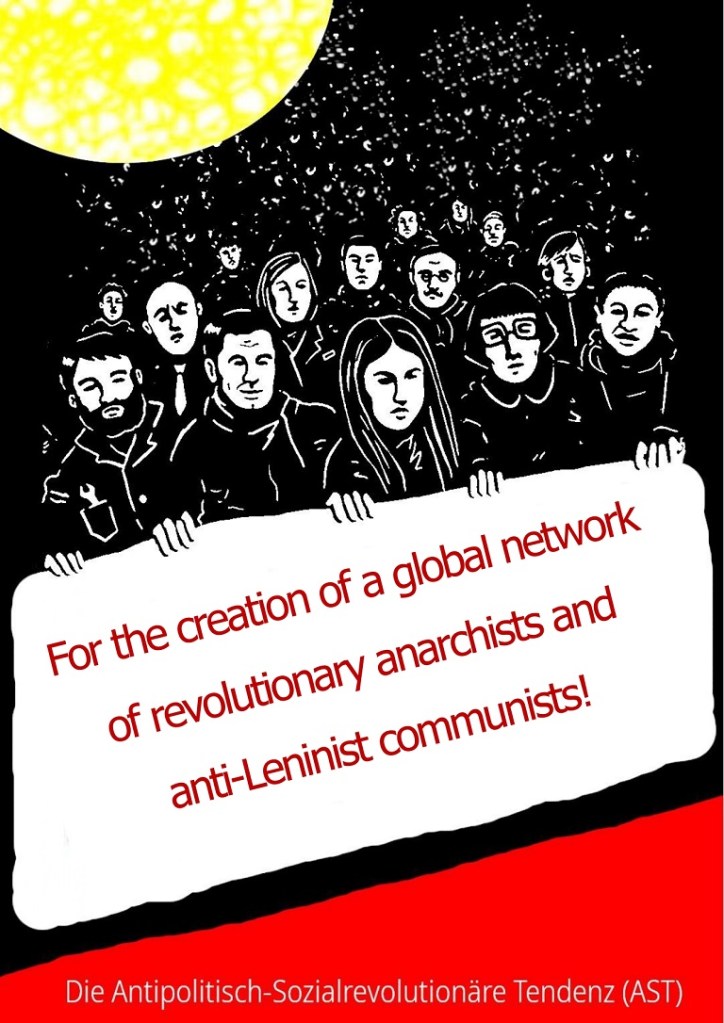
We publish here a text from the German-speaking group AST (Anti-political Social-revolutionary Tendency) that we translated into English and French. Our overall assessment is that we appreciate the militant efforts of these comrades, especially when it comes to revolutionary defeatist action, i.e. the struggle against capitalist war and peace.
There are, however, unresolved points of disagreement in their contributions, particularly on the all-too-famous “question of the party” and its corollary “the transition period”, the question of the State in general and the capitalist State in particular, and not to mention the tricky issue of the very essence of democracy. For communists, the latter can only be grasped as the negation in action of class antagonism (and its revolutionary overcoming) as well as their merging into a national (re)conciliatory entity called “the people” – whether “sovereign” and voting, or under the yoke of a “dictator” or a one-party system, is of little importance. It’s clear that the dividing line is not between “democracy” and “dictatorship”, but between revolution and counter-revolution, between the abolition of capitalist social relations and their consolidation, even if it means painting them red, or even red and black. Fascist or anti-fascist, democracy is always the dictatorship of capital.
In the present text, the AST comrades elaborate in abundance their critique of “the party”, which they too quickly equate with the Leninist party, the Bolshevik party… When criticizing what they call “Party Marxism” (Parteimarxismus), what we see as to be particularly targeted are in fact “the builders of parties and internationals”, the “bearers of consciousness for the class”, this “socialist consciousness [that] is something introduced into the proletarian class struggle from without and not something that arose within it spontaneously” (Kautsky quoted by Lenin in “What is to be done?”).
But more generally, and beyond the terms and expressions used, we can see here a first disagreement with the comrades of AST about the organization of the struggle of the proletariat, which emerges spontaneously from the fertile soil of capitalist social relations, which necessarily asserts itself as a force, as a full energy, and which must bring down any materialization of the social dictatorship of the value, commodity, money, i.e. of Capital and its State. This social force, this destructive energy of “the existing” which destroys our humanity, it’s the proletariat which gets organized as a class (against all classes and for their definitive abolition!), which gets organized as a party (against all parties and for their as well definitive abolition!), which gets organized as a party that is not a party “in the traditional sense of the term” (as the comrades of the KAPD already affirmed over a century ago), but that is in practice an anti-class, an anti-party!!!!
The proletarian revolution has nothing in common with the political “revolutions” of the bourgeoisie. So, the organization of the proletariat as a party has nothing in common with bourgeois political parties and especially not with the Leninist conception of the party. What we refer to is the distinction between the party of Order against the proletarian class as the party of Anarchy, of socialism, of communism. (Marx, The Eighteenth Brumaire of Louis Bonaparte, 1852)
The proletariat organized as a party does not aspire to democratically conquer power but, on the contrary, arises from the imperious necessity to liquidate this power, this democracy and everything which separates the proletariat from its humanity, from its Gemeinwesen.
There was a time, in the 19th century and even at the beginning of the 20th, when the formula of the proletariat organizing itself as a class, and therefore as a party, was very well assimilated into the international discussion. It wasn’t a problem for any sincere militant of our class, even among those who claimed the Black Flag of Anarchy. Among the most militant of them, Malatesta, for example, openly referred to the “anarchist party”: “By anarchist party we mean the ensemble of those who are out to help make anarchy a reality and who therefore need to set themselves a target to achieve and a path to follow”. Or in another way thirty years later he was persisting and signing: “We anarchists can all say that we are of the same party, if by the word ‘party’ we mean all who are on the same side, that is, who share the same general aspirations and who, in one way or another, struggle for the same ends against common adversaries and enemies.”
Class and party are not two different historic entities which should be separately defined only to form a relationship later. On the contrary, they are the distinct expressions of one and the same historic being: Communism. The party is the communist movement constituted as an international force, the organization of the revolutionary class which will bring about communism, arising spontaneously and developing on the basis of a community of interests and perspectives, a real community of proletarian struggle.
This tendency towards the worldwide organization of the proletariat, towards its programmatical affirmation and its organic centralization confronts all the forces and ideologies of the counter-revolution.
Or in other words, we are partisans of the revolutionary self-organization of the proletariat, that is, of the “historical party” of the world communist revolution, which springs up spontaneously from the soil of bourgeois society and has nothing to do with self-proclaimed vanguardism. The self-organization of the proletariat, class independence, and direct action are inseparable and mean struggling without intermediaries or representatives; that is, struggling outside and against unions, parties, elections, parliaments, bourgeois legality, etc.
Considering that, when the proletariat rises up and shakes the capitalist order, the right and left wings of Capital unite into one single party against it, that is, “the party of democracy”; in return, the “historical party” of the revolutionary proletariat is a party against democracy, that is, against the social dictatorship of Capital and its State over the proletariat.
The “historical party” is not a formal party in the “traditional” sense, or a State like the Leninist parties wrongly called “communist”. But it is a party of action which, although it needs to structure itself in order to organize revolutionary tasks, goes far beyond formal aspects. It is the proletariat itself that organically organizes and acts as a revolutionary class. It is the real movement that terminates and overcomes the present state of things. It is the party of communism and anarchy against the party of democracy. It is the revolutionary self-organization of the proletariat in action.
A second disagreement also appears clearly in the point 2 “For the revolutionary destruction of all States”. The proletariat in struggle confronts all the organized forms of the capitalist State, which imposes and realizes the social dictatorship of the value valorizing itself through wage labor, exchange, world market, money… But against this reality, our class must organize, structure and impose its world dictatorship of human needs against Capital and revolutionary terror against bourgeois forces, and this process will not be achieved by simply erasing words and expressions that might seem awkward. This is somewhat clumsily expressed in the AST text: “In the world revolution there will therefore be classless and stateless communities as well as capitalist States”. But they fail to see how they confront each other in a life-and-death struggle…
The proletarian dictatorship means abolishment of existing social relations: abolition of wage labor, abolition of useless professions and productions, elimination of exchange relations from all aspects of our lives, abolition of economy and production for profit and subordination of all productive forces to human needs and needs of the world revolution, disappearance of the difference between work and leisure, city and countryside and all other separations, violent destruction of the State and its replacing with organs of proletarian revolutionary self-organization, all of that which the triumph of the revolution turns into a global human community. Through this historical revolutionary process, the proletariat (as last existing class) abolishes itself and thus the whole class society and fully develops worldwide human community.
The dictatorship of the proletariat thus means the violent abolition of wage labor, abolition of the capitalist mode of production and all the social relations it reproduces. It is necessarily violent, repressive and despotic as well as subversive process that uproots the very social fabric of capitalist reality. It directly and immediately imposes the satisfaction of our human needs, which we are dispossessed from under capitalism by our very role as a class, whose labor power is exploited and whose products of labor are alienated from us.
There will be a violent insurrection against the State, in which the proletariat will seize the means of production and the infrastructures of communication and distribution, and violently attack and overthrow the centers of State power. Then the proletariat will expropriate factories and land to produce for the direct satisfaction of its needs, rather than for the profit of capitalists. Proletarians in uniform will turn their weapons against their own generals, stop fighting the capitalists’ wars, loot weapons depots and share them with the rest of the proletariat, and together, they will release prisoners and storm the centers of power. The capitalist State will be attacked from all sides and actively repressed and subverted by our class violence. Not only the government and the forces of repression, but also the State as a totality, as a system of capitalist social relations – i.e. trade unions, citizenship, faith, family, education, etc. – will be absorbed into the maelstrom of the revolutionary abolition of the existing. This process, which we call the dictatorship of the proletariat, or the transition period between capitalism and fully-achieved communism, is by no means embodied in “apparatuses of violence separate from the society”, as the AST text assumes, but rather as a dialectical unity between the struggling proletarian class and its most far-sighted leading elements, whose motricity, if not a guarantee of the revolution’s success, at least pushes it to its ultimate consequences.
Let’s be clear, this can only be achieved by extending the revolution worldwide, and all human activity must be subordinated to this goal. There’s no such thing as “socialism in one country” (or group of countries), as the Bolsheviks/Leninists of all kinds claim (including even the libertarians who drool with admiration over the “Rojava Revolution”, the Zapatista “Free Communes” or “Free Palestine”, ad nauseam) – on the contrary, it’s an absolutely counter-revolutionary position! The concept of “socialism in one country” was nothing but a tool to enable and justify the strengthening of capital’s dictatorship over the proletariat in Russia at the hands of the Bolshevik party and its policies.
In order to realize the organized activity of the society up to the achievement of communism, the proletarian revolution must violently destroy all the institutions and apparatuses of the counter-revolution which seek to maintain the dictatorship of value against human needs. We must insist on this point – it means the active suppression of wage labor, of exchange (trade), of any form of regional or local autonomy that could become the basis of future nationalist reaction, of freedom of expression and association for counter-revolutionary forces…
But to come back to the AST’s text, may the few and other points of disagreement we emphasized not spoil the pleasure of sharing internationally and submitting for collective criticism this contribution by comrades who, with strengths and weaknesses (as any revolutionary internationalist militant structure developing under the black sun of capital), are trying to outline and affirm the program of communism and the direct action of the proletariat in struggle. And in this sense, the development/consolidation of our world proletarian community of struggle, to which the present text contributes, beyond the division into ideological families, seems to us more than necessary, and indeed inescapable!
Have a good reading!
CW.
Link to the AST article: https://www.autistici.org/tridnivalka/ast-for-the-creation-of-a-global-network-of-revolutionary-anarchists-and-anti-leninist-communists/